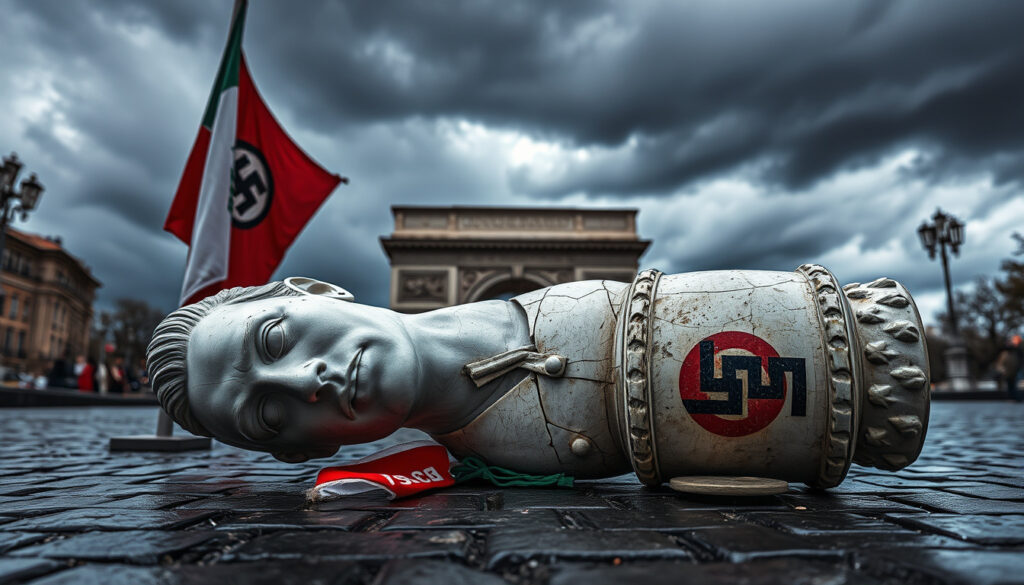
Benito Mussolini: Death, Rise to Power, and Hitler’s Reaction
There are few images from the end of World War II as jarring as the corpse of Benito Mussolini hanging upside down in Milan. The man who invented fascism and led Italy for over two decades met a brutal end in April 1945, and the news of his execution reached Adolf Hitler in his Berlin bunker just one day before the Führer took his own life.
Born: 29 July 1883, Predappio, Italy · Died: 28 April 1945, Giulino di Mezzegra, Italy · Role: Fascist dictator of Italy (1922–1945) · Execution method: Shot by partisans
Quick snapshot
- Mussolini executed by partisans on 28 April 1945 (Wikipedia)
- Hitler learned of the death on 29 April 1945 (MI5)
- Hitler committed suicide on 30 April 1945 (The National WWII Museum)
- Which partisan fired the fatal shot — multiple conflicting accounts exist (Wikipedia)
- Whether Mussolini’s death directly triggered Hitler’s suicide or was secondary (Foreign Policy)
- Exact personal views of Mussolini on LGBTQ issues beyond official policy (Wikipedia)
- Mussolini executed 28 April → Hitler informed 29 April → Hitler dies 30 April (MI5)
- Hitler dictated political testament on 29 April after hearing the news (The National WWII Museum)
- Germany surrenders on 7 May 1945, ending the war in Europe
- Axis leadership suicide pattern emerges: Hitler, Goebbels, Himmler follow
Seven key biographical facts, one pattern: a rapid ascent built on nationalist fervor followed by a catastrophic war alliance that ended in execution.
| Label | Value |
|---|---|
| Full name | Benito Amilcare Andrea Mussolini |
| Born | 29 July 1883, Predappio, Italy |
| Died | 28 April 1945, Giulino di Mezzegra, Italy |
| Cause of death | Execution by firing squad |
| Political party | National Fascist Party |
| Spouse | Rachele Guidi |
| Children | Edda, Vittorio, Bruno, Romano, Anna Maria (and multiple illegitimate) |
What was Mussolini famous for?
Founding Italian fascism
Mussolini created the first fascist regime in Europe, building on the Fasci Italiani di Combattimento he founded on 23 March 1919 (Wikipedia). He transformed postwar discontent into a mass movement that promised national restoration. The March on Rome in October 1922 pressured King Victor Emmanuel III to appoint him prime minister.
Role as dictator (Il Duce)
By 1925, Mussolini had declared himself dictator, banned all opposition parties, and established a totalitarian state (Britannica). He signed the Lateran Treaty in 1929, creating Vatican City as an independent state. His ambitious foreign policy included the invasion of Ethiopia in 1935.
Alliance with Nazi Germany
Mussolini aligned Italy with Hitler’s Germany through the Pact of Steel in 1939 and entered World War II on the Axis side in June 1940 (The National WWII Museum). The alliance proved disastrous: Italian military failures in Greece and North Africa weakened Mussolini’s grip on power.
Mussolini, who once dismissed Hitler’s racial theories as crude, ended his career as Hitler’s puppet in a German-controlled state in northern Italy.
Bottom line: Mussolini built Europe’s first fascist dictatorship, a model Hitler would later study and surpass. But the same war alliance that defined his legacy also destroyed him.
How did Mussolini fall from power?
1943 coup and arrest
On 25 July 1943, the Grand Council of Fascism voted Mussolini out of power in a motion led by Dino Grandi (Wikipedia). King Victor Emmanuel III ordered his arrest the same day. Mussolini was held in a remote mountain hotel on Gran Sasso.
German rescue and puppet state
German paratroopers under Otto Skorzeny rescued Mussolini on 12 September 1943 in the Gran Sasso raid (Britannica). Hitler installed him as head of the Italian Social Republic, a puppet state in northern Italy. Mussolini was now a figurehead with little real power.
Final capture and execution
As Allied forces advanced in April 1945, Mussolini attempted to flee to Switzerland. Partisans of the Italian resistance captured him on 27 April near Lake Como (MI5). The next day, 28 April 1945, he and his mistress Clara Petacci were executed at the gates of Villa Belmonte in Giulino di Mezzegra.
The man who had strutted on balconies for two decades ended his life kneeling before a partisan firing squad. It took just 30 seconds to erase 23 years of rule.
Bottom line: Mussolini’s fall was swift: voted out in July 1943, rescued by Germans, then executed by his own countrymen in April 1945. His body was hung upside down in Milan’s Piazzale Loreto — a spectacle that changed history.
Who actually shot Mussolini?
Walter Audisio’s role
Communist partisan Walter Audisio, operating under the pseudonym “Colonel Valerio,” claimed to have personally fired the shots that killed Mussolini and Petacci (Wikipedia). Audisio was a senior figure in the Italian Communist Party’s military wing.
Partisan execution squad
Three partisans were present at the execution: Audisio, Aldo Lampredi, and Michele Moretti (Wikipedia). Moretti later claimed he fired the shots, creating a dispute that persists among historians. The Committee of National Liberation had authorized the execution.
Controversies around orders
Allegations that British intelligence ordered the execution remain unproven (Foreign Policy). What is clear: the execution was summary, without trial, and the bodies were taken to Milan for public display.
The pattern: of the three partisans present, each gave a different account — the truth died with Mussolini.
What was Hitler’s reaction to Mussolini’s death?
Hitler’s immediate reaction
The Führerbunker received news of Mussolini’s execution on the morning of 29 April 1945 (MI5). The timing was precise: Mussolini had died the previous day. Hitler reportedly expressed fear that his own corpse might suffer similar public humiliation — a fear confirmed by the images of Mussolini hanging upside down in Milan (Foreign Policy).
Impact on Hitler’s psychological state
According to MI5’s historical summary, news of Mussolini’s execution “would have reinforced Hitler’s determination not to be taken alive.” The Foreign Policy analysis notes that the public display of Mussolini’s corpse is “widely treated as a possible psychological factor” in Hitler’s decision. Some historians argue Mussolini’s death directly influenced Hitler, while others maintain Hitler had already resolved to die before hearing the news.
Timeline of Hitler’s own suicide
The chronology is tight: Hitler married Eva Braun shortly after midnight on 29 April, dictated his political testament that same day, and committed suicide on 30 April 1945 (The National WWII Museum). He ordered his body burned immediately after death, a direct countermeasure to the public display of Mussolini’s corpse (Wikipedia).
Hitler faced a choice: capture and possible public humiliation like Mussolini, or a controlled exit. He chose the latter, ensuring his body would never hang in a public square.
Bottom line: Hitler learned of Mussolini’s execution on 29 April, married, wrote his will, and shot himself on 30 April. The sequence is clear, but historians debate whether Mussolini’s death was the cause or a coincidence.
What did Mussolini think of LGBTQ people?
Fascist policy on homosexuality
Mussolini’s regime criminalized homosexuality under Article 528 of the penal code, treating it as an offense against public morality (Wikipedia). Homosexuality was framed as a threat to the fascist ideal of virility and Italian masculinity.
Legal persecution under Mussolini
Gay men faced arrest, prison sentences, and internal exile in remote villages or islands (Wikipedia). By 1936, a special police unit focused on suppressing so-called “moral crimes.” The regime created a network of informants to report suspected homosexuals.
Comparison to Nazi Germany
Mussolini’s persecution was less systematic than Nazi Germany’s: Italy did not send gay men to concentration camps in significant numbers (Wikipedia). However, Mussolini’s personal views were openly homophobic, and his regime enforced legal discrimination that lasted beyond his death, with Article 528 remaining law in Italy until 1981.
Mussolini claimed to be restoring Italy’s moral fabric, yet his own personal life was marked by numerous extramarital affairs. The hypocrisy was noted by contemporaries.
Bottom line: Mussolini’s criminalization of homosexuality was part of his broader fascist agenda to control personal morality. The persecution was real, though less extreme than Hitler’s, and outlasted Mussolini by decades.
Timeline of Mussolini’s life and death
The chronology of Mussolini’s life traces a clear arc from revolutionary socialist to executed dictator.
| Date | Event |
|---|---|
| 29 July 1883 | Born in Predappio, Italy |
| 23 March 1919 | Founding of Fasci Italiani di Combattimento |
| 31 October 1922 | Appointed Prime Minister after March on Rome |
| 3 January 1925 | Declared dictatorship |
| 7 April 1926 | First assassination attempt (Violet Gibson) |
| 11 February 1929 | Lateran Treaty creating Vatican City |
| 10 June 1940 | Italy enters WWII on side of Germany |
| 25 July 1943 | Voted out by Grand Council, arrested |
| 12 September 1943 | Rescued by German paratroopers (Gran Sasso raid) |
| 23 September 1943 | Establishes Italian Social Republic (Salò Republic) |
| 27 April 1945 | Captured by partisans near Lake Como |
| 28 April 1945 | Executed at Giulino di Mezzegra |
| 30 April 1945 | Hitler commits suicide in Berlin |
Confirmed facts and uncertainties
Confirmed facts
- Mussolini’s execution was carried out on 28 April 1945 by Italian partisans (Wikipedia)
- Hitler committed suicide on 30 April 1945 (The National WWII Museum)
- Mussolini’s body was hung in Milan’s Piazzale Loreto (Foreign Policy)
- Hitler was informed of Mussolini’s death on 29 April 1945 (MI5)
- Mussolini’s regime criminalized homosexuality (Wikipedia)
What’s unclear
- Which partisan fired the fatal shot? Multiple conflicting accounts exist (Wikipedia)
- Did Mussolini’s death directly trigger Hitler’s suicide or was it a secondary factor? (Foreign Policy)
- Mussolini’s personal views on LGBTQ issues beyond official policy remain unclear
Key quotes and accounts
“A fitting end to a wretched life.”
“Colonel Valerio fired the shots. I saw him. Mussolini and Petacci died instantly.”
– Walter Audisio, partisan commander who claimed to have executed Mussolini (Wikipedia)
“Hitler was shattered by the news. He saw in Mussolini’s fate the fate he himself might suffer.”
– Hugh Trevor-Roper, historian who interviewed survivors (Foreign Policy)
“The public humiliation of Mussolini’s corpse would have terrified Hitler. He knew the Russians would find him.”
– MI5 historical summary
The evidence is clear that Hitler learned of Mussolini’s execution on 29 April 1945 and committed suicide the next day. Whether this was cause or coincidence, the sequence is undeniable. For historians studying Axis leadership collapse, one conclusion is sharp: the man who had idolized Mussolini as a model for authoritarian restoration chose to burn rather than hang.
For readers seeking the truth about Mussolini’s final days, the implication is that the dictator’s brutal end did not just close a chapter — it may have been the final push that sent Hitler over the edge. The decision is clear: Mussolini’s death was a signal, and Hitler heard it loud and clear.
youtube.com, hartington.net, reuters.com, en.wikipedia.org, reddit.com, reuters.com, nieuwsanalyse.nl
For a deeper look at the ideology that defined his regime, see Mussolinis ideology and death.
Frequently asked questions
Where was Benito Mussolini executed?
Mussolini was executed at the gates of Villa Belmonte in Giulino di Mezzegra, near Lake Como in northern Italy (Wikipedia).
Did Hitler kill himself after Mussolini’s death?
Hitler committed suicide on 30 April 1945, one day after learning of Mussolini’s execution. MI5 states the news would have reinforced his determination not to be captured (The National WWII Museum).
What were Mussolini’s last words?
Accounts vary. Some say Mussolini shouted “Shoot me in the chest!” before being executed. No definitive record exists.
Are Sophia Loren and Benito Mussolini related?
No. Sophia Loren was born in Pozzuoli in 1934 and has no documented family connection to Mussolini (Wikipedia).
What does LGBTIQCAPGNGFNBA stand for?
This is not a real acronym. It appears to be a fabricated or satirical term with no recognized meaning in LGBTQ+ discourse or official use.
What was found in Hitler’s blood sample?
Postmortem tests on Hitler’s remains have been limited. Soviet autopsy reports indicated the presence of cyanide compounds, consistent with his chosen method of suicide.
More related posts
 Pete Doherty: Relationships, Jail, Net Worth, Life Now
 Buzz Aldrin at 95: Health, Moon, and Mars Advocacy
 Dacre Montgomery: Billy Hargrove’s Career & Hollywood Exit
 Pasha Kovalev: Strictly Career, Marriage and Family Life Today
 Premier League Table Today: Top 10 Standings Live
 Best Running Shoes for Men 2026: Lab-Tested Top Picks
 Double-Decker Bus Ireland: Cost, Routes & Hire Guide
 Rick Edwards: Biography, Wife, Children, Career and More
