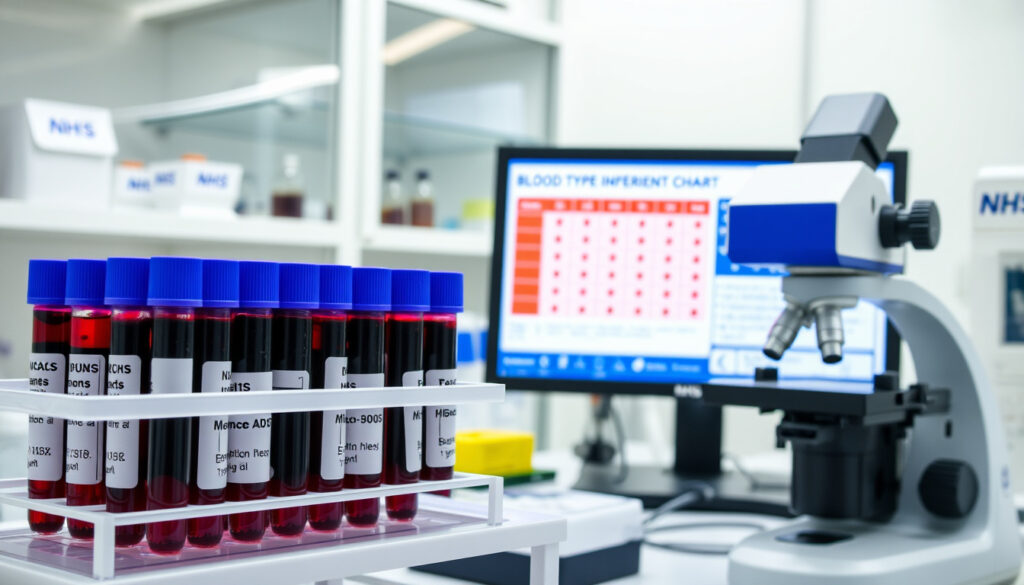
Blood Type Basics: Rarity, Inheritance and NHS Records
Knowing your blood type is essential but often overlooked; this guide explains the eight main groups, inheritance, and NHS donation rules in plain English.
Main blood groups: 4: A, B, AB, O ·
Total blood types: 8 including Rh factor ·
Most common type (UK): O positive ·
Rarest major type: AB negative ·
Genes per parent: One ABO gene each
Quick snapshot
- NHS says blood group is determined by genes inherited from parents (NHS Blood groups)
- NHS Blood Donation says AB negative is the rarest of the 8 main types (NHS Blood Donation – Rare blood types)
- NHS Blood Donation says O negative can be given to anyone in an emergency (NHS Blood Donation – Rare blood types)
- Specific blood type frequency varies by population (NHS Blood Donation – Rare blood types)
- Some rare subtypes extend beyond the 8 main types (NHS Blood Donation – Rare blood types)
- The prevalence of rare subtypes like Ro is not fully mapped across all populations (NHS Blood Donation – Rare blood types)
- Blood type generally stays constant from birth (inherited) (NHS Blood groups)
- Check your NHS records or donate to learn your type (NHS Blood groups)
Five figures, one pattern: blood type compatibility comes down to a few genes and their antigens. Here’s how that breaks down.
| Label | Value |
|---|---|
| Number of main blood types | 8 |
| Most common | O positive |
| Rarest | AB negative |
| Universal donor | O negative |
| Universal recipient | AB positive |
Which blood type is the rarest?
When you ask about the rarest blood type, the answer depends on whether you’re looking at the eight main types or diving into the subtypes that make donation tricky. According to NHS Blood Donation (demand and rarity guidance), AB negative is the rarest of the eight standard types. But here’s the catch: rarity is a population-level metric, not a universal one.
Your blood group is determined by genes inherited from your parents. — NHS Blood groups
What are the rarest blood types overall?
- The ABO system defines 4 main groups — A, B, AB, and O — and the Rh system adds positive or negative.
- AB negative is the rarest of the 8 main types, but specific subtypes like Ro are rarer still.
- NHS Blood Donation says the Ro subtype is vital for treating sickle cell disorder and only 3% of regular donors have it (NHS Blood Donation – Rare blood types).
The Rarest Blood Types page from the NHS notes that “some blood types are rarer than you might think,” and the demand for them is often higher than supply (NHS Blood Donation – Rare blood types).
AB negative is rare, but O negative’s universal donor status makes it more clinically valuable in emergencies, even though it’s more common. Rarity and demand aren’t the same thing.
How rare is AB negative?
NHS Blood Donation says AB negative accounts for only 1% of blood donors (NHS Blood Donation – Rare blood types). That’s not just a number — it means if you’re AB negative and need blood, the pool of compatible donors is thin.
What is the most common blood type?
O positive is the most common type in the UK, which is why you’ll see it top the charts at donation sessions. The NHS notes that O positive is the most frequently occurring blood type, making it the most likely to be on hand when needed (NHS Blood groups).
The implication: the most common type is O positive, but the rarest is AB negative, so AB negative donors are always in short supply relative to demand.
Which is better, O+ or AB+?
If you’re comparing O positive and AB positive, you’re really comparing the most common type with one of the rarest. The NHS says there isn’t a universal “better” — it depends on whether you’re donating or receiving.
Compatibility as donor and recipient
O positive can be given to all Rh-positive blood types (O+, A+, B+, AB+), making it a “universal donor” for positive types. AB positive, on the other hand, is a “universal recipient” for red blood cells from any type, but only for AB recipients.
The NHS Blood Donation guidance says O negative can be given to anyone, and AB positive can receive from all (NHS Blood Donation – Rare blood types).
AB negative is the rarest of the eight main blood types. — NHS Blood Donation
Here’s a simple compatibility table for the ABO system:
| Donor \ Recipient | A | B | AB | O |
|---|---|---|---|---|
| A | Yes | No | Yes | No |
| B | No | Yes | Yes | No |
| AB | No | No | Yes | No |
| O | Yes | Yes | Yes | Yes |
Prevalence and availability
NHS Blood Donation says O positive is the most common, while AB positive is one of the rarest, at around 2% of the population. That’s a stark difference in availability.
Health considerations
Neither is inherently “healthier.” But if you’re a donor, O positive is more valuable for positive patients; if you’re a patient, AB positive can only receive from a small pool.
The trade-off: O positive is more useful for donation, but AB positive has more flexibility in receiving. Neither is better in absolute terms — it’s about what role you’re playing.
Is my blood type on my NHS records?
If you’re in the UK, your blood type might be on your NHS records, but it’s not always visible. The NHS says your blood group is recorded when you have a test, and it can be added to your records, but it’s not automatically shared with you.
How to find your blood type in the UK
You can ask your GP surgery for a blood type test, or you can donate blood and find out your type from the donation service. The NHS Blood groups page explains that you can find out your blood type by testing, but it’s not a routine part of your records unless you’ve had a recent test.
What is recorded with a blood test
NHS Blood Donation says your blood type is determined by the ABO and RhD systems, and this is typically included in your records when you’ve had a cross-match or pregnancy test.
Can you request a test?
Yes, you can ask your GP for a blood type test, but it’s not always funded unless there’s a medical reason. The NHS recommends donating blood as a reliable way to learn your type for free.
Why this matters: your NHS records likely contain your blood type, but you might need to ask to see it, and it’s worth doing so before surgery or pregnancy.
Can your child have a different blood type than both parents?
This is one of the most common blood-type questions, and the answer is a solid yes — but only in certain combinations. The NHS says blood type is inherited from your parents, but a child can have a different type than both of them (NHS Blood groups).
ABO inheritance basics
You inherit one ABO gene from each parent, and the combination determines your blood type. For example, if you inherit an A gene from one parent and a B gene from the other, you’ll be AB.
Rh factor inheritance
The Rh factor (positive or negative) is inherited separately. A child can be Rh negative even if both parents are Rh positive, if both parents carry the recessive negative gene.
Possible combinations
It’s impossible for a child to have a blood type that isn’t possible from the parents’ genes. For example, two O parents can only have an O child, but two A parents can have a child with A or O depending on their hidden genes.
The pattern: a child’s blood type is always a combination of the parents’ genes, but that combination can produce a type different from either parent alone.
Can two O+ parents have a baby?
Yes, but only if we’re talking about the ABO system. If both parents are O positive, they can only pass on the O gene and the Rh positive gene, so the child will be O positive (or O negative only if both carry the negative gene).
The NHS says blood group is determined by genes inherited from parents (NHS Blood groups). So two O parents can’t have an A, B, or AB child.
The upshot: if both parents are O positive, the baby will almost certainly be O positive, unless both parents carry the Rh negative gene — then the baby could be O negative. It’s that simple.
What two blood types can’t have babies together?
There’s no such thing as “can’t have babies” when it comes to blood type. The NHS says all combinations can conceive, but some need medical monitoring (NHS Blood groups).
No absolute block to conception
Blood type doesn’t affect your ability to get pregnant. It’s the Rh factor that can cause complications, especially if the mother is Rh negative and the baby is Rh positive.
If you’re Rh negative and pregnant, the NHS will monitor for Rh incompatibility and offer anti-D injections to prevent complications.
Rh incompatibility risks
The NHS warns that Rh incompatibility can cause a condition called hemolytic disease of the newborn, but it’s preventable with anti-D injections. The NHS Blood groups page notes that this is why Rh status is tested in pregnancy.
ABO incompatibility and pregnancy
ABO incompatibility is less severe, but it can still cause jaundice in newborns. The NHS recommends that all pregnant women get a blood type test to identify any potential issues early.
The catch: the risk isn’t about which blood types can “have babies together” — it’s about the mother’s Rh status, which is why it’s routinely tested in the UK.
Can I be O+ if my parents aren’t?
Yes, you can be O positive even if your parents are A, B, or AB. This is because O is a recessive gene, so it can be carried silently by parents who have a different visible blood type.
Recessive gene pattern
The NHS says blood group is determined by genes inherited from parents (NHS Blood groups). If you inherit an O gene from each parent, you’ll be O, regardless of their visible type.
Examples of parent combinations
For instance, two parents with A or B blood can have an O child if both carry the O gene. This is a classic inheritance pattern that surprises many people.
Myths about blood type inheritance
There’s no way to have an AB child if both parents are O, because O is recessive. But you can be O+ with A+ and B+ parents, which is why blood types can seem like a mystery until you understand the genetics.
The takeaway: your blood type is a genetic hand-me-down that can skip generations or appear differently than expected, but it’s always inherited.
blogs.brighton.ac.uk, blood.co.uk, blood.co.uk, scienceinsights.org, thecardproject.uk, blood.co.uk, nhsbt.nhs.uk, nhsbt.nhs.uk, blood.co.uk, blood.co.uk
Frequently asked questions
How is blood type tested?
Blood type is tested by mixing a sample with antibodies that react to A and B antigens. The NHS says this is done in a hospital or at a blood donation session.
What are the 3 rarest blood types?
AB negative is the rarest of the eight main types. The other two rarest are typically B negative and A negative, based on UK data from NHS Blood Donation.
Can blood type change due to a transplant?
Yes, in rare cases, a bone marrow transplant can change your blood type, because you’re producing new red blood cells from the donor marrow. The NHS notes this is a known effect.
Is O+ blood type in high demand?
O positive is in high demand because it’s the most common type and can be given to all Rh-positive patients, says NHS Blood Donation.
What is the difference between A positive and A negative?
The difference is the Rh factor. A positive has the RhD antigen; A negative doesn’t. This affects who you can donate to, according to the NHS.
Can two O+ parents have a baby that is not O+?
No, two O+ parents can only have O+ or O- children, since they don’t have A or B genes to pass on.
Do siblings always have the same blood type?
No, siblings can have different blood types because they inherit different combinations of genes from their parents.
More related posts
 Georgia O’Connor: Diagnosis, Death, and Boxing Career
 Sara Pascoe: Children, Husband, and Why She Left Sewing Bee
 Eddie Abbew diet, hormones and the 3-3-3 rule
 Lana Del Rey Merch: Official Store & Authentic Items
 European Travel Information and Authorisation System: ETIAS Guide
 Nancy Cartwright net worth and her Simpsons voices
 How to Reduce Blood Pressure: Proven Tips and Methods
 Barbra Streisand 2026: Health, Son, Love Life & Music
