Down Jacket: Definition, Fill Power, and Warmth Explained
Anyone who’s shopped for a winter jacket has seen the label “down fill” and wondered what it actually means. Underneath that puff lies a precise system of insulation that depends on two numbers: fill power and fill weight.
Average fill power range for premium down jackets: 600–900 · Estimated loft-to-weight ratio benefit of down vs. synthetic: 3× warmer per gram · Typical warmth retention when dry: Exceeds synthetic alternatives
Quick snapshot
- Insulated with duck or goose down feathers — REI (outdoor gear co-op)
- Warmth from trapped body heat in air pockets — REI (outdoor gear co-op)
- Measured in cubic inches per ounce — Field Mag (outdoor lifestyle magazine)
- Higher fill power = more warmth per gram — Field Mag (outdoor lifestyle magazine)
- Puffer is a style, down is a fill material — Bushbuck (outdoor gear retailer)
- Many puffers use synthetic fill — Bushbuck (outdoor gear retailer)
- Fill power and fill weight matter — REI (outdoor gear co-op)
- Down loses warming ability when wet — REI (outdoor gear co-op)
The table below sums up the essential attributes of down jackets.
| Attribute | Value |
|---|---|
| Insulation material | Soft underfeathers of ducks or geese (Constant Mountain (outdoor equipment resource)) |
| Typical fill power range for premium jackets | 700–900 |
| Wet weather performance | Poor when saturated; synthetic alternatives preferred (REI (outdoor gear co-op)) |
| Compressibility | High; packable for travel (Bushbuck (outdoor gear retailer)) |
| Weight | Lightweight compared to synthetic of equal warmth |
What is a down jacket?
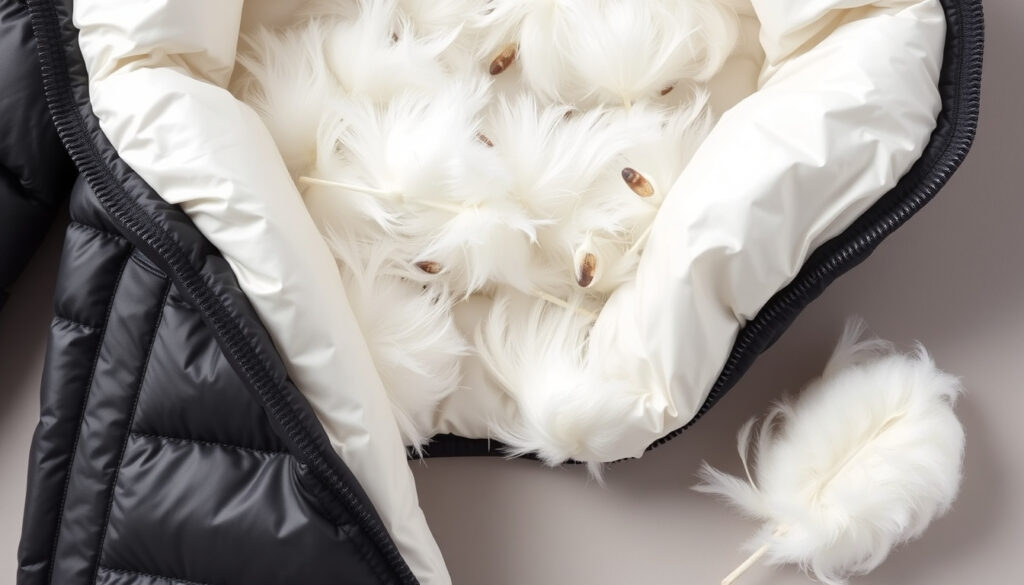
A down jacket uses the soft underfeathers — called down — of ducks or geese as its insulating layer. Unlike stiff outer feathers, down clusters lack quills and form a fluffy mass that traps body heat in millions of tiny air pockets. This construction gives down jackets their signature lightweight warmth. According to REI (outdoor gear co-op), the warmth comes from the trapped air, not the feathers themselves.
How is a down jacket constructed?
Manufacturers sew fabric shells into compartments — called baffles — that hold the down in place. Baffles can be sewn-through (simpler, cheaper) or box-wall (more expensive, prevents cold spots). The fill material is a mix of down clusters and small feathers, with a typical ratio of 90% down to 10% feathers for quality jackets. Constant Mountain (outdoor equipment resource) notes that a 90/10 ratio is common for mid-range to premium models.
What type of insulation does down provide?
Down is a natural insulator that works by trapping air. Each cluster expands to create loft, and that loft determines how many air pockets exist. The higher the loft, the better the insulation. Field Mag (outdoor lifestyle magazine) explains that fill power is the metric used to measure this loft — the volume in cubic inches that one ounce of down occupies after being compressed for one minute.
Down jackets achieve warmth through air-trapping loft, not through the feathers themselves. The construction (baffle design) and fill ratio matter as much as the down quality.
The implication: a jacket with cheap baffles and low-quality down will underperform even if it carries the “down” label.
Why is it called a down jacket?
The term “down” comes from the Old Norse word “dúnn,” meaning the soft underfeathers of waterfowl. These feathers lack the stiff central quill of contour feathers, so “down” refers specifically to the cluster of filaments that create fluffiness. Bushbuck (outdoor gear retailer) emphasizes that down is not synonymous with “feather” — jackets labeled “down” use these underfeathers, while cheaper jackets often mix in stiffer quill feathers.
What is the origin of the word down in down jacket?
The word “down” entered English via Germanic roots, and by the 14th century it referred specifically to the soft plumage of birds. The term “down jacket” emerged in the mid-20th century as outdoor brands began using down as a high-performance insulation for mountaineering and cold-weather gear. Today it is a generic category, but the name still points to that specific feather type.
The naming is literal: a down jacket is filled with down, the lightest and loftiest part of a bird’s plumage. The trade-off? That same softness makes it vulnerable to moisture.
Is a down jacket the warmest type of jacket?
When dry, a well-constructed down jacket can outperform nearly any other insulation type by weight. REI (outdoor gear co-op) confirms that down traps three times more heat per gram than most synthetic fills. But warmth depends on two numbers: fill power and fill weight. A 900-fill jacket with only 30g of down is not warmer than a 450-fill jacket with 100g of down — a point REI makes explicitly.
How does down compare to synthetic insulation for warmth?
- Dry conditions: Down is warmer for the same weight.
- Wet conditions: Wet down collapses and loses 90% of its insulating ability. Synthetic fibers retain some warmth even when damp (REI (outdoor gear co-op)).
- Cost: Premium down jackets cost more than equivalent synthetic jackets.
What factors determine how warm a down jacket is?
Three variables drive warmth: fill power (loft quality), fill weight (total grams of down), and baffle construction. Constant Mountain (outdoor equipment resource) states that for everyday winter wear, 600–700 fill power offers an excellent warmth-to-weight ratio, while 750–850 is the standard for high-performance insulation.
A high fill power number alone does not guarantee warmth. If the fill weight is too low, even premium down can be outperformed by a budget synthetic jacket with more insulation mass.
The pattern: shoppers must check both fill power and fill weight rather than assuming a high fill-power label means maximum warmth.
What does down fill power mean and is 800 fill warmer than 600?
Fill power is a standard lab measurement. Field Mag (outdoor lifestyle magazine) describes the test: one ounce of down is dropped into a graduated cylinder, a weight is placed on top for one minute, and the volume in cubic inches becomes the fill power rating. So 800 fill means one ounce expands to 800 cubic inches, while 600 fill expands to 600 cubic inches.
How is fill power measured?
The test is governed by industry standards (IDFB or ASTM). The result tells you how much loft each ounce produces. Higher fill power means more air trapped per gram, which translates to better insulation at a lower weight. Bushbuck (outdoor gear retailer) notes that fill power ranges from 400 (basic) to 900+ (premium).
What fill power is best for everyday use?
For casual urban wear and moderate cold, 600–700 fill power is sufficient and more affordable. For backcountry trips or extreme cold, 750–850 fill power is recommended. 900+ fill power is for mountaineers who need maximum warmth with minimum pack size, as Constant Mountain (outdoor equipment resource) explains.
Yes, 800 fill is warmer per gram than 600 fill. But the total warmth of your jacket also depends on how many ounces of fill it contains — a cheap jacket with 600 fill might still be warmer if it uses twice as much material. Always check both numbers.
This table shows how fill power ratings translate into real-world performance.
| Fill Power | Loft (cubic inches per oz) | Best Use |
|---|---|---|
| 400–550 | Basic | Light warmth, mild winters (Constant Mountain) |
| 600–700 | Good | Everyday winter wear, great warmth-to-weight (Constant Mountain) |
| 750–850 | High | High-performance, cold weather, backcountry (Constant Mountain) |
| 900+ | Ultra | Premium warmth, minimal bulk (Constant Mountain) |
Down jacket vs puffer jacket: which is better and which is warmer?
Many people use “puffer jacket” and “down jacket” interchangeably, but they refer to different things. A puffer jacket is a style defined by quilted stitching that creates a puffy look. A down jacket is defined by its fill material. As Bushbuck (outdoor gear retailer) explains, a puffer can be filled with down, synthetic fibers, or a blend. So a down jacket is a type of puffer, but not all puffers are down jackets.
What is the construction difference between a down jacket and a puffer jacket?
- Down jacket: filled with goose or duck down, uses baffles to keep fill in place.
- Puffer jacket: style name, can use any fill. Many affordable puffers use synthetic insulation (Field Mag (outdoor lifestyle magazine)).
Is a puffer jacket always warmer than a down jacket?
No. Warmth depends on the fill material, not the outer design. A synthetic puffer with a low fill weight will be less warm than a high-fill-power down jacket. But if you expect rain or snow, a synthetic puffer stays warmer when wet. REI (outdoor gear co-op) notes that down loses its insulating ability when saturated, while synthetic fibers continue to trap some heat.
This table breaks down the practical differences between down jackets and puffer jackets.
| Feature | Down Jacket | Puffer Jacket (any fill) |
|---|---|---|
| Fill material | Down (duck/goose underfeathers) | Down, synthetic, or blend |
| Warmth when dry | Excellent (REI) | Varies by fill |
| Warmth when wet | Poor | Synthetic: moderate; down: poor |
| Weight | Light relative to warmth | Generally heavier for same warmth if synthetic |
| Price | Higher (premium down) | Wide range, often cheaper |
| Packability | Excellent (Bushbuck) | Depends on fill |
Are down jackets actually warm in real-world conditions?
Yes, but only when kept dry. In dry cold, a good down jacket is outstanding — lightweight, compressible, and warm. Constant Mountain (outdoor equipment resource) rates 750–850 fill as ideal for high-performance use. But the moment the down gets wet — from rain, sweat, or humidity — the clusters collapse and insulation plummets.
Do down jackets stay warm when wet?
No. Water causes down to lose its loft. A saturated down jacket can become a cold, heavy shell. REI (outdoor gear co-op) advises that synthetic insulation retains some thermal performance when damp, making it a better choice for wet environments or high-exertion activities where sweating is likely.
How to care for a down jacket to maintain warmth?
- Wash with a specialized down cleaner and dry on low heat with tennis balls to restore loft.
- Store uncompressed (hang or lay flat) to preserve fill power.
- Use a waterproof shell over the jacket in rain or snow to keep down dry. Bushbuck (outdoor gear retailer) notes that proper care extends the life of a down jacket significantly.
Even high-quality down jackets can fail in a heavy downpour unless treated with a durable water repellent (DWR) coating. Many modern down jackets are treated with hydrophobic down to resist moisture, but prolonged wetting still compromises warmth.
The catch: a down jacket’s real-world warmth depends more on your ability to keep it dry than on its fill-power rating.
Which is better: a down jacket or a puffer jacket?
The answer depends on your climate and activity. For cold dry weather, a down jacket is the better choice: lighter, more compressible, and warmer per ounce. For wet or humid climates, a synthetic puffer jacket performs better because it retains warmth when damp and dries faster.
For cold dry weather, which is better?
Down. A 700+ fill down jacket with adequate fill weight will outperform almost any synthetic jacket of the same weight in dry cold. Field Mag (outdoor lifestyle magazine) points out that mountaineers and polar explorers have relied on down for decades in arid, freezing conditions.
For wet or humid climates, which is better?
Synthetic puffer. Even hydrophobic-treated down eventually wets out, and once wet, it becomes heavy and cold. REI (outdoor gear co-op) recommends synthetic insulation for rainy regions, ski touring with high output, or any scenario where the jacket might get damp from inside or out.
Upsides
- Lightweight: down delivers more warmth per gram than any synthetic insulation (REI)
- Compressible: packs down small for travel and storage (Bushbuck)
- Durable: with proper care, a down jacket can last a decade or more
- Breathable: natural fibers allow moisture vapor to escape, reducing clamminess
Downsides
- Poor wet performance: loses 90% of insulation when saturated (REI)
- Expensive: premium down (800+ fill) can cost significantly more than synthetic alternatives
- Ethical concerns: some down is collected via live-plucking; look for RDS (Responsible Down Standard) certification
- Requires careful cleaning and storage to maintain loft (Constant Mountain)
What’s clear and what’s not
Confirmed facts
- Down jackets use duck or goose feathers as insulation.
- Fill power measures loft per ounce (REI).
- 800 fill down is warmer per gram than 600 fill.
- Down loses insulating ability when wet (REI).
What’s unclear
- Exact market share of down vs synthetic jackets in 2025.
Quotes from the industry
Down insulated jackets deliver warmth by trapping body heat inside small air pockets.
— Columbia Sportswear product description
Fill power is a standard measure of the loft or fluffiness of down.
— Outdoor Research article on fill power
Down jackets are not magic — they are a precise engineering trade-off between loft, weight, and moisture resistance. For a buyer in a dry, cold climate who prioritizes packability and warmth per ounce, a quality down jacket is the clear winner. For anyone who faces rain, snow, or high-output activities, the safer choice is a synthetic puffer that keeps its insulation when damp. The decision comes down to your local weather and how you plan to use the jacket.
For the winter commuter in a city like Minneapolis or Stockholm, the choice is clear: invest in a 700–850 fill down jacket with a water-repellent shell. For a rainy city like Seattle or London, a synthetic puffer with good breathability will serve you better, or carry both and layer.
Related reading: Fill Power vs Fill Weight: What Actually Keeps You Warm? · What Is Down Fill Power? A Complete Guide
alpineascents.com, refrigiwear.com, outdoorgearlab.com, us.mountain-equipment.com, scaleupuk.uk
Frequently asked questions
What type of feather is used in a down jacket?
Down jackets use soft underfeathers from ducks or geese — not the stiff outer quill feathers. These clusters lack a central shaft, allowing them to trap air efficiently. (Bushbuck (outdoor gear retailer))
Can a down jacket be washed?
Yes, but use a gentle down-specific detergent and dry on low heat with tennis balls or dryer balls to restore loft. Avoid fabric softeners. (REI (outdoor gear co-op))
How long does a down jacket last?
With proper care — including correct washing and storage — a quality down jacket can last 10–15 years or more. The lifespan depends on fill quality, shell fabric, and how often it is compressed. (Constant Mountain (outdoor equipment resource))
Is down fill cruelty-free?
Not always. Some down is collected from live-plucked birds. Look for jackets certified by the Responsible Down Standard (RDS) or Global Traceable Down Standard, which ensure ethical sourcing. Many major brands now use certified down. (Field Mag (outdoor lifestyle magazine))
What is the difference between down and feather in jackets?
Down is the soft, quill-less underfeathers that provide loft and insulation. Feathers have stiff quills and are often used as a cheaper filler. Jackets labeled “down” contain mostly down; those labeled “feather” or “down & feather” include quill feathers that add weight and reduce insulation. (Bushbuck (outdoor gear retailer))
Do down jackets work in rain?
No. Untreated down loses its insulating ability almost entirely when wet. Even hydrophobic-treated down will eventually fail if saturated. In rain, a waterproof outer layer is essential, or choose a synthetic jacket instead. (REI (outdoor gear co-op))
How should a down jacket be stored?
Store a down jacket loosely — hanging or laid flat — to maintain loft. Do not leave it compressed in a stuff sack for long periods, as that can permanently reduce fill power. Keep it in a cool, dry place. (Constant Mountain (outdoor equipment resource))
More related posts
 Booster Seat Age Requirements in Ireland – Guide & Safety Tips
 Ellie Rowsell: Wolf Alice Biography & Songwriting Facts
 Ray Stevenson Death: What Happened to the Actor and His Net Worth
 Luxmy Gopal: BBC Journalist’s Career, Age, and Personal Life
 Charlie Kirk Dead: Assassination Details, Last Words
 Solid Snake: The Tragic Clone Hero of Metal Gear Solid
 Iron Maiden: History, Biggest Hits, Members & More
 Erik Lyle Menendez: Release, Diagnosis, and Personal Lives
