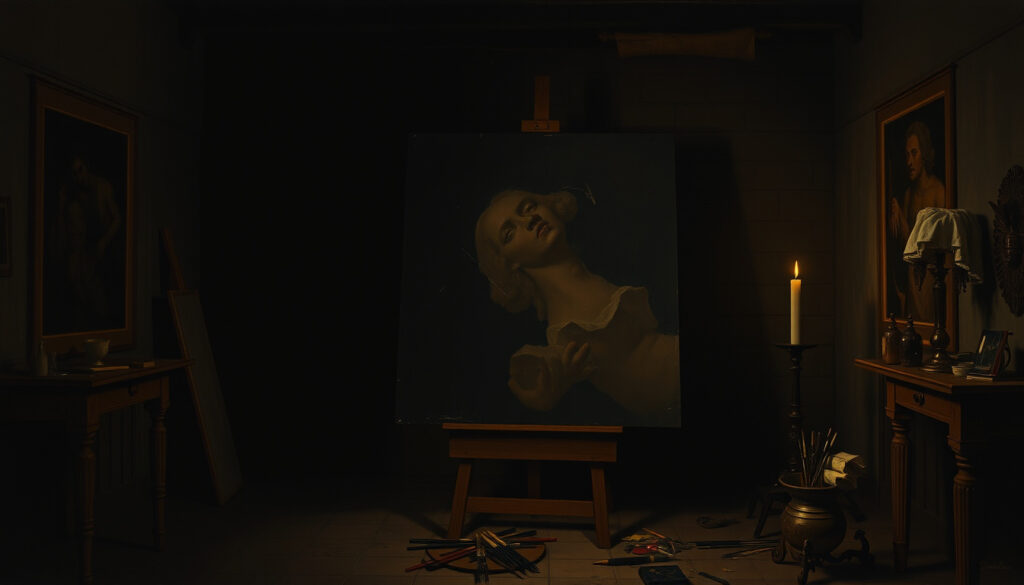
Saturn Devouring His Son: Goya’s Myth, Meaning & Location
Few paintings stop you in your tracks quite like Francisco Goya’s Saturn Devouring His Son. The image of a wild-eyed giant consuming a human body is as shocking today as it was when Goya painted it on the wall of his country house nearly two centuries ago.
Year completed: c. 1819‑1823 ·
Medium: Oil mural transferred to canvas ·
Dimensions: 146 × 83 cm (57.5 × 32.7 in) ·
Location: Museo del Prado, Madrid ·
Part of series: Black Paintings (14 total) ·
Mythological source: Roman god Saturn (Greek Cronus)
Quick snapshot
- The painting is housed in the Museo del Prado (Spain’s national art museum)
- Goya painted it directly on the wall of his dining room at the Quinta del Sordo (Prado)
- It is part of the Black Paintings series (Encyclopaedia Britannica)
- The mural was transferred to canvas in the 1870s (Wikipedia)
- Exact year of creation (1819–1823 range) – Britannica
- Whether the painting was intended for public view or purely personal – Artincontext
- Specific identity of the child depicted – Prado
- Goya’s precise political intentions for the painting – Britannica
- c. 1819‑1823: Goya paints Saturn on the wall of Quinta del Sordo (Britannica)
- 1873: Salvador Martínez Cubells transfers mural to canvas (Fundación Goya en Aragón)
- Ongoing scholarly debate about the painting’s exact date and intended meaning (Artnet)
- The painting continues to draw millions of visitors to the Prado each year (Prado)
Six key facts capture the painting’s profile:
| Fact | Detail |
|---|---|
| Primary myth | Saturn (Cronus) devours children to prevent overthrow |
| Painting medium | Oil on plaster, transferred to canvas |
| Art movement | Romanticism / Early 19th‑century Spanish |
| Unique feature | Child depicted as adult‑sized corpse |
| Discovery note | Painted on wall, unknown to public until 1873 |
| Goya’s age at painting | 73–77 years old (born 1746) |
Why does Saturn devour his children?
The myth of Saturn and the prophecy of overthrow
- In Roman mythology, Saturn (the Greek Cronus) was told that one of his children would overthrow him. To prevent this, he swallowed each child at birth (Encyclopaedia Britannica (established reference work)).
- Goya’s portrayal emphasizes cannibalism and madness over Classical restraint. The child is already dead and partially consumed, unlike earlier Renaissance versions (Museo del Prado).
- According to the Prado, the mythological god can be seen as a personification of the human fear of losing power (Prado).
How Goya’s version differs from earlier depictions
- Peter Paul Rubens’ Saturn (1636) shows the god with a scythe, devouring a small child. Goya’s child is an adult‑sized corpse with no face left (Britannica).
- Goya freezes the moment before any future retribution, locking the viewer into the act itself (Smarthistory).
Bottom line: Goya’s Saturn is not a cold mythological scene; it’s a psychological howl. For art historians, the painting forces a reconsideration of how myth can be weaponized to express personal and political terror. For general viewers, it remains the most visceral depiction of parental fear in Western art.
The Prado’s official catalog describes the work as “one of the most expressive images from the Black Paintings” – a rare admission that a museum piece can be both a masterpiece and a raw nerve.
Where is Saturn eating his son located?
Original placement in the Quinta del Sordo
- Goya painted Saturn directly onto the plaster wall of his dining room on the ground floor of the Quinta del Sordo (Villa of the Deaf Man) outside Madrid (Prado).
- The Prado notes the work occupied the wall across from a portrait of Leocadia Zorrilla; early photographs suggest light from a window on the right, implying placement opposite Two Old Men (Fundación Goya en Aragón (primary research foundation)).
Transfer to canvas and current home in the Museo del Prado
- After Goya’s death, the mural was removed from the wall and transferred to canvas by Salvador Martínez Cubells in 1873–1874 (Wikipedia).
- It entered the Museo del Prado in 1881 and has been on display there ever since (Prado).
The implication: The painting’s journey from a private wall to a public museum took over 50 years, and the physical transfer itself nearly destroyed it – a fragile survival that mirrors the violence depicted.
What happened after Saturn ate his son?
The myth: Rhea’s deception and Jupiter’s rise
- In myth, Saturn’s wife Rhea hid the infant Jupiter (Zeus) and gave Saturn a stone wrapped in swaddling, which he swallowed (Britannica).
- Jupiter later overthrew Saturn and forced him to regurgitate his siblings – Vesta, Ceres, Juno, Pluto, and Neptune (Britannica).
Goya’s narrative: the painting as a timeless moment
- Goya deliberately freezes the moment before any future retribution. The child is already dead and partially consumed; the god’s eyes are wide with madness, not triumph (Smarthistory).
- Art historians commonly read the image as an expression of old age, violence, and psychological horror, with no redemptive sequel (Artincontext).
Bottom line: Goya takes a myth with a clear ending and removes the ending. For museum visitors, the painting becomes a permanent question: what happens to a ruler who has already consumed everything he feared?
Robert Hughes called the painting “a howl of rage and despair.” Yet it hangs in one of the world’s most‑visited museums – a howl that millions pay to hear.
Why was Goya exiled?
Political climate of the Liberal Triennium (1820–1823)
- Goya sympathized with liberal reforms that contradicted King Ferdinand VII’s absolutist rule (Britannica).
- After the restoration of absolutism in 1823, Goya feared reprisal for his political affiliations and his paintings (Britannica).
Goya’s self‑imposed exile in Bordeaux (1824)
- In 1824, at age 77, Goya moved to Bordeaux, France, where he lived until his death in 1828 (Britannica).
- He left the Quinta del Sordo behind, including the Black Paintings on its walls (Prado).
The pattern: Goya’s Saturn was painted during the very years liberal Spain was crumbling. The painting’s raw violence may be as political as it is personal – a dictator devouring his own people.
Is there a painting of Cronus eating his children?
Other artistic treatments of the Cronus/Saturn myth
- Yes – Peter Paul Rubens’ Saturn (1636) depicts the god devouring a child using a scythe (Britannica).
- Giorgio Vasari also painted a Saturn Devouring His Children, though less well‑known (Britannica).
Comparison with Peter Paul Rubens’ Saturn
- Rubens’ Saturn is a muscular, bearded figure holding a scythe; the child is small and infant‑like. Goya’s version is gaunt, wide‑eyed, and the child is a full‑sized corpse (Britannica).
- Rubens’ work is part of a series for the Torre de la Parada, while Goya’s was private and never commissioned (Britannica).
The trade‑off: Where earlier artists depicted myth as allegorical theater, Goya made it a mirror of human terror. Small wonder his version haunts popular imagination more than any other.
How many children did Saturn have?
List of Saturn’s known children per mythology
- Roman mythology credits Saturn with six children: Vesta, Ceres, Juno, Pluto, Neptune, and Jupiter (Britannica).
- He swallowed each child at birth except Jupiter, whom Rhea saved by substitution (Britannica).
Which children appear in the myth
- The number varies across sources; Goya’s painting depicts one unidentified child, not a specific offspring (Prado).
- After Jupiter overthrew Saturn, the rescued siblings became the major Olympian deities (Britannica).
Bottom line: Saturn consumed five of his six children; the one who escaped – Jupiter – fulfilled the prophecy of overthrow. Goya’s painting captures the moment of consumption itself, indifferent to which child it is.
Timeline: Saturn Devouring His Son – from creation to present
The chronology below traces the painting’s journey from Goya’s wall to the Prado’s gallery.
| Date | Event |
|---|---|
| c. 1819‑1823 | Goya paints Saturn on the wall of Quinta del Sordo |
| 1823 | Restoration of absolutist monarchy; Goya fears reprisal |
| 1824 | Goya moves to Bordeaux, France |
| 1828 | Goya dies in Bordeaux |
| 1873 | Salvador Martínez Cubells transfers mural to canvas |
| 1881 | Canvas exhibited at Museo del Prado |
| 1888 | Donated to the Spanish state by the Baron of the Court |
| 1992 | Restoration reveals original colors and brushwork |
Bottom line: From a private country‑house wall to the Prado’s permanent collection, the timeline reveals a painting that barely survived – both physically and politically.
What we know vs. what remains unclear
Confirmed facts
- The painting is housed in Museo del Prado (Prado)
- Goya painted it directly on the wall of his dining room (Prado)
- It is part of the Black Paintings series (Britannica)
- The mural was transferred to canvas in the 1870s (Wikipedia)
What’s unclear
- Exact year of creation (1819‑1823 range) (Britannica)
- Whether the painting was intended for public view or purely personal (Artincontext)
- Specific identity of the child depicted (Prado)
- Goya’s precise political intentions for the painting (Britannica)
Expert voices on Saturn Devouring His Son
“Saturn devouring one of his sons is one of the most expressive images from his Black Paintings.”
— Museo del Prado official catalog
“The picture is a howl of rage and despair…”
— Robert Hughes, art critic and biographer
“The mysterious image has haunted art historians since its discovery.”
— Artnet, specialist art news publication
“The haunting Saturn illustrates the myth of the Roman god Saturn, who, fearing his children would overthrow him, ate them.”
— Encyclopaedia Britannica
Goya’s Saturn is not just a museum piece – it is a psychological test. For anyone drawn to the shadowy edges of art history, the painting offers a raw, unflinching confrontation with power, fear, and mortality. For visitors to the Museo del Prado, the choice is clear: stand before it and let its intensity unsettle you, or skim past it and miss one of the most psychologically charged paintings ever created.
en.wikipedia.org, ava.ead.domalberto.edu.br, briefingroom.uk, worldmuseumguide.org, simplykalaa.com
Frequently asked questions
How did Goya’s Saturn painting come to the Prado?
After Goya’s death, the mural was removed from the wall of Quinta del Sordo and transferred to canvas by Salvador Martínez Cubells in 1873. It was donated to the Spanish state in 1888 and has been at the Museo del Prado since 1881.
What are the Black Paintings of Goya?
The Black Paintings are 14 psychologically intense murals Goya painted directly onto the walls of his home, the Quinta del Sordo, between 1819 and 1823 (Britannica).
Was Saturn Devouring His Son actually painted on a wall?
Yes – Goya applied oil paint directly onto the plaster wall of his dining room (Prado).
What makes Saturn Devouring His Son so disturbing?
The image combines cannibalism, madness, and the violation of parental bonds. Goya portrays the child as a full‑sized corpse and the god’s expression as pure terror, not triumph (Smarthistory).
Did Goya paint any other versions of this subject?
No – only this single known version exists. Earlier artists such as Rubens and Vasari painted the same myth, but Goya’s is the only surviving version by him (Britannica).
How old was Goya when he painted Saturn?
Goya was between 73 and 77 years old (born 1746; painting dated 1819‑1823). He painted it near the end of his life while living in his country house outside Madrid (Britannica).
Can I see the original Saturn painting today?
Yes – it is on permanent display at the Museo del Prado in Madrid, room 67 (Prado).
Related reading: Helen of Sparta: Beauty, Myth, and the Trojan War · Roy Lichtenstein: Pop Art Pioneer & Comic Strip Master
More related posts
 Aston Villa vs Wolves: 2-0 Result, Highlights & Stats
 Why Do Footballers Cut Holes in Their Socks
 Lee Ingleby: Career, Harry Potter, and George Gently
 Richard Burton: Cause of Death and Legacy
 Leslie Grantham: EastEnders Actor, Life, Death, and Family
 Sammy Virji: Real Name, Age, Ethnicity, Tour Dates
 Arsenal F.C. vs Brentford F.C. Timeline: Head-to-Head History
 1.93 Meters to Feet Conversion – Exact Value & Height Guide
