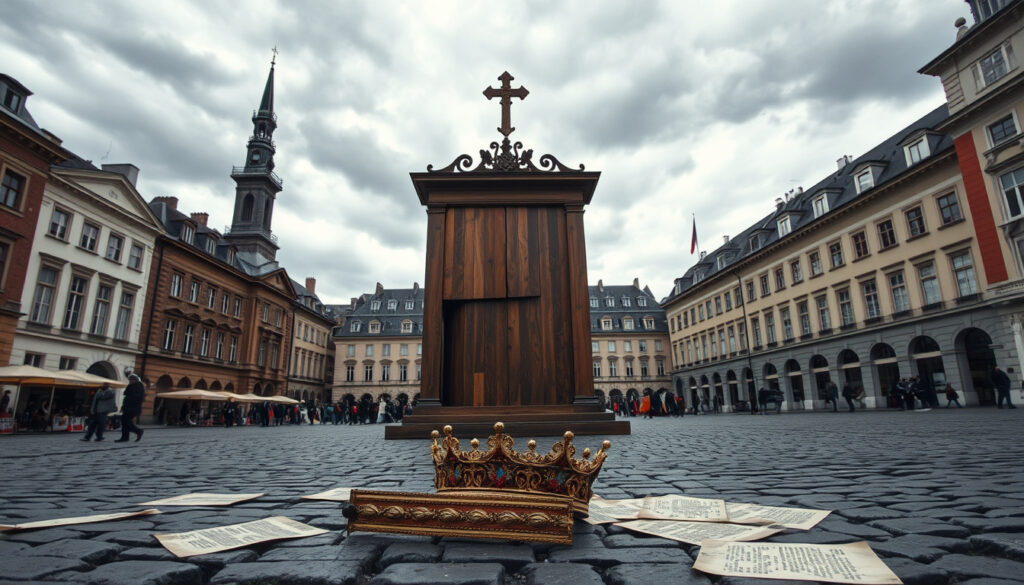
Louis XVI: Final Words, Trial, and Execution Facts
A king’s last words should feel like the most private moment in history—but Louis XVI’s became a public argument before the blood was washed off the scaffold. The 38-year-old former king was executed on 21 January 1793 at Place de la Révolution in Paris, and the words he did or did not say have been used ever since to make him either a martyr or a traitor.
Born: 23 August 1754, Versailles · Reign: 1774–1792 · Executed: 21 January 1793, Paris · Age: 38 · Method: Guillotine
The basic frame of Louis XVI’s life is less contested than almost anything else around him:
| Full name | Louis-Auguste de France, Duke of Berry |
|---|---|
| Born | 23 August 1754, Versailles |
| Died | 21 January 1793, Paris |
| Spouse | Marie Antoinette of Austria, married 1770 |
| Reign duration | 1774–1792 |
| Age at execution | 38 years old |
| Execution method | Guillotine at Place de la Révolution |
What were Louis XVI’s final words?
Historians cannot give a single, perfectly settled transcription. The version most often quoted appears in the World History Encyclopedia:
“I die innocent of all the crimes laid to my charge; I pardon those who brought about my death, and I pray God that the blood about to be shed may never be required of France.”
— Louis XVI, as recorded through the account of Henry Essex Edgeworth
“The king spoke of his innocence, pardoned his enemies, and prayed that the blood about to be shed would not be required of France.”
— Wikipedia biography of Louis XVI
Later writers, including War History Online, point out that the line often shortened to “I die innocent” because the drumroll drowned out parts of the speech.
The implication: the exact wording matters less than the fact that the revolutionaries needed to silence the king mid‑sentence.
Why was Louis XVI condemned to death?
The trial was never just a legal procedure. It was a way of proving that the Revolution had changed the meaning of sovereignty itself.
According to the World History Encyclopedia, the National Convention tried Louis as “Citizen Louis Capet,” a king stripped of his royal title and prosecuted for crimes against the state. The urgency came from a political crisis: foreign invasions, threats to the Revolution, and the discovery of secret correspondence between the king and abroad.
Timeline from trial to guillotine
- December 1792: Louis appears before the National Convention and faces questioning. (Encyclopaedia Britannica)
- January 1793: the Convention finds him guilty and votes on the punishment. (Encyclopaedia Britannica)
- 21 January 1793: Louis is executed at Place de la Révolution, as Encyclopaedia Britannica records.
What this means: the conviction turned on a narrow margin—387 to 334—revealing how divided the revolutionaries themselves were.
Why did Marie Antoinette and Louis XVI not have children immediately?
The marriage of Louis and Marie Antoinette became a favorite subject of court gossip and later of revolutionary propaganda. The couple were both very young when they married, and the early years of the marriage were watched by a court that rarely gave them privacy.
“The early years of the marriage were marked by inexperience and embarrassment rather than malice.”
— Henriette Campan, lady-in-waiting to Marie Antoinette
The queen’s lady-in-waiting, Henriette Campan, left a memoir describing the early marriage as a story of inexperience and embarrassment rather than malice. Those memoirs are one reason historians have been careful not to repeat the crudest rumors as fact.
What is not seriously disputed is that the physical distance between the couple changed. Marie Antoinette gave birth to her first child, Marie Thérèse, in December 1778—eight years after the wedding, as the biographical material on the queen also shows.
The pattern: the delay was exploited by enemies who turned a private matter into evidence of treason.
What disease did Marie Antoinette have?
Medical records from Marie Antoinette’s imprisonment indicate she suffered from uterine infections and tuberculosis. A report from 1793 notes bleeding and weakness, but no autopsy was performed after her execution, so diagnoses rely on prison doctors’ observations. (Unofficial Royalty)
Did Marie Antoinette have a black son?
The “other father” story was a political weapon, not a medical finding. It began in the gossip pages and libel literature around Marie Antoinette and was never backed by credible evidence.
Historians have often noted that every surviving legal record from the royal household treats Louis XVI as the father of his children. The claim that the children were not his fits a recognizable pattern: Marie Antoinette’s body was treated as foreign, dangerous, and sexually uncontrollable.
No historian alive treats the paternity rumor as an established fact, and the legal records confirm that Louis recognized each child as his.
The implication: the rumor survived because it served revolutionary propaganda, not because of any evidence.
What happened to Marie Antoinette’s children after the execution?
Louis XVI’s daughter, Marie Thérèse, was the only member of the immediate family to survive the Revolution. His son, Louis XVII, died in prison while still a child.
The queen did not survive the Terror. Marie Antoinette was executed on 16 October 1793, less than a year after her husband, as recorded in the broader Wikipedia biography of the king.
In a single political trauma, the family was torn apart: the king executed, the queen executed, the son dying in prison, and only the daughter surviving to become a symbol of the old royal family.
The consequence: Marie Thérèse’s survival kept the Bourbon lineage alive, making her a key figure in later restoration attempts.
- Attempted to address the crowd before drums drowned out his voice. (World History Encyclopedia)
- “I die innocent of all the crimes laid to my charge.” (EyeWitness to History)
- Pardoned his enemies and prayed for France. (Wikipedia)
- Tried by the National Convention. (Encyclopaedia Britannica)
- Convicted of high treason. (World History Encyclopedia)
- Executed 21 January 1793. (Encyclopaedia Britannica)
- Marie Thérèse exchanged in 1795 and survived. (Wikipedia)
- Louis Joseph died of tuberculosis in 1789. (Unofficial Royalty)
- Louis XVII died in prison at age 10. (Wikipedia)
- Unproven political slander. (World History Encyclopedia)
- No credible evidence supports another father. (Wikipedia)
- All children recognized by Louis XVI in legal records. (Unofficial Royalty)
Related reading
- Encyclopaedia Britannica on Louis XVI
- World History Encyclopedia on the trial and execution
- EyeWitness to History on the final moments
- War History Online on the execution
- Thomas Jefferson: The Founding Father and Slavery Paradox
- Lord Byron: Life, Works, and Legacy of the Romantic Poet
worldhistory.org, encyclopedia.com, alphahistory.com, historyisnowmagazine.com, heritage-history.com, en.wikipedia.org, kids.kiddle.co
Frequently asked questions
When was Louis XVI executed?
Louis XVI was executed on 21 January 1793 at Place de la Révolution in Paris, as recorded by Encyclopaedia Britannica.
What did Louis XVI say before he died?
The most commonly repeated version, recorded through the account of Henry Essex Edgeworth, has the king saying he died innocent, pardoned his enemies, and prayed that the coming bloodshed not be visited on France.
Why did Marie Antoinette and Louis XVI not have children immediately?
An early memoir by the queen’s lady-in-waiting, Henriette Campan, describes inexperience and embarrassment. The king and queen had no children until December 1778, eight years after their wedding.
Were Marie Antoinette’s children actually fathered by Louis XVI?
No credible evidence supports the rumors that another man fathered her children. Every surviving legal record treats Louis XVI as the father, and historians generally treat the story as a political libel.
How long was Louis XVI king?
Louis XVI reigned from 10 May 1774 to 21 September 1792, when the monarchy was abolished, a total of 18 years.
More related posts
 Pete Tong: Meaning, Net Worth, Biography & Why the Phrase Exists
 Sticky Vicky: Net Worth, Death, and Daughter’s Legacy
 B&Q Milton Keynes – Opening Hours, Address and Services
 Matthew Macfadyen: Biography, Accent, and Why He Hated Playing Darcy
 Jeans Marks Spencer: M&S Denim Styles, Fits & Tips
 Mazzy Star: Tragic Story, What Happened, and Hope Sandoval Now
 Geoffrey Boycott: Career, Quotes, and Controversies
 Charlie Kirk Dead: Assassination Details, Last Words
