What Is a Maisonette? Definition, Vs Flat & Key Facts
If you’ve been house-hunting in the UK, you’ve probably come across the term “maisonette” and wondered what sets it apart from a flat. It’s one of those property words that gets used loosely, which can lead to confusion when you’re trying to figure out exactly what you’re buying. The good news is that the distinction matters less once you know the key features to look for.
Typical Floors: 2 · Own Entrance: Yes · Internal Stairs: Yes · Part of Building: Larger block · Origin: French for small house
Quick snapshot
- Self-contained two-storey flat (Haart)
- Own front door from street (Petty Son and Prestwich)
- Internal staircase (Architecture for London)
- Exact square footage compared to flats varies by property
- Typical demographics of residents not formally tracked
- Converted townhouse maisonettes became common through the 20th–21st century (SAM Conveyancing)
- Urban demand for maisonettes continues to grow as buyers seek space with privacy (Bleman Property Group)
| Attribute | Maisonette |
|---|---|
| Floors | Usually 2 storeys |
| Access | Self-contained front door |
| Stairs | Internal connecting stairs |
| Building Type | Part of larger structure |
| Etymology | French “maisonnette” (small house) |
What Is a Maisonette?
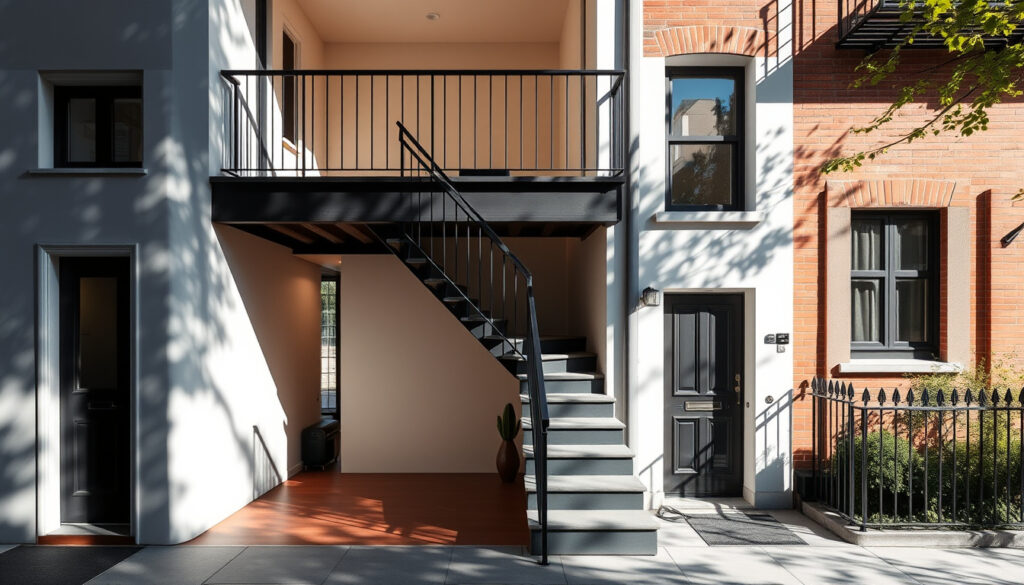
A maisonette is a self-contained flat that spans two storeys within a larger building, with its own private entrance opening directly to the outside world. The word comes from the French “maisonnette,” meaning small house—and that description captures the feel better than many people realise.
Estate agents often treat “maisonette” as interchangeable with other types of self-contained housing, but the property industry uses a simple rule: the defining feature is the private entrance that leads straight outside, not through a shared hallway. This distinguishes it from purpose-built two-storey flats that still use communal corridors.
Origin and meaning
The term “maisonette” emerged to describe a living arrangement that bridges the gap between a flat and a house. Where a flat sits on a single floor and shares its entrance with other residents, a maisonette gives you your own front door and vertical space over two levels. Converting larger Victorian and Edwardian properties into separate maisonettes became common practice throughout the 20th and 21st centuries, particularly in cities like London and Bristol where housing demand outstripped supply.
Key features
- Two floors of living space, typically arranged with living areas on one level and bedrooms on another
- Private entrance directly to the street or a private outdoor space
- Internal staircase connecting the two floors
- Often found above commercial premises, above garages, or within converted townhouses
- Minimal communal areas compared to purpose-built flats
What Are the Differences Between a Flat and a Maisonette?
The distinction between a flat and a maisonette comes down to three main factors: entrance type, floor layout, and the sense of privacy each provides.
Flats are single-storey units within a larger building that typically share hallways, entrance lobbies, and communal areas with other residents. Maisonettes, by contrast, occupy two floors and open directly to the outside through their own front door. This means maisonette residents avoid walking through shared indoor spaces to reach their home.
Entrance and access
A flat in Bristol, for example, usually means navigating a shared entrance hall and possibly a lift before reaching your front door. A maisonette in the same city would give you a front door that opens straight to the street or a private path. SAM Conveyancing notes that this direct, private access is “the big factor that makes a property a maisonette.”
Layout and floors
Flats operate on one level. Maisonettes use vertical space, giving you the ability to separate living and sleeping areas across two floors. This split-level design creates a more house-like feel—something that Bleman Property Group describes as “a mini-house within a larger property.”
Ownership aspects
Both flats and maisonettes in the UK are typically leasehold, meaning leaseholders pay ground rent and service charges. However, maisonettes often have lower service charges because there are fewer communal areas to maintain. When a maisonette occupies a converted townhouse, each unit may be responsible for different parts of the structure rather than sharing costs across a large block.
The table reveals a clear trade-off pattern: maisonettes sit between flats and houses on both cost and independence. Flats offer affordability and low maintenance but restrict privacy. Houses provide full autonomy but at premium prices. Maisonettes attempt to deliver house-like living within a flat’s ownership structure—a compromise that works well for many buyers but requires accepting some limitations.
Maisonettes offer more privacy and space than flats, but they require stairs—something that can matter significantly for mobility, resale appeal, or future accessibility needs.
Why Is a Maisonette Not a House?
Despite the house-like feel, a maisonette is legally and structurally a flat. The key reason is that it forms part of a larger building, and ownership is usually leasehold rather than freehold.
A house in the UK typically sits on its own plot of land with no shared structure. A maisonette, however, occupies part of a building that may contain other flats, commercial units, or additional maisonettes. Even when a converted Victorian townhouse contains just two maisonettes, each one shares structural elements with the other.
Legal and structural reasons
- Part of a larger building with shared structural elements
- Usually sold on a leasehold basis, with a freeholder owning the building
- May not include a private garden—outdoor space is often shared or absent
- Mortgage lenders treat maisonettes differently from houses due to the leasehold structure
Ownership differences
Houses are typically freehold, giving the owner full control over the property and land. Maisonettes almost always come with leasehold tenure, which means the freeholder maintains a stake in the property. This arrangement brings ground rent payments, service charges, and—when the lease runs short—complications with mortgage lending. SAM Conveyancing recommends an L2 survey for maisonette purchases due to their complex structural arrangements.
Before committing to a maisonette purchase, verify the remaining lease term and review the structural survey to understand shared responsibilities with other leaseholders in the building.
Does a Maisonette Have Stairs?
Yes—by definition, a maisonette includes an internal staircase connecting its two floors. This internal stairway is what distinguishes it from a single-level flat, even one described as being on “two floors” in older buildings.
The staircase is typically built into the property rather than accessed externally. Some maisonettes in purpose-built blocks may use external walkways for private access, but the internal connection between levels remains.
Standard layout
In most maisonettes, you enter on the ground floor and find living spaces (lounge, kitchen, dining area) along with a bathroom or utility room. Stairs lead up to one or two bedrooms and potentially a second bathroom on the upper floor. This arrangement mirrors how houses distribute space across floors.
Exceptions
Very rarely, a property may be marketed as a maisonette despite being on a single floor—particularly if it has a unique entrance situation. However, a true maisonette must have the internal staircase linking two distinct levels. If stairs are missing, the property is legally a flat, regardless of how it is marketed.
What Are the Disadvantages of a Maisonette?
Maisonettes offer genuine benefits—privacy, space, and a house-like layout—but they come with drawbacks worth considering before you buy.
Maintenance issues
Because maisonettes sit within larger buildings, owners share responsibility for structural maintenance, roof repairs, and exterior upkeep. Leaseholders in converted properties often face unexpected costs when major work is needed on shared structure. The Mortgage Bab notes that this shared responsibility can catch buyers off guard if they expect the independence of house ownership.
Resale challenges
Maisonettes with steep or narrow staircases may appeal to fewer buyers, particularly as the population ages. Properties without lifts face harder resale markets among those with mobility concerns. Additionally, the leasehold structure can complicate sales if lease terms have run too short for mortgage approval.
Potential noise
Depending on the building’s construction, maisonette residents may experience noise from adjacent units—particularly in converted properties where original walls and floors were not designed for multi-household living.
Before buying a maisonette, check the lease length, service charge history, and planned maintenance works. An L2 survey is specifically recommended for maisonettes due to their structural complexity.
Three property types, three distinct positions on the privacy-space-cost spectrum.
| Feature | Maisonette | Flat | House |
|---|---|---|---|
| Floors | Two | One | Two or more |
| Entrance | Private, direct to outside | Shared communal | Private, standalone |
| Layout | Split-level | Single-level | Full house plan |
| Stairs | Internal | None | Internal |
| Outdoor space | Possible but often shared | Rare | Private garden |
| Service charges | Lower (fewer communal areas) | Higher | None |
| Tenure | Leasehold (typically) | Leasehold | Freehold (typically) |
| Typical survey | L2 recommended | Standard | Standard |
| Relative cost | Mid-range | Lower | Higher |
For UK buyers weighing up their housing options, the choice between a maisonette and a flat hinges on a straightforward trade-off: maisonettes deliver more privacy and spatial flexibility, but flats offer easier maintenance and lower upfront costs. Buyers prioritising long-term comfort and house-like living should lean toward a maisonette; those valuing simplicity, security, and city-centre convenience should consider a flat.
Upsides
- More privacy than flats due to separate entrance
- Split-level layout allows living and sleeping area separation
- Often less expensive than comparable houses
- Lower service charges than multi-unit flats
- Potential for private outdoor space
- More bespoke layouts than purpose-built flats
Downsides
- Stairs may limit accessibility as residents age
- Leasehold tenure brings ground rent and service charges
- Shared structural responsibility with other leaseholders
- Resale may be harder with limited buyer pool
- Converted properties may have noise or insulation issues
- No private garden typically
Related reading: Flat or maisonette · Difference between flat and maisonette
themortgagebab.co.uk, airsatrealestate.co.uk, michaelanthony.co.uk, guinnesshomes.co.uk
A maisonette, as Ballot Brief describes, sits between a flat and house thanks to its private front door and internal stairs.
Frequently Asked Questions
Is a maisonette bigger than a flat?
Maisonettes typically offer more floor space than single-level flats because they use two floors. However, there are no strict size limits, and a very large flat can exceed a small maisonette in square footage. The vertical expansion of a maisonette provides more room configuration options rather than necessarily more total space.
Which is better, a maisonette or a flat?
The answer depends on priorities. If privacy, separate entrance, and split-level living matter most, a maisonette wins. If low maintenance, city locations, and affordability are paramount, a flat may be the better choice. Neither is universally superior—the right option depends on lifestyle needs, budget, and long-term plans.
Who typically lives in a maisonette?
Maisonettes appeal to buyers seeking house-like space without full house prices—often first-time buyers, young families, or those upgrading from a flat who want more room and privacy. They are popular in urban areas like London, where the maisonette format provides a practical solution to limited housing supply.
What is a maisonette in Scotland?
Scottish property law differs from English law in several areas, but the basic concept of a maisonette remains similar: a self-contained flat on two levels with its own entrance. However, the legal definitions, tenure structures, and conveyancing processes vary, so anyone buying in Scotland should work with a Scottish solicitor familiar with local property conventions.
Can a maisonette be on one floor?
By strict definition, no—a maisonette must have two floors connected by an internal staircase. Properties sometimes marketed as one-floor maisonettes may technically be flats with unusual entrance arrangements. Always check the actual floor plan and layout before committing to a purchase.
What is a maisonette apartment?
“Maisonette apartment” is not a standard UK property term. “Apartment” typically refers to an upscale or purpose-built flat, often in a managed block. If an apartment spans two floors, it may have communal access even with internal stairs—making it legally different from a maisonette, which requires private external entrance.
Do maisonettes have good resale value?
Maisonettes reportedly hold good resale value due to their rarity and the specific combination of features they offer. However, resale performance depends heavily on location, condition, lease length remaining, and the specific buyer market. Properties with shorter leases or unusual layouts may face extended sale times.
Petty Son and Prestwich (Estate Agents)
This is probably the most misused of all property terms, yet there’s a simple rule that defines a true maisonette: it must have its own private entrance that opens directly to the outside world.
The Mortgage Bab (Mortgage Advisor)
Maisonettes don’t share a communal hallway, they have their own entrance and are usually entirely separate from the building that they are situated in.
Leysbrook (Property Experts)
The big factor that makes a property a maisonette is direct, and private, access inside and outside the building.
More related posts
 Kevin O’Leary: Net Worth, Allegations, Trump Support & Full Bio
 Johnny Vegas ADHD Diagnosis: What Medical Condition He Has
 1.93 Meters to Feet Conversion – Exact Value & Height Guide
 Where to Watch Severance: Apple TV+ Guide
 Full Charles Melton Biography: Career and Personal Life
 Low Rise Jeans 2026: Fit Guide, Body Types & Brands
 Andy Warhol: Death, LGBTQ Identity, Disability Speculation
 London to Brighton Cycle – 2026 Dates Routes Prices Guide
