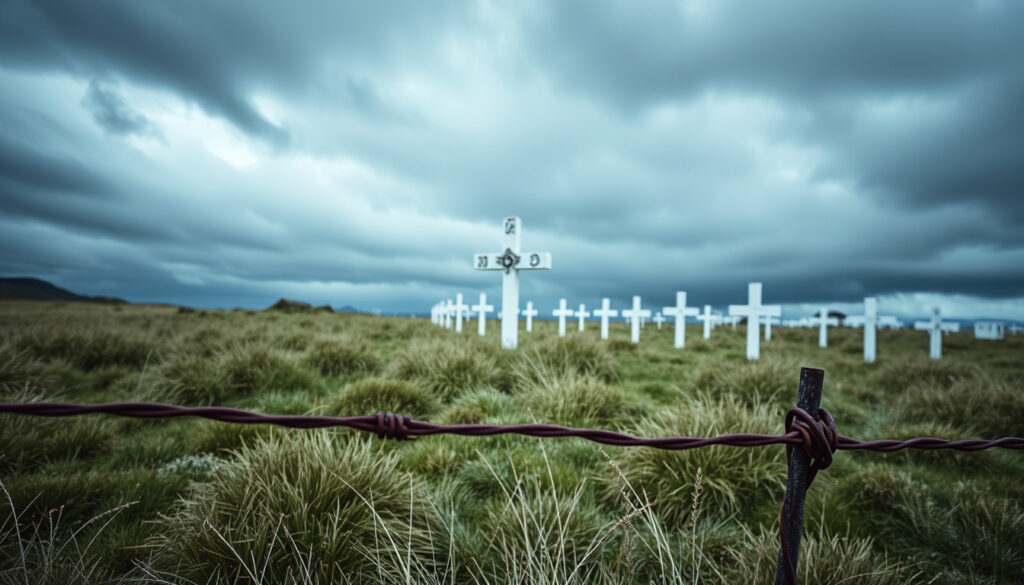
Falklands War: Causes, Timeline, Casualties & Legacy
The Falkland Islands are a remote, windswept speck on the map, but in 1982 this tiny archipelago became the stage for a brutal war that reshaped British politics and shattered Argentina’s military junta. Over 74 days, 255 British and 649 Argentine servicemen lost their lives in a conflict driven by national pride and a sovereignty dispute stretching back to the 19th century.
Duration: 74 days ·
British military deaths: 255 ·
Argentine military deaths: 649 ·
Falkland civilian deaths: 3 ·
Start date: 2 April 1982
Quick snapshot
- 255 British military deaths (Help for Heroes (UK veterans charity))
- 649 Argentine military deaths (Wikipedia (community-reviewed encyclopedia))
- British victory on 14 June 1982 (Help for Heroes (UK veterans charity))
- Exact number of Argentine aircraft shot down (estimates 70–100) (Britannica (authoritative encyclopedia))
- Role of intelligence sharing among Latin American nations remains partially classified (Britannica (authoritative encyclopedia))
- Precise figures for indirect civilian casualties (e.g., from unexploded ordnance) (Britannica (authoritative encyclopedia))
- Level of Libyan financial and military aid to Argentina remains unclear (Britannica (authoritative encyclopedia))
- Extent of Soviet intelligence passed indirectly via Cuba is partially classified (Britannica (authoritative encyclopedia))
- 2 April 1982: Argentine invasion (Help for Heroes (UK veterans charity))
- 14 June 1982: Argentine surrender (Help for Heroes (UK veterans charity))
- Argentina continues to claim sovereignty, but UK maintains control based on islander self-determination (Britannica (authoritative encyclopedia))
- Dispute persists diplomatically; no active military threat (Britannica (authoritative encyclopedia))
Six key facts, one snapshot: the war’s start and end dates, human toll, and decisive outcome.
| Fact | Value |
|---|---|
| Start date | 2 April 1982 |
| End date | 14 June 1982 |
| Duration | 74 days |
| British deaths | 255 |
| Argentine deaths | 649 |
| Result | British victory |
Why did the UK start the Falklands war?
Background of the sovereignty dispute
- Argentina claimed sovereignty over the Falklands since the early 19th century; Britain seized them in 1833 and rejected those claims (Britannica (authoritative encyclopedia)).
- A long-running sovereignty dispute and the collapse of negotiations between Britain and Argentina are cited as immediate background causes (Help for Heroes (UK veterans charity)).
- A South Georgia incident on 19 March 1982 heightened tension when Argentine scrap-metal workers raised the Argentine flag there (Help for Heroes (UK veterans charity)).
Argentine invasion of 2 April 1982
Argentina invaded the Falkland Islands on 2 April 1982, claiming sovereignty (Help for Heroes (UK veterans charity)). The military junta under Leopoldo Galtieri saw the islands as a nationalist rallying point to distract from domestic economic crises.
British political and military response
Prime Minister Margaret Thatcher viewed the invasion as an unacceptable violation of British territory. Britain dispatched a naval task force on 5 April 1982 to oppose the occupation (Wikipedia (community-reviewed encyclopedia)). Diplomatic efforts, including UN Security Council Resolution 502 passed on 3 April 1982 (Wikipedia (UN documentation)), demanded Argentine withdrawal but failed. The implication: for Britain, the principle of self-determination for the islanders outweighed the huge logistical cost of a 13,000-kilometre military campaign.
How many died in the Falkland war?
British military casualties
- 255 British servicemen died (Help for Heroes (UK veterans charity)).
- 777 British personnel were wounded (Wikipedia (community-reviewed encyclopedia)).
Argentine military casualties
- 649 Argentine military deaths (Wikipedia (community-reviewed encyclopedia)).
- 1,657 Argentine wounded (Wikipedia (community-reviewed encyclopedia)).
- Nearly half of Argentine fatalities came from the sinking of the cruiser General Belgrano on 2 May 1982, which killed 323 Argentine sailors (Apple Podcasts (military history analysis)).
Civilian casualties
Three Falkland Island civilians were killed during the conflict (Help for Heroes (UK veterans charity)). Why this matters: while the war is remembered as a military confrontation, the civilian toll underscores that even a short, remote war has direct impacts on local populations.
Why did Argentina lose the Falklands war?
Logistical and strategic disadvantages
Argentina’s air force was effective but faced long supply lines and limited munitions. The British task force, with 127 ships and 25,948 personnel (Help for Heroes (UK veterans charity)), had superior naval power and could sustain operations far from home.
Military training and equipment gaps
British forces had better training, technology, and naval power. Britain lost seven ships (Imperial War Museums (UK military history institution)), but Argentine losses were heavier. The sinking of HMS Sheffield on 4 May 1982 was the first British warship lost in 37 years (Help for Heroes (UK veterans charity)).
Diplomatic isolation
Argentina lacked allies; the US and European nations supported Britain. The United States provided intelligence and logistical support to the UK. France supplied Exocet missiles to Argentina before the war but later embargoed further sales. Most Western nations backed Britain; UN resolutions called for Argentine withdrawal (Britannica (authoritative encyclopedia)). The pattern: poor planning and underestimation of British resolve contributed to defeat.
Why did NATO not defend the Falklands?
NATO’s geographic and treaty scope
NATO’s mutual defense clause (Article 5) applies only to attacks in North America or Europe. The Falkland Islands are outside NATO’s defined area, so the alliance as a whole had no obligation to intervene (Britannica (authoritative encyclopedia)).
UK’s reliance on national forces
Britain mounted the campaign with its own military assets. Individual NATO members, notably the US, provided intelligence and logistical support to the UK, but not under NATO command.
Indirect NATO member support
France supplied Exocet missiles to Argentina prior to the conflict, then embargoed further sales under British pressure. The catch: while NATO as an organization stayed out, its key members tilted heavily toward Britain, demonstrating that alliance politics operate beyond formal treaties.
Who helped Argentina in the Falklands War?
Diplomatic support from Latin America
Peru provided aircraft and diplomatic backing. Most Latin American nations voiced support for Argentina’s sovereignty claim, but few offered material aid (Britannica (authoritative encyclopedia)).
Military equipment suppliers
Italy and France sold weapons to Argentina before the war. The Soviet Union reportedly passed intelligence indirectly via Cuba, though details remain unclear (Britannica (authoritative encyclopedia)). Libya offered financial and military aid, but limited.
International political stance
Most Western nations supported Britain; UN resolutions called for Argentine withdrawal. The trade-off for Argentina: rhetorical solidarity from non-aligned nations did not translate into effective military or economic support.
Timeline of the Falklands War
Seven key dates, one progression: from invasion to surrender in 74 days.
| Date | Event |
|---|---|
| 2 April 1982 | Argentine forces invade and occupy the Falkland Islands (Help for Heroes). |
| 3 April 1982 | UN Security Council adopts Resolution 502, demanding Argentine withdrawal (Wikipedia). |
| 5 April 1982 | British task force sets sail from Portsmouth (Wikipedia). |
| 21 May 1982 | British forces land at San Carlos Water (Britannica). |
| 28 May 1982 | Battle of Goose Green – British victory (Britannica). |
| 11 June 1982 | Battle of Mount Longdon – key Argentine defensive position taken (Britannica). |
| 14 June 1982 | Argentine forces surrender; ceasefire declared (Help for Heroes). |
What we know and what remains unclear
Confirmed facts
- 255 British military deaths (Help for Heroes)
- 649 Argentine military deaths (Wikipedia)
- 74-day duration (Britannica)
- British victory on 14 June 1982 (Help for Heroes)
- UN Resolution 502 passed on 3 April 1982 (Wikipedia)
What’s unclear
- Exact number of Argentine aircraft shot down (estimates vary between 70 and 100) (Britannica)
- Precise figures for indirect civilian casualties (e.g., from unexploded ordnance) (Britannica)
- Role of intelligence sharing among Latin American nations remains partially classified (Britannica)
- Level of Libyan financial and military aid to Argentina remains unclear (Britannica)
- Extent of Soviet intelligence passed indirectly via Cuba is partially classified (Britannica)
Voices from the conflict
Rejoice, rejoice!
— Margaret Thatcher, British Prime Minister, after the recapture of South Georgia, 25 April 1982 (Britannica)
Las Malvinas son nuestras.
— Leopoldo Galtieri, Argentine dictator, speech on 2 April 1982 declaring the islands Argentine (Britannica)
They came with overwhelming force. There was nothing we could do.
— Rex Hunt, British Governor of the Falkland Islands, describing the Argentine invasion (Britannica)
The Falklands War lasted just 74 days, but its consequences echo decades later. For Argentina, the defeat toppled the military junta, leading to democratic elections in 1983. For the United Kingdom, the victory bolstered Margaret Thatcher’s government and cemented a policy that the islanders’ right to self-determination trumps Buenos Aires’ territorial claims. For the islanders themselves, the legacy is a permanent British military presence and an economy now buoyed by oil exploration—but still, a sovereignty dispute that remains unresolved.
Frequently asked questions
What was the Falklands War?
The Falklands War was an undeclared conflict between Argentina and the United Kingdom in 1982 over the Falkland Islands (Islas Malvinas) and associated dependencies (Britannica).
Who won the Falklands War?
The United Kingdom won the war; Argentine forces surrendered on 14 June 1982 (Help for Heroes).
How long did the Falklands War last?
The conflict lasted 74 days, from 2 April to 14 June 1982 (Britannica).
What were the main battles of the Falklands War?
Key battles include the San Carlos landings (21 May), Battle of Goose Green (28 May), and Battle of Mount Longdon (11 June) (Britannica).
What is the current status of the Falkland Islands?
The Falkland Islands remain a British Overseas Territory; the UK maintains military forces there. Argentina continues to claim sovereignty, but islanders voted overwhelmingly to remain British in a 2013 referendum (Britannica).
How did the Falklands War affect Argentina?
The defeat discredited the military junta, leading to its collapse and the restoration of democracy in 1983 (Britannica).
Why is the Falklands War significant in military history?
It demonstrated the effectiveness of naval task force operations over long distances, the vulnerability of modern warships to air attacks, and the role of air power in a maritime conflict (Imperial War Museums).
More related posts
 Kevin Jonas: Net Worth, Family, and Hiatus Loss
 Ruby Franke: Latest Verified Information and Case Timeline (2025)
 Ercan Ramadan Biography: Age, Net Worth, Wife, and More
 Jey Uso: Biography, Age, Wife, Kids, and WWE Career
 High Schooler: Definition, Age Range, and Spelling Guide
 French Presidents: Full List and Macron’s Personal Life
 Marvin Humes: JLS Star to Radio Host & Family Man
 Busta Rhymes: Fastest Rapper? Net Worth, Legal & Health
