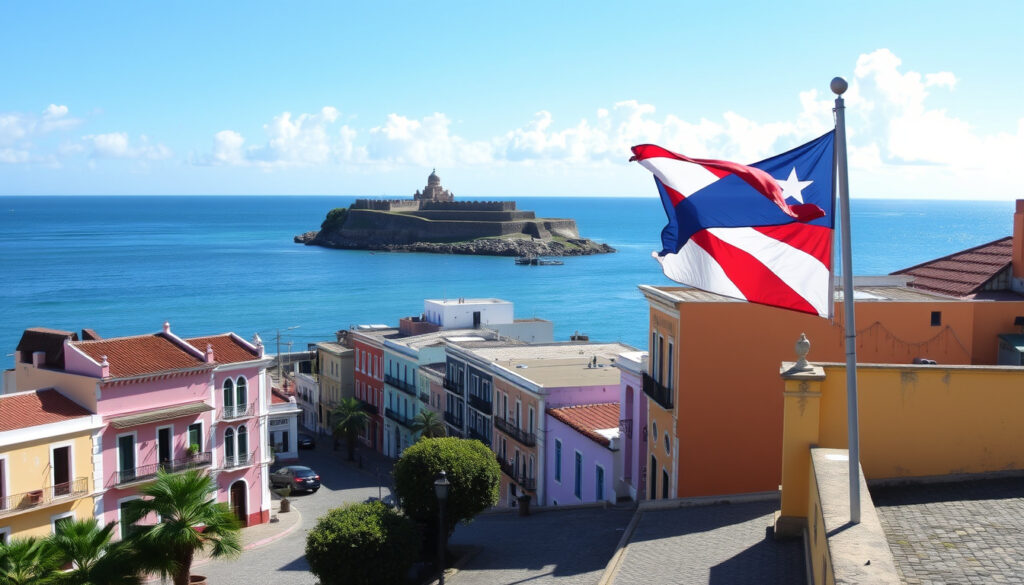
Puerto Rico: US Territory, Citizenship, Travel & Living Guide
There’s a Caribbean island that’s part of the United States but not a state — Puerto Rico — where you can sip a piña colada under the same flag as the mainland yet need a different mindset about taxes and voting. Its 3.2 million residents are American citizens by birth, though they face a set of rules that often surprise visitors and would-be movers.
Population: ~3.2 million ·
Capital: San Juan ·
Status: Unincorporated U.S. territory ·
Currency: U.S. Dollar ·
Official languages: Spanish, English ·
Area: 3,515 sq mi
Quick snapshot
- Puerto Rico is an unincorporated territory of the United States (Connecticut General Assembly (legislative research))
- Puerto Ricans have been U.S. citizens since 1917 (NBC News)
- U.S. citizens can move to Puerto Rico without a visa (USA.gov (federal government travel portal))
- Whether Puerto Rico will ever become a state, an independent nation, or remain a territory is unresolved (Forum Together (analysis))
- The long-term effects of Act 60 tax incentives on population growth are still being studied (Creative Planning (international wealth advisory))
- 1898: Puerto Rico ceded to the United States after the Spanish–American War (Connecticut General Assembly (legislative research))
- Non-binding statehood referendum in 2020 showed 52% in favor; further congressional action remains uncertain (PRelocate Guidebook (relocation guide))
Eight key facts at a glance, with one pattern: nearly every aspect of Puerto Rico — from its official name to its time zone — reflects its in-between status as a U.S. territory with its own local government.
| Label | Value |
|---|---|
| Official Name | Commonwealth of Puerto Rico |
| Capital | San Juan |
| Population (2024 est.) | 3.2 million |
| Area | 3,515 sq mi (9,104 km²) |
| Currency | U.S. Dollar (USD) |
| Official Languages | Spanish, English |
| Time Zone | Atlantic Standard Time (AST, UTC−4), no DST |
| Drives on the | Right |
Is Puerto Rico part of the USA?
What is the political status of Puerto Rico?
- Puerto Rico is an unincorporated territory of the United States, meaning it belongs to the U.S. but is not a state (Forum Together (analysis)).
- It operates under its own constitution ratified in 1952, with a locally elected governor and legislature (Discover Puerto Rico (official tourism site)).
- The U.S. Congress retains ultimate authority over the territory, including its legal system and foreign affairs (Creative Planning (international wealth advisory)).
Is Donald Trump the president of Puerto Rico?
The U.S. President is the head of state for Puerto Rico — just as for any state — but does not directly govern the island. Puerto Rico has its own elected governor and executive branch. The president appoints a small number of federal officials, but day-to-day governance is local (PRelocate Guidebook (relocation guide)).
Puerto Rico’s locally elected governor outranks any presidential appointee on the island, but the territory’s laws can still be overridden by Congress — a tension that doesn’t exist for 50 states.
The implication: Puerto Rico’s local governance coexists with federal oversight, a unique arrangement in the U.S. system.
Are Puerto Ricans US citizens?
Yes, since the Jones–Shafroth Act of 1917, anyone born in Puerto Rico is a U.S. citizen. They can obtain U.S. passports, live in any state, and work for the federal government. However, unless they reside in a state, they cannot vote in presidential elections or elect voting members of Congress (Remitly (travel resource)).
The implication: Puerto Ricans have the obligations of citizenship (including military service) but lack full representation at the federal level — a distinction that continues to fuel debate about the island’s status.
Are Puerto Ricans US citizens?
Do Puerto Ricans have U.S. passports?
Puerto Ricans are U.S. citizens, so they can apply for and hold a U.S. passport. Travel between Puerto Rico and the mainland is domestic; no passport is required for U.S. citizens when flying directly from within the United States (Holland & Knight (law firm analysis)).
Can Puerto Ricans vote in U.S. presidential elections?
Only if they establish residency in a state or Washington, D.C. Those living on the island cannot vote for president because they are not in a state. However, they participate in party primaries to choose delegates (Forbes (business magazine)).
The catch: citizenship does not guarantee full voting rights for residents of the territory.
Is Puerto Rico in which country?
Is Puerto Rico in the Caribbean?
Geographically, Puerto Rico is located in the northeastern Caribbean Sea, east of the Dominican Republic and west of the U.S. Virgin Islands. It is part of the Greater Antilles archipelago (Connecticut General Assembly (legislative research)).
What country owns Puerto Rico?
Puerto Rico is not owned by another country in the usual sense; it is an unincorporated territory of the United States. This means it is under U.S. sovereignty but is not a state. It is often described as a commonwealth, a term that acknowledges its local self-government within the U.S. legal framework (USA.gov (federal government travel portal)).
The catch: no other country has a claim to Puerto Rico, but its residents cannot vote for the head of state who ultimately represents them — a quirk of the U.S. territorial system.
What is Puerto Rico best known for?
What are the top tourist attractions in Puerto Rico?
- El Yunque National Forest — the only tropical rainforest in the U.S. National Forest System (Discover Puerto Rico (official tourism site))
- Old San Juan with its 500-year-old fortresses and cobblestone streets
- Beaches like Flamenco Beach (Culebra) and Luquillo Beach
What is Puerto Rico famous for in terms of food?
Puerto Rican cuisine blends Spanish, African, and Taíno influences. Signature dishes include mofongo (mashed plantains with garlic and pork), arroz con gandules (rice with pigeon peas), and pernil (slow-roasted pork shoulder). The national drink is the piña colada, said to have been invented in San Juan (Discover Puerto Rico (official tourism site)).
What is the culture of Puerto Rico like?
Music is central: salsa, reggaeton, and bomba y plena all have roots on the island. Spanish is the primary language, but English is widely spoken. The culture is a vibrant mix of indigenous, African, and Spanish heritage celebrated in festivals like the San Sebastián Street Festival.
Puerto Rico’s cultural exports — from reggaeton to mofongo — have shaped global trends, yet many Americans can’t name a single Puerto Rican artist or dish. The gap between recognition and ignorance mirrors the island’s political invisibility.
What this means: Puerto Rico’s cultural exports are globally influential, yet often overlooked in mainstream American awareness.
Who is the only billionaire in Puerto Rico?
Who is Orlando Bravo?
Orlando Bravo is a private equity investor and the founder of Thoma Bravo, one of the largest software-focused investment firms in the world. According to Forbes, he is the only billionaire residing in Puerto Rico, with a net worth estimated above $2 billion.
How did Orlando Bravo become a billionaire?
Bravo built Thoma Bravo from a small buyout shop into a firm that manages more than $130 billion in assets. He moved to Puerto Rico and has been a vocal advocate for the island’s tax incentives under Act 60, which allows new residents to pay reduced territorial taxes on certain income (Holland & Knight (law firm analysis)).
The pattern: high-net-worth individuals benefit from local tax incentives, but the average resident does not see the same advantages.
Can an American go live in Puerto Rico?
What documents are needed to move to Puerto Rico?
U.S. citizens need only a valid state-issued driver’s license or passport to enter. No visa, no passport for travel, and no special permits are required. Once there, you need proof of residency — such as a lease or utility bill — to get a local ID and register for taxes (USA.gov (federal government travel portal)).
Do I need a visa to live in Puerto Rico?
No. U.S. citizens and lawful permanent residents can move to Puerto Rico as easily as moving to another state. For non-U.S. citizens, standard U.S. immigration rules apply — they need a visa or green card to enter, because Puerto Rico is a U.S. jurisdiction (USA.gov (federal government travel portal)).
What are the tax implications of moving to Puerto Rico?
Puerto Rico has its own tax system separate from the U.S. federal income tax. Residents generally pay local taxes on Puerto Rico-source income, not U.S. federal tax. Act 60 offers generous exemptions on capital gains, passive income, and certain business profits for qualifying new residents who meet strict physical presence rules (Holland & Knight (law firm analysis)). However, the IRS requires anyone moving to a territory with worldwide income over $75,000 in the year of the move to file Form 8898 (IRS official form).
The trade-off: lower taxes come with reduced federal voting power and potential complexities around Social Security and Medicare portability. For most Americans, the decision is a lifestyle bet as much as a financial one.
Confirmed facts
What’s unclear
- The exact future status of Puerto Rico (statehood, independence, or continuation) remains unresolved
- The long-term population impact of Act 60 tax incentives is still being researched
- Whether passport rules apply in all scenarios for non-citizens is nuanced and case-dependent (USA.gov)
“U.S. citizens and permanent residents do not need a passport to travel to Puerto Rico.”
— USA.gov (federal government travel portal)
“Puerto Ricans are U.S. citizens and can freely travel and move between Puerto Rico and the 50 states.”
— NBC News (journalistic source)
“Whether a passport is needed to travel to or from a U.S. territory depends on the destination and the traveler’s citizenship status.”
— USA.gov (federal government travel portal)
For an American considering a move to Puerto Rico, the choice hinges on whether the tax benefits outweigh the loss of federal voting rights and the need to navigate a distinct local bureaucracy. The trade-off means an American must weigh financial advantages against political representation.
Frequently asked questions
Do Puerto Ricans pay U.S. federal taxes?
Most residents pay local income tax to Puerto Rico rather than U.S. federal income tax on Puerto Rico-source income. However, they still pay Social Security and Medicare taxes. Federal employees and those with mainland income may owe U.S. taxes.
Does Puerto Rico have its own Olympic team?
Yes. Puerto Rico competes as a separate national Olympic committee and has won medals in boxing, tennis, and athletics.
What is the most popular sport in Puerto Rico?
Baseball is by far the most popular sport. The island has produced dozens of Major League Baseball stars, including Roberto Clemente and Francisco Lindor.
What is the national dish of Puerto Rico?
Arroz con gandules (rice with pigeon peas) is widely considered the national dish, often served with pernil or lechón asado.
Is Puerto Rico a safe place to visit?
Tourist areas like Old San Juan, Isla Verde, and Rincón are generally safe. Petty crime can occur, but violent crime against tourists is rare. The island’s overall crime rate has declined in recent years.
What is the weather like in Puerto Rico year-round?
Tropical: average temperatures stay between 75°F (24°C) and 85°F (29°C). Rain is common, especially May through November, which is also hurricane season.
More related posts
 Jade Little Mix: Verified Facts on Relationships & More
 Gangnam Style Meaning, Release Year, and Global Impact
 Cast of The Patriot (2000) – Actors & Characters List
 Tasha Ghouri: Deafness, Cochlear Implant, Love Island & Strictly
 Dmitri Shostakovich: Life, Works, Illness & Controversy
 Max Branning: Full Guide to His Affairs, Children & 2025 Return
 Coral Reef Guide: From the Great Barrier Reef to Ireland’s Depths
