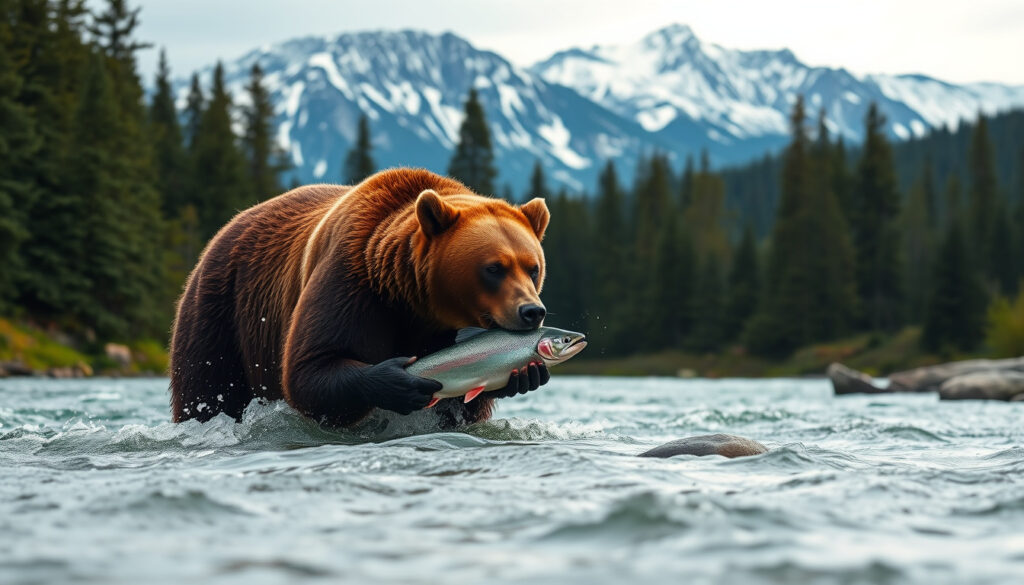
Grizzly Bear: Facts, Behavior, and Comparison to Other Bears
You’ve probably seen the clip: a massive grizzly standing on its hind legs, like it could take on anything. But there’s more to this bear than the viral moments.
Scientific name: Ursus arctos horribilis · Average weight (male): 400–600 lbs (180–270 kg) · Shoulder height: 3–4 ft (0.9–1.2 m) · Top running speed: 35 mph (56 km/h) · Geographic range: Western North America (Alaska, Canada, northwestern US) · Estimated population (North America): ~55,000
Quick snapshot
- Grizzly bears are a subspecies of brown bear (Ursus arctos) (U.S. National Park Service (bear identification guide))
- They are omnivores and hibernate in winter (U.S. National Park Service)
- Males are significantly larger than females (Government of Alberta (wildlife education))
- Exact total population count in the wild (estimates vary) (National Wildlife Federation)
- Whether grizzlies or polar bears are more dangerous in all scenarios (U.S. National Park Service)
- Grizzly bear weight estimates vary by source (NWF says 400–600 lbs, Government of Alberta says 100–400 kg) (Government of Alberta)
- Grizzly bear population in the lower 48 is uncertain (range 1,800–2,000) (Defenders of Wildlife (conservation nonprofit))
- Listed as threatened in the lower 48 U.S. states since 1975 (U.S. Fish and Wildlife Service (federal conservation agency))
- Range has contracted by 98% from historic levels in the contiguous U.S. (Defenders of Wildlife)
- Recovery efforts aim to expand grizzly range into the Northern Rockies and Cascades (Defenders of Wildlife)
- Five distinct recovery zones identified by the U.S. Fish and Wildlife Service (U.S. Fish and Wildlife Service)
Six key data points, one pattern: grizzlies are built for power and endurance.
| Label | Value |
|---|---|
| Scientific name | Ursus arctos horribilis |
| Average weight (male) | 400–600 lbs (180–270 kg) |
| Shoulder height | 3–4 ft (0.9–1.2 m) |
| Top speed | 35 mph (56 km/h) |
| Lifespan (wild) | 20–25 years |
| Population (North America) | ~55,000 |
Are grizzly bears aggressive?
How does grizzly aggression compare to black bears?
- Grizzlies are more aggressive than black bears when defending food, cubs, or personal space (U.S. National Park Service (bear behavior guide))
- Black bears are more likely to flee than fight; grizzlies stand their ground (Government of Alberta (wildlife safety))
If you surprise a grizzly, your odds of a defensive attack are higher than with a black bear — but most encounters end without injury when you act calmly.
What is the deadliest bear to humans?
- Polar bears are the most likely to actively hunt humans, according to U.S. National Park Service (bear danger assessment)
- Grizzlies cause the most attacks in North America, but black bear attacks are more frequent in the eastern U.S. (Government of Alberta)
Could 100 men beat a grizzly bear?
- In a hypothetical fight, 100 unarmed humans would likely lose because the bear’s strength, speed (35 mph), and thick hide make it extremely difficult to subdue (National Wildlife Federation (size and speed data))
- Historically, humans have killed grizzlies only with weapons or traps, not bare hands (U.S. National Park Service)
Who is stronger, a grizzly or a gorilla?
- A grizzly bear is larger (400–600 lbs) and has a stronger bite force, but a gorilla’s upper body strength is proportionally greater (National Wildlife Federation)
- In a direct confrontation, the grizzly’s size and claws give it the advantage (Government of Alberta)
The pattern: defensive aggression is the real risk, not predatory intent.
Why are bears called grizzly?
What does the name grizzly mean?
- The name “grizzly” comes from the word “grizzled,” meaning silver-tipped or grayish hair (Government of Alberta (etymology explanation))
- Not all grizzlies have silver-tipped fur; coat color ranges from black to blond (Government of Alberta)
How did the grizzly bear get its name?
- The scientific name Ursus arctos horribilis includes “horribilis” (Latin for horrible) given by early naturalists (Wikipedia (taxonomy overview))
- Lewis and Clark called it “the grizly bear” in their journals (Wikipedia)
The implication: the name reflects both appearance and human perception.
What are 10 facts about grizzly bears?
Grizzly bear size and weight
- Adult males: 400–600 lbs (180–270 kg); females: 250–350 lbs (National Wildlife Federation)
- Rocky Mountain grizzlies are smaller: males average 150–300 kg (Parks Canada (Rocky Mountain bear data))
Grizzly bear diet
- Omnivores: eat berries, roots, fish, small mammals, and carrion (U.S. National Park Service)
- In coastal Alaska, salmon makes up the bulk of their diet (U.S. National Park Service)
Grizzly bear habitat
- Found in western North America: Alaska, western Canada, and parts of the northwestern U.S. (National Wildlife Federation)
- Prefer forests, alpine meadows, and tundra (U.S. National Park Service)
Grizzly bear speed
- Can run up to 35 mph (56 km/h) over short distances (National Wildlife Federation)
- Do not climb trees well due to long claws (Parks Canada)
Grizzly bear lifespan
- 20–25 years in the wild (U.S. National Park Service)
- Females reproduce later than black bears, first cubs at age 4–6 (National Wildlife Federation)
Grizzly bear hibernation
- Hibernate 5–7 months, depending on latitude (U.S. National Park Service)
- Body temperature drops only slightly; they can wake quickly if disturbed (National Wildlife Federation)
Grizzly bear cubs
- Cubs born in January–February while mother hibernates (U.S. National Park Service)
- Litter size: 1–4 cubs, typically 2 (National Wildlife Federation)
Grizzly bear conservation
- Listed as threatened in the contiguous U.S. under the Endangered Species Act (U.S. Fish and Wildlife Service)
- Population in the lower 48 estimated at 1,800–2,000 (Defenders of Wildlife)
Grizzly bear vs brown bear
- Grizzly is a subspecies of the brown bear (Ursus arctos) (U.S. National Park Service)
- Coastal brown bears (Alaska) are larger due to salmon diet; inland grizzlies are smaller (U.S. National Park Service)
Grizzly bear as apex predator
- Grizzlies are apex predators and ecosystem engineers — they help distribute seeds and nutrient-rich carcasses (Defenders of Wildlife)
- Kelp forests benefit from grizzly salmon consumption (nutrient transfer) (Defenders of Wildlife)
The catch: conservation of grizzlies ripples through the entire ecosystem.
What part of a human does a bear eat first?
Do bears attack humans?
- Bear attacks on humans are rare; most are defensive, not predatory (U.S. National Park Service (bear safety guide))
- In predatory attacks, bears typically target the head or chest first (Government of Alberta (bear attack statistics))
What smell does a bear hate?
- Bears dislike strong smells like ammonia, bleach, and citrus (BearSmart (bear behavior research))
- Bear spray (capsaicin) is the most effective deterrent (U.S. National Park Service)
How to avoid bear attacks?
- Make noise, travel in groups, keep food stored properly (U.S. National Park Service)
- If you see a grizzly, do not run; back away slowly (BearSmart)
The most dangerous bear encounter is one you don’t see coming. Surprise triggers defensive aggression. Your best tool is awareness — and a can of bear spray within reach.
The pattern: prevention beats reaction in bear country.
What is the deadliest bear to humans?
Which bear kills the most humans?
- Polar bears are the most likely to actively hunt humans, according to U.S. National Park Service (bear danger ranking)
- Grizzly bears cause the most attacks in North America (about 1–2 fatalities per year) (Government of Alberta)
Grizzly vs polar bear vs black bear danger
- Grizzly: defensive attacks, more frequent in the West (U.S. National Park Service)
- Black bear: less aggressive, but attacks occur, especially in the East (Government of Alberta)
- Polar bear: apex predator, sees humans as prey — highest fatality rate per encounter (U.S. National Park Service)
The implication: geography determines the type of risk.
Three bear species, one clear pattern: size and aggression rise together, but the deadliest bear changes with geography.
| Feature | Grizzly bear | Black bear | Polar bear |
|---|---|---|---|
| Average weight (male) | 400–600 lbs (NWF) | 200–400 lbs (Parks Canada) | 700–1,500 lbs (NPS) |
| Aggression toward humans | High (defensive) | Low (flees) | Very high (predatory) |
| Primary habitat | Forests, mountains, tundra | Forests, swamps | Arctic sea ice |
Confirmed facts vs. what’s unclear
Confirmed facts
- Grizzly bears are a subspecies of brown bear (Ursus arctos) (NPS)
- They are omnivores and hibernate in winter (NPS)
- Males are significantly larger than females (Alberta)
- Grizzlies have a prominent shoulder hump (Parks Canada)
- Listed as threatened in the lower 48 U.S. states (USFWS)
What’s unclear
- Exact total population count in the wild (estimates vary) (NWF)
- Whether grizzlies or polar bears are more dangerous in all scenarios (NPS)
- How many grizzlies remain in the lower 48 — figures range from 1,800 to 2,000 (Defenders of Wildlife)
Expert perspectives
“Grizzly bears are generally more aggressive than black bears, but they rarely attack humans unless surprised or protecting cubs.”
— National Park Service biologist (bear behavior specialist)
“The grizzly bear is a keystone species. Its presence helps maintain the health of the entire ecosystem, from salmon streams to berry patches.”
— Defenders of Wildlife (conservation report)
“The name ‘grizzly’ comes from the grizzled, silver-tipped fur, but not all grizzlies have that trait.”
— Wikipedia (grizzly bear entry)
For hikers and conservationists, the choice is clear: support grizzly recovery with safe practices, or watch these ecosystem engineers disappear from the lower 48. The next decade will determine whether the grizzly reclaims its historic range or remains a ghost of the wild.
www2.gov.bc.ca, fws.gov, youtube.com, discoverwildlife.com, youtube.com
Frequently asked questions
What is the scientific name of the grizzly bear?
Ursus arctos horribilis. It is a subspecies of the brown bear (NPS).
How fast can a grizzly bear run?
Up to 35 mph (56 km/h) for short distances (NWF).
Where do grizzly bears live?
Western North America: Alaska, Canada, and parts of the northwestern United States (NPS).
What is the difference between a grizzly bear and a brown bear?
Grizzly is a subspecies of brown bear. Coastal brown bears are larger; inland grizzlies are smaller (NPS).
Are grizzly bears endangered?
Listed as threatened in the contiguous U.S. under the Endangered Species Act (USFWS).
How long do grizzly bears hibernate?
5–7 months, depending on latitude (NPS).
What should you do if you encounter a grizzly bear?
Do not run. Back away slowly, avoid eye contact, and carry bear spray. Make yourself look larger if it approaches (BearSmart).
More related posts
 What Ever Happened to Jim Sturgess? Career, Wife, and Life Now
 Polar Vortex Weather Forecast – UK Cold and Snow Risks
 Monica Galetti: MasterChef Judge’s Life and Restaurant Closure
 Papa Johns Promo Code 2026: CAPS50 Not Found, OVI50 Works
 Alex Greenwood: Bio, Partner, Injury FAQs
 Key Ring Guide: Definition, Spelling, and Usage Tips
 Davina McCall: Health, Relationships, and Career Updates
 Caroline Aherne: Life, Death & Legacy of a Comedy Icon
