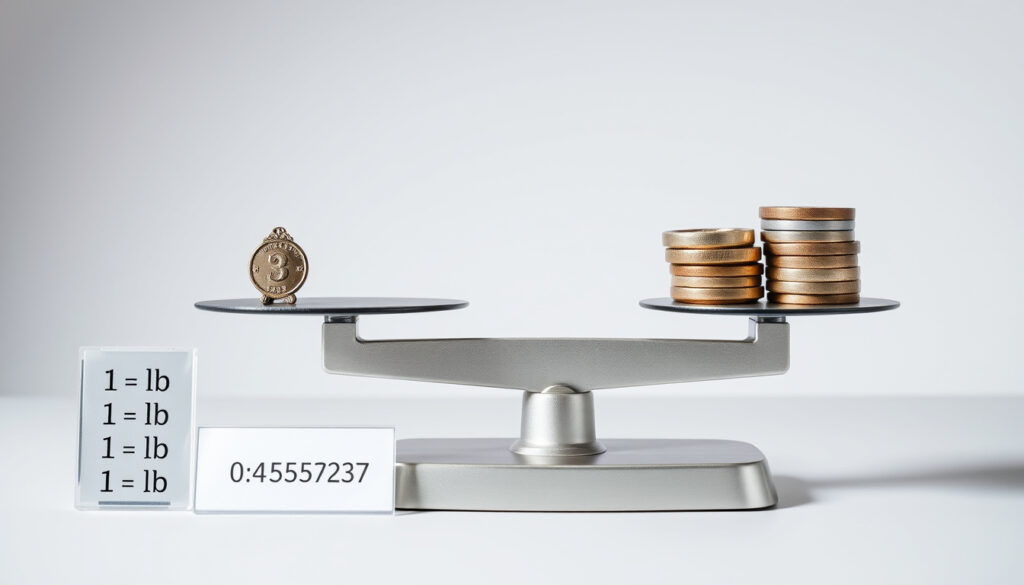
1 Pound in KG: 0.45359237 kg Exact Converter + Table
Most people have heard that a pound is roughly half a kilogram. Package shippers, gym-goers, and recipe users alike tend to lean on that mental shortcut — and it usually works fine. Except when it doesn’t: a 10% gap between 0.5 and 0.45359237 kg adds up fast in shipping charges, powerlifting totals, and medical dosages. This guide gives you the exact number, walks you through the math, and tackles the myths that lead people astray.
1 lb: 0.45359237 kg · 2 lb: 0.90718474 kg · 5 lb: 2.26796185 kg · 10 lb: 4.5359237 kg · Exact factor: 1 lb = 0.45359237 kg
Quick snapshot
- 1 avoirdupois pound = exactly 0.45359237 kg (RapidTables)
- 1 kilogram = exactly 2.20462262185 lb (RapidTables)
- 1 lb = 453.59237 grams exactly (Calculator Soup)
- No major ambiguities remain for avoirdupois pound conversions used in commerce and fitness
- Troy pound (used for precious metals) has a different value and falls outside this article’s scope
- The exact ratio stays locked; no future change to the 0.45359237 factor is anticipated
- More digital calculators and smart scale apps will likely expose users to the precise factor over the rounded 0.45 or 0.5 approximations
The table below consolidates the core conversion values that appear throughout this guide.
| Label | Value |
|---|---|
| Definition | 1 lb = exactly 0.45359237 kg (international avoirdupois) |
| 1 kg | 2.20462262185 lb |
| 500 g | 1.10231131092 lb |
| Precision | Use 6 decimals for accuracy |
How much does 1 lb weigh in kg?
One avoirdupois pound is defined as exactly 0.45359237 kilograms. This is not an approximation — it is the internationally agreed ratio that any reliable conversion tool uses under the hood.
Exact value
The exact figure is 0.45359237 kg. You can verify this on the RapidTables (conversion reference tool) or in the NIST SI Brochure (official U.S. conversion factor publication). Eight decimal places are standard in technical work; rounding to fewer digits is where errors creep in.
Conversion formula
To convert any weight from pounds to kilograms, multiply by 0.45359237:
kilograms = pounds × 0.45359237
Working backwards, divide by 0.45359237 or multiply by 2.20462262185 to go from kilograms to pounds.
Quick calculator steps
- Take your weight in pounds
- Multiply by 0.45359237
- Result is your weight in kilograms
Is 1 pound equal to 1 kg?
No. One pound is less than half a kilogram — not equal to it. This is one of the most persistent conversion errors, and it matters most when precision counts.
Common misconception
The belief that 1 lb ≈ 1 kg likely stems from rounding both numbers for quick mental math. In reality, 1 kg equals 2.20462262185 pounds, meaning the pound is a smaller unit. One pound is only about 45% of a kilogram.
Treat 0.5 as a rough estimate only. For anything beyond casual weight monitoring, the exact factor 0.45359237 avoids compounding errors over multiple conversions.
Actual difference
The gap between 0.5 and 0.45359237 is 0.04640363 — roughly a 9% underestimate each time you use the shortcut. Calculator Soup (conversion reference with myth explanations) highlights this exact discrepancy as a common source of error in fitness and logistics contexts.
Is 1 pound 0.5 kg?
This is arguably the most widespread rounding shortcut — and it is wrong by about 10%. The exact value, 0.45359237 kg, is consistently lower than 0.5 kg, and that difference accumulates quickly in recipes, shipments, and gym calculations.
Why people think so
Teachers, apps, and online calculators often round to two or three decimal places. A value of 0.45359237 rounds to 0.45 on a two-decimal display, and many learners mentally bump it to 0.5 for convenience — a shortcut so common that it has become folk wisdom in gym culture and kitchen cooking.
Precise calculation
1 lb = 0.45359237 kg is the fixed, internationally agreed value. For practical use, a six-decimal figure (0.453592 kg) strikes a balance between precision and readability. Anything rounder introduces measurable error.
A 10 lb kettlebell is not “5 kg” — it is 4.54 kg. Using 0.5 as your shortcut underestimates the weight by roughly 0.46 kg, which can shift powerlifting load categories or cause shipping cost disputes.
Is 2 pounds equal to 1 kg?
No. Two pounds equals 0.90718474 kg, which is about 10% less than a full kilogram. This myth likely survives because 2.2 lb ≈ 1 kg is a commonly taught approximation — and some people round down from 2.2 to 2.
Rough approximation
The approximation 2.2 lb ≈ 1 kg is useful for quick estimates, but 2.2 is already slightly rounded up from the exact 2.20462262185. Dropping the decimal to “2 pounds = 1 kg” compounds that error and overshoots in the wrong direction.
Exact value
2 lb = 0.90718474 kg exactly. The RapidTables (conversion reference tool) provides a full table showing precise conversions from 1 to 100 lb using the exact factor.
Is 500g the same as 1 lb?
No. Half a kilogram (500 g) equals 1.10231131092 lb — about 10% more than a single pound. The confusion arises because 500 g and 1 lb are close in everyday use, but they are not interchangeable.
Grams to pounds
To convert grams to pounds, divide by 453.59237. For quick mental math, note that 450 g ≈ 1 lb and 500 g ≈ 1.1 lb — a distinction that matters when weighing food portions or package labels.
500g conversion
500 g = 1.10231131092 lb. This means a 500 g bag of flour is slightly heavier than a 1 lb bag — and if a recipe calls for “1 lb flour” but you buy a 500 g bag in a metric country, you are about 46 grams short. Calculator Soup (conversion reference with practical examples) breaks down this exact scenario.
Home cooks substituting a 500 g bag for a 1 lb call will fall short by roughly 46 grams — enough to affect texture in sensitive recipes like certain pastries or bread.
Step-by-step conversion guide
Whether you are converting a single weight or building a personal reference table, the process is the same. Follow these steps to convert any pound value to kilograms using the exact factor.
Step 1: Identify your pound value
Write down the weight in pounds you need to convert. For whole numbers or common gym weights like 5, 10, 15, or 25 lb, the multiplication is straightforward — and you can use the table below for quick reference.
Step 2: Multiply by 0.45359237
Apply the exact conversion factor. For example, 5 lb × 0.45359237 = 2.26796185 kg. Using a calculator or spreadsheet avoids rounding errors from manual arithmetic.
Step 3: Round to your desired precision
Six decimal places (0.453592) is sufficient for most practical uses. Two decimal places (0.45) works only for rough estimates — never for recipes, medical contexts, or competitive sports where small errors compound.
Step 4: Verify with a trusted tool
Cross-check your result against the RapidTables (conversion reference tool) or the NIST SI Brochure (official U.S. conversion factor publication) to confirm your calculation. Competitive weightlifting conversions published by USA Powerlifting (official competition conversion chart) also provide reliable benchmarks.
The conversion table below puts the formula into practice for common weight increments.
| Pounds (lb) | Kilograms (kg) |
|---|---|
| 1 | 0.45359237 |
| 2 | 0.90718474 |
| 3 | 1.36077711 |
| 4 | 1.81436948 |
| 5 | 2.26796185 |
| 8 | 3.62873896 |
| 10 | 4.53592370 |
| 15 | 6.80388555 |
| 20 | 9.07184740 |
| 25 | 11.33980925 |
| 55 | 24.94758035 |
| 100 | 45.35923700 |
Fourteen common conversions, one consistent pattern: multiply by 0.45359237 to get the exact kilogram value.
Historical context and why the ratio matters
The kilogram was originally defined as the mass of one cubic decimeter of water. By 1875, the Metric Convention replaced that prototype with a physical artifact — the International Prototype Kilogram (IPK) — housed at the International Bureau of Weights and Measures. The NIST (U.S. national metrology institute) maintains the U.S. copy of this standard.
In 2019, the kilogram was redefined via the Planck constant, moving from a physical artifact to a quantum constant. The avoirdupois pound-to-kilogram ratio, however, remained fixed by international agreement — no conversion factor changed as a result of the redefinition.
The avoirdupois pound itself traces back to the Roman libra. It was standardized within the imperial system as exactly 16 ounces, with 1 ounce equaling 28.349523125 grams — and 16 × 28.349523125 = 453.59237, which reconciles with the kilogram definition. The Wikipedia (metric system history timeline) covers this evolution in detail.
The 0.45359237 ratio is not going anywhere. No future redefinition of the kilogram will alter how many kilograms a pound weighs — the number is locked by international convention.
“1 pound (lb) is defined as exactly 0.45359237 kilograms (kg)”
“The kilogram (kg) is defined by taking the fixed numerical value of the Planck constant h to be 6.62607015 ×10⁻³⁴”
Related reading: 200 cm in feet · 325 F to C
indextap.com, workybooks.com, youtube.com, tdiinternational.com, youtube.com, en.wikipedia.org, legionathletics.com
The precise 1959 conversion factor of 0.45359237 kg per pound is explored in depth within exact 1 lb to kg guide, offering complementary tables and applications.
Frequently asked questions
What is 4 pounds in kg?
4 lb = 1.81436948 kg. Multiply 4 by 0.45359237 to get the exact value.
How many pounds in 1 kg?
1 kg = 2.20462262185 lb. Use the inverse factor (2.20462262185) or divide by 0.45359237.
What is 10 lbs to kg?
10 lb = 4.5359237 kg. This is a commonly used benchmark for gym plates, dumbbells, and small parcels.
Is 500g equal to 0.5 kg?
Yes, 500 g = 0.5 kg by definition. However, 0.5 kg ≠ 1 lb — it is about 10% more (1.10231131092 lb).
How to convert lbs to kg manually?
Multiply your weight in pounds by 0.45359237. For example: 15 lb × 0.45359237 = 6.80388555 kg.
What is 5 pounds in kg?
5 lb = 2.26796185 kg. A 5 lb dumbbell is slightly over 2 kg — useful to know when buying metric-weight gym equipment.
What is 3 pounds in kg?
3 lb = 1.36077711 kg. A 3 lb bag of sugar is roughly 1.36 kg.
What is 15 pounds in kg?
15 lb = 6.80388555 kg. Competitive weightlifters often track their barbell loads in both systems; the USA Powerlifting (official competition conversion chart) provides precise benchmarks for each load class.
For home cooks, the takeaway is simple: never substitute 1 lb flour with a 500 g bag and expect identical results. For gym-goers, a 20 kg plate is 44.09 lb — not 40 lb. And for anyone shipping internationally, the difference between 0.5 and 0.45359237 adds up fast when you are paying by the kilogram.
More related posts
 Patrick Dorgu: Salary, Parents, Injury & Nationality Facts
 Neal McDonough: Sobriety, Refusal to Kiss & Career
 Is State Pension Age 66 or 67 – UK Timetable and Calculator Guide
 Booster Seat Age Requirements in Ireland – Guide & Safety Tips
 Kevin Sinfield: Knighthood, Fundraising, Family & Rugby Career
 Kara Tointon: Double Mastectomy, Relationships and Family
 Wolf Man (2025 Film) – Release Date, Cast and Plot Guide
 What Does Niacinamide Do – Skin Benefits and Acne Relief
