Coral Reef Guide: From the Great Barrier Reef to Ireland’s Depths
You’ve probably seen the postcard-perfect image of a coral reef: turquoise water, colourful fish, endless sun. But there’s a whole other world of reefs hiding in the cold, dark waters off the coast of Ireland — and they’re just as fascinating, if far less visited.
Global coral reef area: ~284,300 km² · Reef-building coral species: 800+ · Great Barrier Reef length: 2,300 km · Cold-water coral depth range: 50–3,000 m · Annual economic value: $375 billion
Quick snapshot
- Underwater ecosystem built by coral polyps (NPWS – Irish government habitat authority)
- Hermatypic corals secrete calcium carbonate (NOAA Coral Reef Watch)
- Two main types: warm-water and cold-water (NPWS)
- Tropical reefs in shallow, warm waters (NOAA Coral Reef Watch)
- Cold-water reefs in deep ocean (e.g., Ireland) (NPWS)
- Most famous: Great Barrier Reef, Australia (Great Barrier Reef Marine Park Authority)
- Coral bleaching from rising temperatures (NOAA Coral Reef Watch)
- Ocean acidification reduces growth (NOAA Coral Reef Watch)
- Overfishing, pollution, and coastal development (NPWS)
- Marine protected areas (MPAs) (NPWS)
- Reducing carbon emissions (NOAA Coral Reef Watch)
- Sustainable fishing and tourism practices (Great Barrier Reef Marine Park Authority)
Six key numbers tell the story of coral reefs — from the vast expanse of the Great Barrier Reef to the surprising depth of cold-water species off Ireland.
| Metric | Value |
|---|---|
| Global coral reef area | ~284,300 km² |
| Number of reef-building coral species | 800+ |
| Depth range of cold-water corals | 50–3,000 m |
| Annual economic value | ~$375 billion |
| Country with most reef area | Indonesia (~51,020 km²) |
| Great Barrier Reef length | 2,300 km |
Are there any coral reefs in Ireland?
Yes, but not the kind you’d snorkel in. Ireland’s “coral reefs” are cold-water, deep-sea habitats that thrive in near-freezing darkness. The National Parks & Wildlife Service (NPWS – official Irish conservation agency) classifies them as cold-water reef habitats, distinguishing them sharply from tropical warm-water reefs.
What types of coral reefs are found in Ireland?
Ireland’s reefs are built by two main coral species: Lophelia pertusa and Madrepora oculata, according to the NPWS. These stony corals create a complex three-dimensional structure that provides habitat for many other species. The reefs are classified as “biogenic” — built by living organisms — and occur in water temperatures of just 4–8°C, at depths between 200 and 1,600 m, with salinity of 32–36%.
Where are Irish coral reefs located?
- Along the continental shelf slope
- Rockall Bank
- Hatton Bank
The NPWS notes that Irish cold-water coral reefs are generally associated with carbonate mounds — some rising 300–500 m above the sea floor. A 2004 ICES paper (international marine science body) confirms that the best developed reef examples are usually found near the summit of these giant mounds, typically at 500–1,200 m depth, with mound structures varying from a few meters to over 300 m in height. A comprehensive review by NPWS (Reef Habitat in Irish Offshore Waters) recognises 74 distinct cold-water coral biotopes in Irish waters alone.
TL;DR: Ireland protects some of the North Atlantic’s most extensive cold-water coral provinces, but trawling and deep-sea mining pose immediate risks to ecosystems that have taken millennia to form.
What is a coral reef called?
The term “coral reef” refers to an underwater ecosystem built by colonies of tiny animals called coral polyps. The NPWS describes them as biogenic structures — built by living organisms — that create complex three-dimensional habitats.
What is a coral reef?
At its biological core, a coral reef is a living structure built from the calcium carbonate skeletons secreted by coral polyps. These polyps belong to the class Anthozoa within the phylum Cnidaria, the same group that includes sea anemones and jellyfish.
What is the scientific term for reef-building corals?
Reef-building corals are called hermatypic corals. They harbour symbiotic algae (zooxanthellae) that provide up to 90% of their energy needs through photosynthesis. This relationship — sunlight for algae, shelter for coral — is why most hermatypic corals are limited to shallow, clear, warm waters.
Cold-water corals like Lophelia pertusa are ahermatypic — they lack zooxanthellae and survive by trapping plankton and organic particles. The AskAboutIreland educational site explains that Irish cold-water reefs are about 4,500 years old and grow at just 4–25 mm per year.
Tropical reefs grow fast (up to 10 cm/year) but are vulnerable to warming waters. Cold-water reefs grow glacially slow — but in chilly depths, they face far fewer temperature shocks.
The pattern: The speed of reef growth determines vulnerability to change, with each type facing distinct but serious pressures.
Where is the most famous coral reef?
The most famous coral reef on Earth is the Great Barrier Reef, stretching over 2,300 km along the northeast coast of Queensland, Australia. It covers an area of approximately 344,400 km² and is visible from space.
What is the name of the most famous coral reef?
The Great Barrier Reef is the largest coral reef system on the planet, comprising over 2,900 individual reef systems and 900 islands. It is a UNESCO World Heritage site and supports an estimated 9,000 species of marine life (Great Barrier Reef Marine Park Authority).
Where is the Great Barrier Reef?
The reef runs parallel to the coast of Queensland, Australia. Its northern boundary is near Papua New Guinea, and its southern reaches extend to Lady Elliot Island. The majority of the reef is protected within the Great Barrier Reef Marine Park, which was established in 1975.
Which country has the most coral reefs?
Indonesia has the most coral reef area of any country — roughly 51,020 km², or about 18% of the global total. This makes it the world’s coral reef capital (Wikipedia – widely cited online encyclopedia).
What country has the highest coral reef area?
Indonesia’s Coral Triangle — a region spanning parts of Indonesia, Malaysia, Philippines, Papua New Guinea, Timor-Leste, and Solomon Islands — contains 76% of all coral species and is the global epicentre of marine biodiversity.
How does Indonesia compare to other countries?
- Indonesia: ~51,020 km²
- Australia: ~48,960 km² (Great Barrier Reef contributes most of this)
- Philippines: ~25,060 km²
These three countries together account for nearly half the world’s coral reef area.
Indonesia and the Philippines have the most to lose from reef degradation — and the most to gain from effective conservation. For island nations with limited land, healthy reefs are the bedrock of food security and coastal protection.
Why are coral reefs dying?
Coral reefs worldwide are in serious decline. The two biggest drivers are rising sea temperatures and ocean acidification, both tied to climate change. The NOAA Coral Reef Watch (official US monitoring programme) provides real-time bleaching alerts and archive temperature data showing that thermal stress events have become more frequent and severe since the 1990s.
What is coral bleaching?
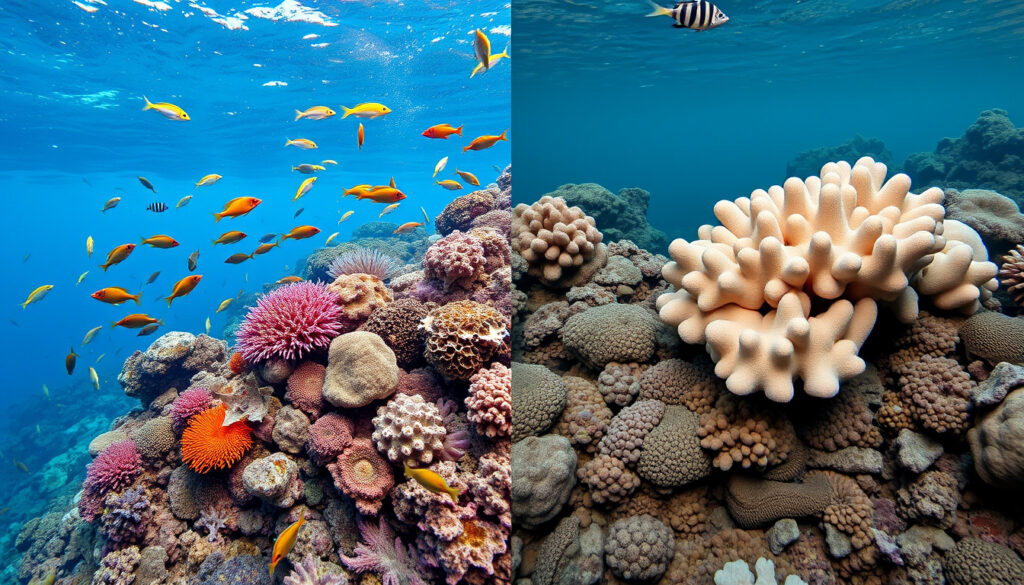
Coral bleaching occurs when elevated water temperatures cause corals to expel their symbiotic algae (zooxanthellae). Without the algae, corals lose their colour and their primary energy source. If temperatures remain high for an extended period, the corals die. The NOAA Coral Reef Watch maps show that during the 2014–2017 global bleaching event, 75% of the world’s reefs experienced bleaching-level heat stress and 30% reached mortality level.
What are the main threats to coral reefs?
- Climate change: Rising CO₂ levels are warming and acidifying oceans. Acidification reduces the availability of carbonate ions, making it harder for corals to build their skeletons.
- Pollution: Agricultural runoff, sewage, and plastic waste smother reefs and promote algal overgrowth.
- Overfishing: Removal of herbivorous fish allows algae to outcompete corals.
- Coastal development: Dredging, land reclamation, and sedimentation directly bury or cloud reef habitats.
The NPWS and AskAboutIreland note that cold-water reefs are also vulnerable — trawling and deep-sea mining pose immediate physical threats, while the long-term impacts of climate change on deep-water ecosystems remain unclear.
The implication: The same carbon emissions that drive tropical bleaching are also changing the chemistry of the deep ocean, putting even the remotest reefs at risk.
Clarity check
Confirmed facts
- Ireland has cold-water coral reefs at depths of 200–1,600 m (NPWS)
- Key reef-forming species are Lophelia pertusa and Madrepora oculata (NPWS)
- Great Barrier Reef is the largest and most famous coral reef system (GBRMPA)
- Indonesia has the most coral reef area globally (Wikipedia)
- Coral bleaching is caused by elevated sea temperatures (NOAA Coral Reef Watch)
What’s unclear
- Exact rate of global coral decline – estimates vary by region and monitoring method.
- Resilience of cold-water reefs to climate change – deep-sea conditions buffer warming but acidification effects are poorly studied.
- Full economic valuation of all reefs – the $375 billion figure does not include many non-market ecosystem services.
- Specific recovery rates for Irish cold-water reefs after disturbance.
- Long-term survival of carbonate mounds under projected ocean acidification scenarios.
Expert perspectives
“Irish deep water coral reefs are changing faster than previously thought.”
— Marine Institute Ireland (reported in research consultation)
“Cold-water coral reefs create a complex 3-dimensional structure. They provide habitat for many other species living on live and dead coral or between branches.”
— National Parks & Wildlife Service (NPWS habitat classification)
“The best developed reef examples are usually found close to the summit of giant carbonate mounds.”
For Ireland, the choice is clear: protect these ancient, slow-growing deep-sea reefs from bottom trawling and future deep-sea mining, or risk losing ecosystems that have taken thousands of years to build — and may never recover.
Related reading: Daddy Long Legs: Spider, Crane Fly, Harvestman? Myths & Facts · Head Shower Guide: Types, Pressure, Lifespan & Replacement
npws.ie, southernpulse.org, research.ed.ac.uk, universitytimes.ie, cityguidecanada.org, transceltic.com, askaboutireland.ie, cora.ucc.ie, theconversation.com
Frequently asked questions
How long does it take for a coral reef to form?
Tropical reefs can grow 1–10 cm per year. Cold-water reefs like those in Ireland grow just 4–25 mm annually, so a 4,500-year-old Irish reef may be only a few metres thick (AskAboutIreland).
What is the difference between warm-water and cold-water coral reefs?
Warm-water reefs rely on sunlight and symbiotic algae (zooxanthellae) and live in shallow, clear tropical waters. Cold-water reefs lack algae, survive by catching plankton, and thrive in deep, dark, cold water (4–8°C).
Can coral reefs recover from bleaching?
If heat stress is brief, corals can reabsorb algae and recover. Prolonged or repeated bleaching kills the coral skeleton, which may be colonised by algae. Recovery from severe bleaching can take decades (NOAA Coral Reef Watch).
What is the economic value of coral reefs?
Reefs provide fisheries, tourism, storm protection, and biodiversity worth an estimated $375 billion annually. This figure, from global ecosystem valuation studies, includes direct and indirect benefits.
Are there coral reefs in Europe besides Ireland?
Yes. Cold-water coral reefs occur along the Norwegian margin, the Mediterranean, and the Canary Islands. Ireland’s reefs on the Porcupine Bank and Rockall Trough are among the most studied in Europe (ICES paper).
What is the role of algae in coral reefs?
In tropical reefs, symbiotic zooxanthellae provide food to the coral and give it colour. In cold-water reefs, algae are absent – the corals rely on capturing organic particles from the water column (AskAboutIreland).
How do coral reefs protect coastlines?
Reefs act as natural barriers, absorbing up to 97% of wave energy and reducing erosion and storm surge impact on shorelines. The Great Barrier Reef Marine Park Authority estimates that the reef protects $5–10 billion in coastal infrastructure annually.
What is the largest coral reef system in the world?
The Great Barrier Reef is the largest, spanning 2,300 km along Australia’s Queensland coast. The second-largest is the Mesoamerican Barrier Reef (1,000 km), stretching from Mexico to Honduras.
More related posts
 Signs of Emotional Abuse: 5, 7, and 10 Indicators
 Permanent Resident: Meaning, Duration, and How to Get It
 Consumer Unit Replacement: Cost, Regulations & DIY Legality UK
 Thomas Jefferson: The Founding Father and Slavery Paradox
 Millie Court: Age, Love Island Win, Split & Career Now
 Toyah Willcox: Biography, Hits, Husband, and More
 Sam Quek: Biography, Olympic Gold, Husband, Children & Net Worth
 Sara Pascoe: Children, Husband, and Why She Left Sewing Bee
