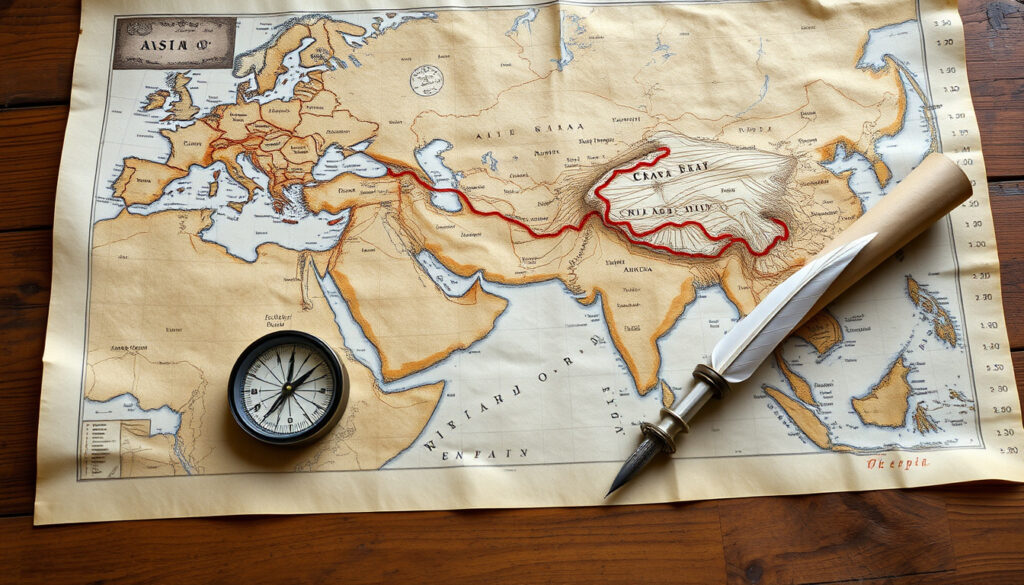
Marco Polo: Explorer, Author, and Servant of Kublai Khan
If you’ve ever shouted “Marco” in a swimming pool and waited for a friend to answer “Polo,” you already know the name. The Venetian merchant behind the echo served Kublai Khan, survived a 24-year round trip along the Silk Road, and then dictated a travel account that became a medieval bestseller (BBC Travel (history feature)). What follows sorts the documented life from the legends that still cling to it.
Born: c. 1254, Venice ·
Died: January 8, 1324, Venice ·
Travel period: 1271–1295 ·
Primary written work: The Travels of Marco Polo (Book of the Marvels of the World) ·
Key destination: Court of Kublai Khan, Mongol Empire ·
Travel route: Silk Road
Quick snapshot
- Polo was born into a Venetian merchant family around 1254 and died in Venice on January 8, 1324 (Encyclopaedia Britannica (historical biography)).
- He traveled the Silk Road with his father Niccolò and uncle Maffeo (Britannica Kids (student encyclopedia)), and the family spent roughly 17 years inside the Mongol Empire (Encyclopaedia Britannica (historical biography)).
- Whether every claim in his book is accurate; skeptics note that he omits Chinese customs such as tea drinking (Wikipedia (manuscript scholarship)).
- The personal relationship with Kublai Khan; no contemporary document describes it (Wikipedia (Kublai Khan biography)).
- 1271: the Polos leave Venice; they reach Kublai’s summer capital at Shangdu around 1274 or 1275 (Britannica Kids (student encyclopedia)).
- 1292–1295: the return voyage ends in Venice, three years after leaving China (BBC Travel (history feature)).
- Manuscript research is still testing which passages came from Polo and which from later copyists (Deutsche Welle (history desk)).
Six biographical facts, one pattern: nearly everything we can firmly say about Polo traces back to the same small stack of medieval sources.
| Full Name | Marco Emilio Polo |
| Born | c. 1254, Venice, Republic of Venice (Encyclopaedia Britannica (historical biography)) |
| Died | January 8, 1324, Venice (Encyclopaedia Britannica (historical biography)) |
| Occupation | Merchant, explorer, writer |
| Major Book | The Travels of Marco Polo (c. 1300) (Deutsche Welle (history desk)) |
| Employer/Monarch | Kublai Khan, Emperor of the Mongol Empire (Yuan Dynasty) (Wikipedia (Kublai Khan biography)) |
What Was Marco Polo Best Known For?
Marco Polo is best known for one journey and one book: the Silk Road crossing that landed him in the Mongol Empire’s capital, and the dictated manuscript — later known as The Travels of Marco Polo — that showed Europeans a world they had only guessed at.
The Venetian Merchant and Explorer
- Polo was a Venetian merchant from a trading family; he set out for Asia with his father Niccolò and uncle Maffeo, who had already made one trip east and met Kublai Khan (Britannica Kids (student encyclopedia)).
- His route followed the Silk Road — not a single road but a connected network linking East Asia, Central Asia, the Middle East, and Europe — through regions that correspond to the Middle East, Persia, Afghanistan, and Central Asia (Britannica Kids (children’s encyclopedia)).
The outward trip took more than three years, and the Polos arrived at Kublai’s summer capital at Shangdu around 1274 or 1275 (Britannica Kids (student encyclopedia)).
The Book of the Marvels of the World
The Travels of Marco Polo was not written by Marco Polo. He dictated it in a Genoese prison, and the man who shaped the prose was Rustichello da Pisa, a writer of romances — which is why the book reads like a marvels catalog rather than a merchant’s ledger (Deutsche Welle (history desk)).
The book circulated under several names — Il milione in Italian, The Travels of Marco Polo in English — and the original manuscript is gone. The text survives in so many divergent manuscript traditions that every modern version is partly a reconstruction (Wikipedia (manuscript scholarship)).
- It was translated and copied widely across Europe during and after Polo’s lifetime (BBC Travel (history feature)).
- Its success made Polo the standard European reference point for Mongol China for centuries afterward.
The implication: Polo’s fame was built less on what he personally wrote than on the copyists and translators who decided his stories were worth repeating.
What Happened to Kublai Khan and Marco Polo?
Short version: Marco went to work for the ruler of the Mongol Empire, stayed about 17 years, and left with imperial backing for a three-year journey home.
Polo’s Service in the Mongol Court
- Kublai received the Polos at his summer capital at Shangdu around 1274 or 1275 (Britannica Kids (student encyclopedia)).
- Marco entered imperial service and was sent on missions described in his account, including travel to Yunnan and southeastern China; historians debate how official those posts really were (Encyclopaedia Britannica (China sojourn analysis)).
- The family remained in the Mongol emperor’s dominions, including China, for about 17 years (Encyclopaedia Britannica (historical biography)).
When the Polos asked to leave, Kublai reportedly supplied ships for their voyage from eastern China toward Persia (Britannica Kids (children’s encyclopedia)).
The Return to Venice
The return trip took three years, from 1292 to 1295. That was no scenic detour; the Polos were escorting a Mongol princess to Persia (BBC Travel (history feature)).
After the delivery in Persia, the family continued overland and arrived in Venice in 1295 — 24 years after leaving it (Britannica Kids (student encyclopedia)). Three years later, Marco was captured during fighting between Venice and Genoa and dictated his book while imprisoned; he was released in 1299 (Britannica Kids (children’s encyclopedia)).
What this means: the most famous travel book of the Middle Ages exists because Marco lost a battle. The Venetian-Genoese war was the accident that turned a merchant’s memories into literature.
Did Kublai Khan Love Marco Polo?
The honest answer: the historical record never says. What the record shows is trust, utility, and a foreigner given unusual responsibilities — which is not the same as affection.
A Trusted Advisor and Envoy
- Polo’s account describes him serving as an envoy and official, with missions to Yunnan and southeastern China; the exact extent of that role is debated (Encyclopaedia Britannica (China sojourn analysis)).
- Kublai reportedly supplied ships and a diplomatic mission for the Polos’ journey home — a practical sign of how much he valued them (Britannica Kids (children’s encyclopedia)).
What the record does not contain is any personal attachment. The Polos had to seek permission to leave, which fits a ruler reluctant to lose useful assets more than a friend saying goodbye.
Historical Interpretations of Their Relationship
Netflix’s Marco Polo dramatizes the pair as mentor and protégé, giving Kublai lines about Marco’s future that sound intimate. That is scriptwriting, not chronicle — and a sign of how much modern storytelling has reshaped the historical record.
Popular retellings keep returning to the relationship, and the Netflix series is only the latest version; the sources simply do not document a personal bond (Wikipedia (Kublai Khan biography)).
The catch: once a screenwriter puts words in a historical figure’s mouth, those words tend to stick. Separating them from the record takes active effort.
Who Was Better, Genghis or Kublai?
Historians flinch at “better,” but the comparison is worth making because the two khans built different things. Genghis conquered an empire; Kublai governed one.
Genghis Khan: The Founder of the Mongol Empire
- Genghis united the Mongol tribes and founded the Mongol Empire in 1206 (Wikipedia (Kublai Khan biography)).
- He is remembered as a military conqueror and lawgiver who reshaped Central Asia’s political order (Wikipedia (Kublai Khan biography)).
By the time Polo was born, Genghis had already been dead for nearly three decades. His conquests created the world Polo walked into, but he was not part of it.
Kublai Khan: The Emperor of the Yuan Dynasty
- Kublai, Genghis’s grandson, completed the conquest of China and founded the Yuan dynasty in 1271 (Wikipedia (Kublai Khan biography)).
- He claimed legitimacy as a Chinese emperor, consolidating power and promoting culture rather than continuing the steppe campaigns of his grandfather (Wikipedia (Kublai Khan biography)).
That is the khan Polo actually served — a settled ruler with a bureaucracy, not a nomadic conqueror. His book even identifies the Chinese city of Quinsay with present-day Hangzhou, a detail that fits a traveler describing an administered empire rather than a battlefield (Encyclopaedia Britannica (China sojourn analysis)).
Three comparisons, one pattern: Genghis built the empire, Kublai governed it, and Marco Polo knew only the second half.
| Genghis Khan | Kublai Khan | |
|---|---|---|
| Role | Founder of the Mongol Empire, 1206 (Wikipedia (Kublai Khan biography)) | Grandson of Genghis; founder of the Yuan dynasty, 1271 (Wikipedia (Kublai Khan biography)) |
| Style | Military conqueror and lawgiver (Wikipedia (Kublai Khan biography)) | Consolidator who claimed Chinese imperial legitimacy (Wikipedia (Kublai Khan biography)) |
| Polo connection | Died in 1227, decades before Polo reached Asia (Wikipedia (Kublai Khan biography)) | Hosted Polo for roughly 17 years (Encyclopaedia Britannica (historical biography)) |
The trade-off: Genghis built the largest contiguous land empire of his era through conquest; Kublai kept enough of it stable that a Venetian merchant could travel through and write home about the cities. If “better” means better for Polo, Kublai wins. If it means better conqueror, that is Genghis — and the two were never competing for the same job.
Did Marco Polo Really Meet Genghis Khan?
No — and the answer is pure arithmetic.
Timing and Historical Context
Genghis Khan died in 1227 (Wikipedia (Kublai Khan biography)). Marco Polo’s journey ran from 1271 to 1295 (Encyclopaedia Britannica (historical biography)). The gap is roughly 44 years. They never shared a court, a meeting room, or a century.
- The Polos served Kublai Khan — Genghis’s grandson — not Genghis himself (Wikipedia (Kublai Khan biography)).
- Any story that places Polo and Genghis in the same scene ignores that Genghis had been dead for more than four decades when Polo arrived in Asia.
The confusion is understandable: the Mongol Empire has one famous founder and one famous European visitor, and retellings compress them into a single story. Chronology keeps the record honest.
What this means: if a version of the story puts Polo and Genghis in the same room, treat it as fiction. The only khan Polo could have met was Kublai.
Timeline: The 24-Year Journey
Nine dates, one shape: the first six are movement, the last three are memory.
| Date | Event | Source |
|---|---|---|
| Marco Polo is born in Venice. | Encyclopaedia Britannica (historical biography) | |
| The Polos depart Venice for Asia. | Encyclopaedia Britannica (historical biography) | |
| The family arrives at Kublai Khan’s summer capital at Shangdu. | Britannica Kids (student encyclopedia) | |
| 1275–1292 | Polo serves in the Mongol court and travels on missions, including to Yunnan and southeastern China. | Encyclopaedia Britannica (China sojourn analysis) |
| The Polos leave China, escorting a Mongol princess toward Persia. | BBC Travel (history feature) | |
| The Polos return to Venice after 24 years of travel. | Encyclopaedia Britannica (historical biography) | |
| Marco is captured during fighting between Venice and Genoa. | Britannica Kids (children’s encyclopedia) | |
| The manuscript later titled The Travels of Marco Polo circulates in Europe. | Deutsche Welle (history desk) | |
| Marco Polo dies in Venice. | Encyclopaedia Britannica (historical biography) |
The pattern: Polo’s life splits into two acts — the journey and the book. Everything after 1295 is the aftermath of the first act.
Confirmed Facts and Persistent Doubts
The gap between what scholars accept and what popular stories add is wide. Here is where the record stands.
Confirmed facts
- Polo was a Venetian merchant born around 1254 who died in Venice on January 8, 1324 (Encyclopaedia Britannica (historical biography)).
- He traveled with his father Niccolò and uncle Maffeo (Britannica Kids (student encyclopedia)) and spent roughly 17 years inside the Mongol Empire (Encyclopaedia Britannica (historical biography)).
- He dictated his account in prison with Rustichello da Pisa’s collaboration (Deutsche Welle (history desk)).
- His book spread widely and was translated and copied across Europe (BBC Travel (history feature)).
What’s unclear
- Whether every place and custom in the book is accurate; he omits Chinese practices such as tea drinking, which critics say is odd for a long-term resident (Wikipedia (manuscript scholarship)).
- The exact extent of Polo’s official role in Kublai’s court (Encyclopaedia Britannica (China sojourn analysis)).
- The personal nature of his relationship with Kublai Khan, which no contemporary source describes (Wikipedia (Kublai Khan biography)).
- The “last words” attributed to Polo, which appear only in a 16th-century chronicle rather than in any contemporary record (Encyclopaedia Britannica (historical biography)).
- How much of the surviving text is Rustichello’s literary shaping rather than Polo’s own reporting (Deutsche Welle (history desk)).
Why the imbalance: the certain facts are about the outlines of a life; the doubts are about the contents of a book. That is a typical medieval problem — one traveler, one manuscript, no other witnesses.
The Voices of the Polo Story
Three passages show how much rewriting has gone into Polo’s legacy — the deathbed legend, the book’s own prologue, and a modern television rewrite.
I did not tell half of what I saw, because no one would have believed me.
Marco Polo (attributed, deathbed saying; recorded in a 16th-century chronicle, not a contemporary source)
This is the most famous thing Polo supposedly said, and it is reported by a Renaissance editor rather than by anyone present at his deathbed (Encyclopaedia Britannica (historical biography)).
Emperors and kings, dukes and marquises, counts, knights, and burgesses, and all people who wish to know the various races of mankind and the peculiarities of the various regions of the world, take this book and have it read to you.
Prologue of The Travels of Marco Polo (c. 1300), likely framed by Rustichello da Pisa (Deutsche Welle (history desk))
That opening is marketing from the medieval book trade: a promise of wonders, aimed at an aristocratic audience that loved marvels (Deutsche Welle (history desk)).
You are not a guest in my court. What you see, I see. What you learn, you bring back to me.
Kublai Khan, as characterized in Netflix’s Marco Polo — fictional drama, not a historical quote
The Netflix series gives Kublai an intimate authority that medieval sources never recorded. It works dramatically; it is not evidence.
The gap between the three voices is the whole story: each era has re-voiced Polo to suit its own appetite for wonders.
The Takeaway
Marco Polo was real, his journey was real, and the book that made him famous is real. But every layer of his story has been edited by someone with a motive: copyists altered the manuscript, Renaissance editors added the deathbed line, and screenwriters have supplied the romance. For readers who want the historical Polo, the choice is clear: start with the chronicles and the manuscript scholarship, or accept a legend that reads better than the evidence supports.
PolicyLine’s other biographical profiles, from revolutionary leaders to Romantic poets, share this article’s focus on separating documented lives from popular legend: Ho Chi Minh: Revolutionary Leader, Name Meaning, and Legacy and Lord Byron: Life, Works, and Legacy of the Romantic Poet.
Frequently asked questions
Where did Marco Polo travel?
He traveled from Venice through the Middle East, Persia, Afghanistan, and Central Asia to the court of Kublai Khan in China, then took on missions within the empire before returning to Europe via Persia (Britannica Kids (children’s encyclopedia)).
How long did Marco Polo stay in China?
Roughly 17 years, though he also traveled outside China on imperial missions during that period (Encyclopaedia Britannica (historical biography)).
What was the name of Marco Polo’s book?
It is known by several titles: The Travels of Marco Polo, Il milione in Italian, and among modern scholars, The Book of the Marvels of the World (Deutsche Welle (history desk)).
Was Marco Polo a real person?
Yes. Marco Polo was born in Venice around 1254 and died there on January 8, 1324; his existence is well documented (Encyclopaedia Britannica (historical biography)).
What did Marco Polo bring back from China?
His lasting import was information: a manuscript that described Chinese cities, customs, and government so vividly that it became a medieval bestseller (BBC Travel (history feature)).
Why was Marco Polo’s book important?
It gave Europeans their most detailed early account of China and the Mongol Empire, and it influenced later explorers and mapmakers who treated it as a practical guide to the East (BBC Travel (history feature)).
More related posts
 Wilfried Nancy Sacked: 33-Day Celtic Tenure Explained
 Julian Caillon: Age, Career, and Strictly Journey
 Lauren Lyle – Biography, Age, Height, Partner, and Movies
 Eden Hazard Retirement: Why He Quit, Net Worth & More
 Compound Interest Calculator UK – Free Tool for Savings and Pensions
 Michael Sheen: Relationships, Family, Controversies & Career
 Jamie Oliver: Biography, Health, Family & Business Downfall
 Neil Young Glastonbury 2025 – Confirmed Pyramid Headliner Details
