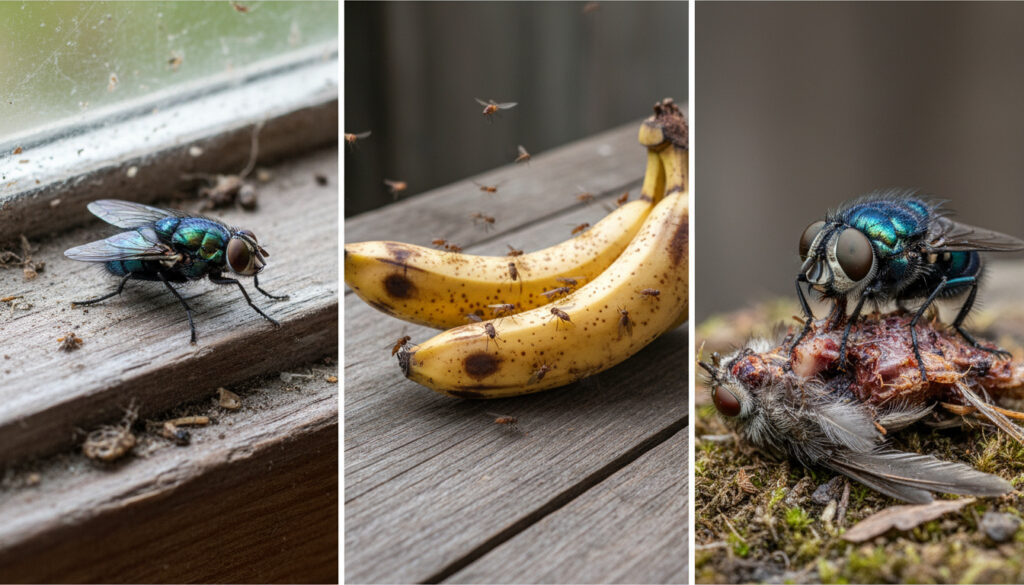
How Long Do Flies Live – Housefly, Fruit Fly and Blowfly Lifespans
The lifespan of a fly varies dramatically by species, thermal conditions, and habitat. Houseflies typically survive 15 to 30 days as adults, while fruit flies can live 40 to 50 days under ideal circumstances. Blowflies generally persist for three to four weeks. These durations shift significantly based on temperature gradients, nutritional access, and whether the insects develop in controlled laboratories or variable outdoor environments.
Understanding fly longevity requires examining complete metamorphosis from egg through adult stages. The common housefly, Musca domestica, completes its entire cycle in seven to ten days when temperatures reach 35°C (95°F). Cooler conditions extending down to 14°C (57°F) can prolong this process to 45 days or more. Such thermal sensitivity directly impacts pest management strategies and population control timelines.
Fruit flies (Drosophila spp.) prioritize rapid reproduction over extended individual survival, completing generations in eight days under optimal conditions. Blowflies exhibit intermediate patterns, with metallic blue-green adults attracted to carrion and contaminated meat. These biological distinctions create specific implications for public health interventions and domestic hygiene protocols.
How Long Do House Flies Live?
Houseflies represent the most common domestic pest species, with adult longevity averaging two to four weeks under typical household conditions. However, this timeframe compresses or extends based on microenvironmental factors including humidity, temperature, and food substrate availability.
15-30 days average lifespan under standard conditions
7-10 days at 95°F; up to 45 days at 60°F
12+ generations per year in temperate zones
500+ eggs per female across 5-6 batches
Several consistent patterns emerge regarding housefly survival:
- Sexual dimorphism in longevity: Females typically outlive males due to larger body size and greater energy reserves
- Rapid maturation: Adults achieve sexual maturity within 16 to 24 hours of emergence from pupal cases
- Climate vulnerability: Indoor air conditioning significantly shortens lifespan through temperature reduction
- Diapause capacity: Hibernation occurs during adverse conditions, potentially extending survival months
- Predation pressure: Wild populations face higher mortality from predators compared to laboratory settings
- Reproductive output: High egg production correlates with reduced individual adult longevity
| Species | Egg Hatch | Larva Duration | Pupa Duration | Adult Lifespan | Full Cycle (Optimal) |
|---|---|---|---|---|---|
| Housefly | 8 hours to 1 week | 3 to 7 days | 2 to 6 days (at 35°C) | 15 to 30 days | 7-10 days (95°F) |
| Fruit Fly | ~1 day | 4 to 5 days | 4 days | 40 to 50 days | 8 days optimal |
| Blowfly | 0 to 18 hours | 2 to 3 days | Brief (2-4 days) | 3 to 4 weeks | 2 to 4 weeks |
Fruit Fly Lifespan and Life Cycle
Drosophila species operate on fundamentally different temporal scales than houseflies, prioritizing rapid generational turnover over extended individual survival. Under laboratory conditions with consistent temperatures and abundant nutritional substrates, these insects complete entire life cycles in approximately eight days.
Adult Longevity
Adult fruit flies typically persist for 40 to 50 days when maintained under optimal conditions with adequate moisture and carbohydrate access. This represents significantly greater longevity than houseflies, though individual specimens deprived of nutritional sources perish considerably sooner. Research indicates that temperature fluctuations above or below 75-80°F reduce these durations proportionally.
Rapid Reproduction Cycle
Reproductive capacity defines fruit fly population dynamics more than individual longevity. Females deposit approximately 500 eggs throughout their lives, targeting fermenting organic matter including overripe fruit, vegetable matter, and sugary substances. Developmental data demonstrates that eggs hatch within 24 hours, progressing through larval stages in 4-5 days and pupal transformation in 4 days under warm conditions.
Genetic research laboratories maintain Drosophila stocks under precisely controlled conditions, often achieving the shortest possible generation times. Domestic kitchen environments present variable temperatures and inconsistent food sources, typically extending the full life cycle to 1-2 weeks rather than the theoretical 8-day minimum.
Factors That Affect Fly Lifespan
Multiple environmental and biological variables compress or extend fly longevity beyond species-specific baselines. Understanding these factors proves essential for effective pest management and predicting population explosions.
Temperature Effects
Thermal conditions represent the primary determinant of both individual longevity and generational speed. Entomological studies demonstrate that housefly life cycles compress to 7-10 days at 35°C (95°F) but extend to 45 days at 14°C (57°F). For context on temperature conversions, see 325 F to C conversion. Higher temperatures generally accelerate metabolism and reproduction while potentially shortening individual adult lifespan through accelerated aging processes.
Food Availability
Nutritional access fundamentally constrains survival at all developmental stages. Larvae require decaying organic substrates—manure, garbage, or fermenting vegetation—to complete development. Adult longevity data indicates that food deprivation significantly reduces survival times below species averages. Adult flies consume liquid or semi-liquid foods, accessing nutrients through sponging mouthparts. Without carbohydrate sources, adult fruit flies fail to reach their theoretical 40-50 day maximums.
Indoor vs. Outdoor Environments
Habitat context generates significant longevity variations. Agricultural extension research distinguishes between indoor environments—where air conditioning reduces temperatures and extends development times—and outdoor summer conditions that accelerate reproduction. Houseflies maintain year-round activity in warm climates, entering diapause (hibernation) during cold periods. Indoor populations often benefit from stable temperatures but face elimination through pest control measures, while outdoor populations encounter predators, parasitoids, and weather mortality.
Lifespan Variations Across Fly Species
While houseflies and fruit flies dominate domestic environments, blowflies present distinct temporal patterns and ecological roles. Blowfly biology indicates adult phases lasting three to four weeks, with metallic blue-green bodies distinguishing them from dull gray houseflies. These insects complete entire generations in approximately two to four weeks, faster than houseflies under equivalent conditions.
Species classification affects both longevity and public health significance. Public health guidelines categorize houseflies and blowflies as “filth flies” due to their attraction to manure, carrion, and garbage, creating outdoor-indoor overlap in infestation patterns. Fruit flies, conversely, specialize in fermenting produce and rarely carry the same pathogen load, though they indicate sanitation issues in food preparation areas.
Houseflies and blowflies constitute “filth flies” due to developmental requirements for decaying organic matter or animal waste. Fruit flies (Drosophila) represent a distinct ecological group specializing in fungal fermentation of overripe fruit, with corresponding differences in pathogen transmission potential and control strategies.
How Long Is the Full Fly Life Cycle?
Complete fly development requires passage through four distinct morphological stages, with total duration ranging from one week to two months depending on thermal and nutritional conditions. The following sequence represents typical timelines for common species under moderate conditions.
- Egg Stage (8-24 hours to 1 week): Females deposit 75-500 eggs in batches on decaying substrates. Orkin research indicates hatching occurs within 24 hours at optimal temperatures, extending to one week in cooler environments.
- Larval Stage (3-14 days): Legless maggots feed on substrate materials. Housefly larvae typically require 3-7 days, while blowfly larvae develop in 2-3 days. Developmental data shows cool temperatures extending this phase beyond 30 days.
- Pupal Stage (2-20 days): Larvae migrate to dry, cool locations and encase in puparia. At 35°C (95°F), houseflies require 2-6 days; at 14°C (57°F), this extends to 20 days. Wikipedia documents this thermal dependency.
- Adult Stage (15-50 days): Emergence occurs through anterior head pouches. Houseflies live 15-30 days; fruit flies 40-50 days; blowflies 2-4 weeks. Pest control research confirms females consistently outlive males.
What We Know and What Remains Uncertain
Entomological research establishes clear baselines for fly longevity while leaving certain variables unresolved. The following comparison distinguishes verified facts from areas requiring further investigation.
- Housefly adults average 15-30 days at 20-25°C room temperature
- Full developmental cycle completes in 7-10 days at 35°C (95°F)
- Female longevity exceeds male lifespan across all common species
- Temperature increases accelerate metabolism and shorten individual adult lifespan
- Four-stage metamorphosis (egg, larva, pupa, adult) occurs universally
- Precise lifespan limits in natural wild settings versus laboratory controls
- Individual genetic variation within species affecting longevity
- Exact humidity thresholds independent of temperature effects
- Long-term dietary impacts on adult survival beyond starvation studies
- Urban versus rural population longevity comparisons
Why Fly Lifespan Matters
Fly longevity directly impacts disease transmission dynamics and public health risk assessment. Houseflies and blowflies, classified as filth flies, transport pathogens including Salmonella, E. coli, and trachoma bacteria from decaying matter to human food surfaces. Adult lifespan determines the duration of potential pathogen carriage, while rapid generational turnover enables explosive population growth during warm seasons.
Pest control operations rely on accurate lifespan data to time interventions effectively. Understanding that houseflies complete full cycles in seven to ten days at summer temperatures informs treatment scheduling, preventing re-infestation between applications. Similarly, recognizing that fruit flies require accessible fermentation sources for 40-50 days emphasizes the importance of eliminating breeding substrates rather than targeting adult populations exclusively.
Sources and Expert References
Data regarding housefly longevity and developmental stages derives from multiple authoritative sources. Orkin’s entomological research documents the 15-30 day adult lifespan and rapid sexual maturation within 24 hours. Wikipedia’s housefly entry provides detailed thermal dependency data, confirming the 7-10 day cycle at 35°C and extended durations at 14°C.
Optimal conditions at 35°C (95°F) can extend housefly adult life to approximately one month, while thermal stress or nutritional deprivation may compress survival to minimum viable durations.
Aggregated from Texas A&M AgriLife Extension and Kapture Pest Control Data
Additional verification comes from Texas A&M AgriLife Extension regarding indoor control methods and environmental factors, and Kapture Pest Control for comparative species data. Fruit fly specific developmental timelines reference DIY Pest Control resources, while blowfly data derives from JP Pest Services and Illinois Department of Public Health filth fly classifications.
Summary
Houseflies live 15 to 30 days as adults, fruit flies survive 40 to 50 days, and blowflies persist for three to four weeks under typical conditions. Complete life cycles range from seven to ten days for houseflies at 95°F to eight days for fruit flies under laboratory conditions. Temperature, food availability, and environmental control represent the primary variables affecting these durations. For reference on temperature conversions relevant to thermal biology, see 325 F to C conversion, and for additional measurement contexts, 170 lbs to kg conversion.
Frequently Asked Questions
How many days do fly eggs take to hatch?
Housefly eggs typically hatch within 24 hours at optimal temperatures (35°C/95°F), but may require up to one week in cooler conditions around 14°C (57°F). Fruit fly eggs generally hatch within 24 hours, while blowfly eggs can hatch in as little as 8-18 hours on suitable carrion substrates.
What is the longest living fly species?
Among common synanthropic species, fruit flies (Drosophila spp.) exhibit the longest adult lifespans at 40-50 days under optimal conditions. Houseflies generally survive 15-30 days, while blowflies live 3-4 weeks. Exact species comparisons remain challenging due to varying laboratory conditions and wild population studies.
Do flies hibernate?
Houseflies and related species enter diapause—a hibernation-like state—during adverse cold conditions, significantly extending their potential survival beyond typical active lifespans. This dormancy allows populations to persist through winter months in protected locations, resuming rapid reproduction when temperatures rise above 15°C (59°F).
Can flies survive without food?
Adult flies require continuous access to liquid or semi-liquid nutrients. Without food, fruit flies fail to achieve their typical 40-50 day lifespans, perishing considerably sooner. Houseflies similarly require carbohydrate sources and water; deprivation dramatically compresses survival below the standard 15-30 day window.
Why do female flies live longer?
Female flies typically outlive males across housefly, fruit fly, and blowfly species due to larger body size and greater energy reserves. This sexual dimorphism in longevity correlates with reproductive strategy, as females must survive multiple reproductive cycles to deposit 500+ eggs in sequential batches, while males prioritize rapid maturation and mating.
More related posts
 Royal Mail Prices 2025 – Full Guide and October Increases
 Emilia Fox in 2025: Children, Relationship, Net Worth, and More
 Louis XVI: Final Words, Trial, and Execution Facts
 Charlie Mackesy: Biography, Book, and OBE
 One Piece Characters: Full List, Facts, and Fan Debates
 Jennifer Ehle: Biography, Husband, Age, and 2024 Projects
 Saturn Devouring His Son: Goya’s Myth, Meaning & Location
