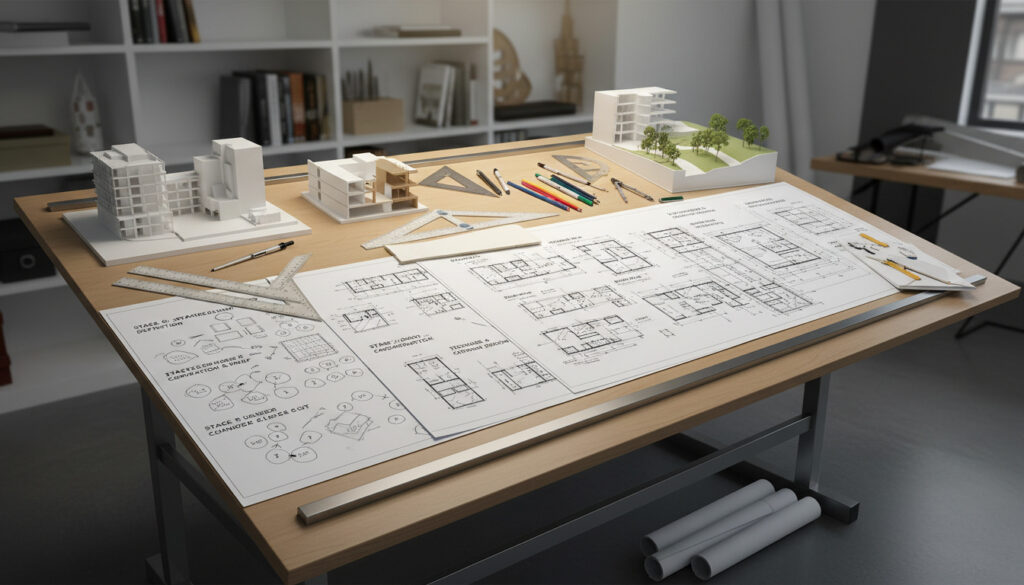
RIBA Plan of Work – 2020 Stages Overview and PDF Guide
The RIBA Plan of Work serves as the definitive process map for building design and construction across the United Kingdom. Developed by the Royal Institute of British Architects, this standardized framework organizes complex projects into eight distinct stages, guiding professionals from initial strategic definition through post-occupancy use.
First established in 1963 and significantly updated in 2020, the framework now emphasizes circular economy principles. Its current iteration promotes building reuse over demolition, embedding sustainability targets and structured information exchanges throughout the project lifecycle. Architects, contractors, and clients rely on these stages to align expectations, manage procurement, and ensure regulatory compliance.
Unlike earlier linear models, the 2020 edition presents stages as a continuous cycle. This shift reflects modern priorities regarding carbon reduction and adaptive reuse, positioning the Plan of Work as both a project management tool and an environmental accountability framework.
What is the RIBA Plan of Work 2020?
Comprehensive process structure developed by RIBA for UK construction projects
Numbered 0-7 covering strategic definition through operational use
Latest official version replacing previous linear models
Established framework evolving through 2013 and 2020 updates
The 2020 edition structures projects into eight stages (0-7) with vertical axes for outcomes, core tasks, statutory processes, procurement, and information releases. Each stage builds upon the previous, creating accountability from business case development through building operation.
- Organizes projects from briefing to operation since 1963
- Eight distinct stages from Strategic Definition to Use
- Circular diagram promoting building reuse over demolition
- Integrated sustainability taskbars at every stage
- Structured information exchanges for accountability
- Procurement strategy embedded from inception
- Post-occupancy evaluation as mandatory final stage
| Feature | RIBA Plan of Work 2020 | RIBA Plan of Work 2013 |
|---|---|---|
| Stage Count | 8 stages (0-7) | 11 stages (A-K) |
| Structure | Circular lifecycle | Linear progression |
| Sustainability Integration | Dedicated taskbar | Limited emphasis |
| Information Exchanges | Mandatory taskbar | Not structured |
| Procurement Strategy | Aligned from Stage 0 | Separate tender stage |
| Release Year | 2020 | 2013 |
| Diagram Type | Circular | Linear |
| Stage 0 | Strategic Definition | N/A (covered in Appraisal) |
| Final Stage | Stage 7: Use | Stage K: Feedback |
| Building Reuse Priority | Primary focus | Demolition focus |
Where to download the RIBA Plan of Work PDF?
Official templates and overview documents reside on the Royal Institute of British Architects website. The organization provides definitive PDF resources including the 2020 template and stage-by-stage guides. These documents establish the contractual and procedural basis for architectural appointments.
While third-party platforms host various diagrams and summaries, authoritative versions require direct access through RIBA.org. The 2020 template includes taskbars for sustainability, procurement, and information exchanges alongside stage descriptions.
Primary PDF downloads originate exclusively from RIBA.org. Third-party hosts may provide outdated or incomplete versions; always verify document dates against the 2020 standard.
What are the differences in RIBA Plan of Work 2023?
No 2023 update exists within available documentation. Industry sources consistently reference the 2020 edition as the current standard. Queries regarding 2023, 2024, and 2025 versions yield no confirmation of new releases from the Royal Institute of British Architects.
Why the 2023 confusion exists
Significant interest in post-2020 updates has generated search volume around newer editions. However, available PDFs and official communications maintain the 2020 framework without revision. Professionals seeking the latest version should verify directly through RIBA channels rather than unofficial repositories.
Current version status
The 2020 edition remains actively implemented across UK construction. Its circular diagram and eight-stage structure continue to define project workflows, with no evidence of imminent replacement or major revision through 2025.
Despite online queries for 2023, 2024, and 2025 editions, no such updates are confirmed. The 2020 framework stands as the authoritative standard until RIBA announces otherwise.
How does the RIBA Plan of Work 2013 compare?
The 2013 edition utilized eleven stages designated A through K, following a linear progression from appraisal through completion. This model emphasized sequential delivery with distinct tender and construction phases separate from design development.
The 2020 restructuring reduced stages to eight (0-7) while expanding functional depth. Concept Design (Stage 2) and Technical Design (Stage 4) now bookend Spatial Coordination (Stage 3), creating clearer separation between creative and regulatory phases. Manufacturing and Construction (Stage 5) consolidates production information and site execution under unified oversight.
The 2020 edition introduced mandatory taskbars for sustainability and information exchanges, replaced the linear A-K nomenclature with numerical stages 0-7, and transformed the diagram from linear to circular to emphasize lifecycle thinking.
How has the RIBA Plan of Work evolved over time?
- : Initial framework established by RIBA to standardize architectural processes
- : Major revision to eleven stages (A-K) incorporating modern procurement methods
- : Current edition released with eight stages (0-7) and circular lifecycle model
- : Introduction of sustainability taskbars and information exchange protocols
- : Formalization of Stage 7 (Use) for post-occupancy evaluation
- : Continuous application without interim updates; 2020 remains active standard
Which RIBA Plan of Work versions are officially confirmed?
Established Information
- 2020 edition is the current official standard
- Eight stages numbered 0-7
- Circular diagram format promoting reuse
- Official PDFs available via RIBA.org
- Framework originated in 1963
- 2013 edition (A-K) superseded by 2020
Information Remaining Unclear
- No confirmation of 2023 update existence
- No evidence of 2024 edition development
- No documentation of 2025 release plans
- Future revision timelines unpublished
Why does the RIBA framework matter for UK construction?
The Plan of Work establishes the contractual backbone for architectural services across the United Kingdom. By defining distinct stages from strategic definition through handover and use, the framework creates shared vocabulary between clients, designers, and contractors. What Does RIDDOR Stand For – UK Workplace Reporting Explained demonstrates how standardized frameworks improve safety and accountability across industries, similar to how RIBA stages structure building projects.
Its 2020 circular model explicitly prioritizes carbon reduction through building adaptation rather than demolition. This alignment with climate targets positions the framework as a regulatory-adjacent tool for environmental compliance, while its information exchange requirements support Building Safety Regulator documentation needs.
What do industry authorities say about the RIBA Plan of Work?
The RIBA Plan of Work represents the definitive model for construction process management, providing the industry-wide framework through which project teams coordinate complex building deliveries.
— Royal Institute of British Architects
The 2020 update fundamentally shifted architectural practice toward lifecycle thinking, embedding sustainability and reuse as core project drivers rather than optional additions.
— National Building Specification (NBS)
What are the key takeaways for construction professionals?
The RIBA Plan of Work 2020 provides the active standard for UK building projects, organized into eight stages (0-7) with mandatory sustainability and information exchange protocols. RIBA Plan of Work – 2020 Stages, PDFs and Latest Updates offers additional resources for navigating this framework. Professionals should download official templates directly from RIBA.org, verify that they are using the 2020 edition rather than seeking unpublished 2023 or 2024 updates, and implement the circular model’s reuse priorities to meet current carbon reduction targets.
Frequently Asked Questions
Is there an official RIBA Plan of Work 2024?
No evidence of a 2024 edition exists in available documentation. The Royal Institute of British Architects maintains the 2020 version as the current standard. Professionals should consult riba.org directly for any future updates beyond the 2020 framework.
Has RIBA released a 2025 edition?
Search results and official sources do not reference a 2025 update. The 2020 edition remains the definitive standard for construction project stages. Verification through official RIBA channels is recommended for the most current information.
What constitutes a project execution plan under RIBA?
The framework integrates procurement strategies and responsibility matrices rather than using a standalone execution plan. Stage 0 establishes the business case and funding routes, while subsequent stages develop detailed delivery methodologies aligned with client objectives.
How does the Plan for Use stage operate?
Stage 7, Use, encompasses post-occupancy evaluation, maintenance protocols, and aftercare services. This final stage ensures buildings perform as designed, facilitating feedback loops that inform future projects under the circular economy model.
Are RIBA Plan of Work PDFs free to download?
Official templates and overview documents are available through RIBA.org. While third-party hosts may provide diagrams, the authoritative PDFs originate from the Royal Institute of British Architects website and associated official publications.
Which RIBA version introduced the circular diagram?
The 2020 edition replaced the linear 2013 model with a circular representation emphasizing building reuse and lifecycle thinking. This visual shift reflects integrated sustainability priorities and carbon reduction strategies.
How does Stage 0 differ from Stage 1?
Stage 0, Strategic Definition, identifies project viability and business cases. Stage 1, Preparation and Briefing, develops feasibility studies, site surveys, and detailed briefs based on the strategic parameters established previously.
More related posts
 Catherine Missal: Age, Relationship, Tell Me Lies Role & More
 Rock Hudson: Life, Death, Relationships, and Legacy
 Jasveen Sangha Sentenced to 15 Years in Ketamine Case
 Caoilfhionn Dunne pronunciation, age, and biography
 Mlp Rainbow Dash: Profile, Representation & Relationships
 Steve McManaman: Career, Real Madrid Titles, Net Worth, Life Now
 Brian Shaw: Height, Weight, Comparisons & Allegations
 Signs of Emotional Abuse: 5, 7, and 10 Indicators
