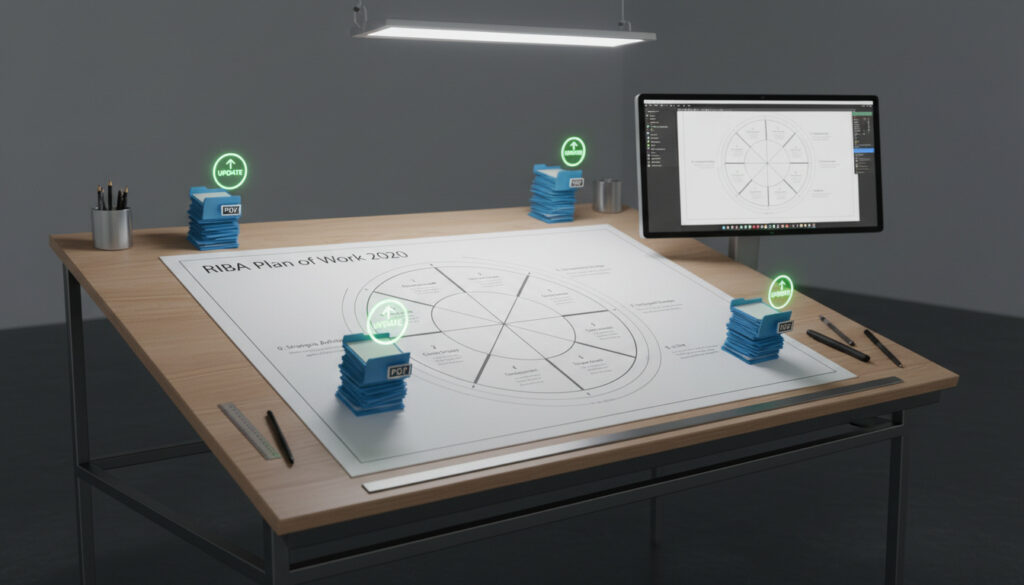
RIBA Plan of Work – 2020 Stages, PDFs and Latest Updates
The RIBA Plan of Work represents the definitive process framework for delivering building projects in the United Kingdom. Developed by the Royal Institute of British Architects, this standardized model organizes the entire construction lifecycle—from initial strategic definition through post-occupancy operation—into eight sequential stages numbered zero through seven.
Architecture practices, contractors, and clients utilize this structure to coordinate complex workflows, define deliverables, and manage transitions between design and construction phases. First introduced in its modern eight-stage format in 2013 and subsequently refined in 2020, the framework establishes protocols for information exchange, responsibility allocation, and sustainability integration across multidisciplinary teams.
Despite increasing online queries regarding potential 2023, 2024, or 2025 editions, the 2020 version remains the current official standard. The framework aligns with NBS digital tools and serves as the foundation for the RIBA Job Book, offering templates for projects ranging from small residential developments to large commercial structures.
What is the RIBA Plan of Work?
Definitive model for building design and construction process management
Eight stages from Strategic Definition (0) to In Use (7)
2020 edition (queries exist for 2023+)
Official RIBA PDFs and NBS Toolbox
- Organizes projects from initial briefing through operation using eight sequential stages
- 2020 edition introduces structured Information Exchanges between project phases
- Integrates sustainability considerations and procurement strategies from Stage 0
- Replaced the 2013 version with enhanced taskbars and Responsibility Matrix protocols
- Serves as the structural foundation for the RIBA Job Book 10th edition
- Coordinates multidisciplinary teams through defined roles and deliverables
- Aligns with NBS digital construction standards and BIM methodologies
| Version | Key Features | Status | Stages |
|---|---|---|---|
| 2013 | Introduced core requirements, sustainability aspirations, BIM Toolkit integration | Superseded; BIM Toolkit retired June 2022 | 0-7 |
| 2020 | Information Exchanges taskbar, Responsibility Matrix, refined procurement focus | Current official version | 0-7 |
| 2023 | No major updates confirmed; references align with 2020 framework | Unconfirmed | 0-7 |
| 2024 | No official release identified | Unconfirmed | — |
| 2025 | Unofficial educational references only; no official RIBA release | Not official | — |
What are the Key Stages in the RIBA Plan of Work?
The framework divides projects into eight distinct phases, consistent across both the 2013 and 2020 versions. Each stage defines specific outcomes, core tasks, and information exchanges required before progressing to the next phase.
Strategic Definition and Preparation (Stages 0-1)
Stage 0: Strategic Definition establishes the business case, strategic brief, and project viability assessment. Teams identify client requirements, site constraints, and regulatory contexts before committing resources.
Stage 1: Preparation and Brief develops detailed project objectives, feasibility studies, initial budgets, and the project brief. This phase produces the Responsibility Matrix and procurement strategy, setting the foundation for design development. RIBA documentation indicates this stage determines whether the project proceeds to concept design.
Design Development (Stages 2-4)
Stage 2: Concept Design generates initial design proposals, integrates sustainability strategies, and outlines engineering requirements. Teams produce sketch schemes demonstrating spatial arrangements and aesthetic direction.
Stage 3: Spatial Coordination resolves spatial conflicts, produces detailed layouts, and prepares documentation for planning submission. This stage ensures architectural, structural, and service elements align before technical development.
Stage 4: Technical Design develops detailed drawings, specifications, and compliance documents required for construction. All design elements reach resolution sufficient for manufacturing and procurement processes to commence. According to industry guidance, this stage finalizes the information needed for building control approval.
Construction and Handover (Stages 5-6)
Stage 5: Manufacturing and Construction oversees site works, component fabrication, and procurement activities. The project execution plan guides adherence to technical designs, with quality assurance protocols ensuring compliance with specifications.
Stage 6: Handover and Closeout encompasses final inspections, building commissioning, and documentation handover. Teams complete snag lists, transfer operation and maintenance manuals to clients, and obtain necessary certifications for occupancy.
Post-Occupancy (Stage 7)
Stage 7: In Use involves post-occupancy evaluation, routine maintenance, and performance monitoring. This phase assesses whether the built environment meets the original strategic brief and identifies lessons for future projects. Construction management resources note this stage closes the feedback loop initiated at Stage 0.
The 2020 edition introduces specific taskbars dictating what information must transfer between stages. For example, the Business Case developed at Stage 0 directly informs the Stage 1 budget parameters, ensuring strategic continuity throughout the project lifecycle.
What is the RIBA Plan of Work 2020?
The 2020 edition refines the eight-stage structure established in 2013 while introducing enhanced coordination mechanisms. This version responds to evolving industry needs around digital construction, sustainability compliance, and integrated project teams.
Information Exchanges and Taskbars
The 2020 framework implements structured Information Exchanges—specific protocols governing data transfer between stages. Taskbars visualize these exchanges, indicating which project team members generate information, who receives it, and what format it requires. This system reduces ambiguity in multidisciplinary workflows where architectural, engineering, and contractor inputs must align precisely.
Sustainability and Procurement Integration
Unlike the 2013 version, the 2020 edition embeds sustainability considerations as mandatory taskbar items from Stage 0, rather than optional add-ons. The framework requires teams to define sustainability aspirations during strategic definition and track performance through Stage 7. Procurement strategy receives similar emphasis, with Stage 1 deliverables including detailed procurement route selection affecting subsequent design decisions.
Responsibility Matrix Implementation
The 2020 version mandates a Responsibility Matrix identifying who performs specific tasks and who holds accountability for deliverables. This clarification addresses common conflicts in traditional procurement routes where design liability transitions between consultants and contractors. NBS guidance confirms this matrix integrates with their digital Plan of Work Toolbox.
Where to Download RIBA Plan of Work PDFs?
Official documentation remains accessible through RIBA and NBS channels, though users should verify they access current versions rather than superseded materials or unofficial derivatives.
The RIBA Plan of Work 2020 Overview PDF provides the definitive reference for all eight stages, taskbar implementations, and core objectives. This document serves as the primary source for understanding current stage boundaries and deliverables.
The RIBA official website hosts free overviews, templates, and guidance documents. Visitors may download the 2020 Overview PDF directly without membership requirements. Complementing these resources, the RIBA Job Book 10th edition provides downloadable PDF and RTF checklists aligned to specific stages.
Documents appearing on Scribd, SlideShare, or similar platforms claiming to represent “RIBA Plan of Work 2025” or updated editions lack official verification. The 2020 framework remains the current standard, with no evidence of official PDF releases for 2023, 2024, or 2025.
NBS offers the RIBA Plan of Work Toolbox, replacing the retired BIM Toolkit (discontinued June 2022). This digital resource generates templates for Project Roles Tables, Responsibility Matrices, and Multidisciplinary Schedules compatible with the 2020 stages.
What About RIBA Plan of Work 2023 and Later Versions?
-
RIBA introduces the eight-stage model (0-7), replacing earlier iterations with fewer phases. The version establishes sustainability aspirations and core project requirements as standard components.
-
Current official version released, incorporating Information Exchanges taskbars, enhanced Responsibility Matrix protocols, and refined procurement strategies. This edition remains the authoritative baseline.
-
RIBA retires the online BIM Toolkit, recommending migration to the NBS Plan of Work Toolbox for digital project coordination aligned with the 2020 framework.
-
Industry queries regarding 2023, 2024, and 2025 versions increase significantly, though RIBA has released no official updates superseding the 2020 edition. References to “RIBA Plan of Work 2025” in educational contexts relate to practice management training rather than new official standards.
Which RIBA Plan of Work Versions Are Officially Recognized?
| Established Information | Information That Remains Unclear |
|---|---|
| The 2020 edition is the latest official version sanctioned by the Royal Institute of British Architects | Whether RIBA intends to release a 2023, 2024, or 2025 update to the core framework |
| Eight stages (0-7) have remained consistent since the 2013 introduction | Specific content or structural changes that might appear in future editions |
| The BIM Toolkit was officially retired in June 2022 and replaced by NBS Toolbox integration | Timeline for potential digital tool updates beyond current NBS integration |
| 2020 version added explicit Information Exchange requirements not present in 2013 | Whether sustainability requirements will expand beyond current Stage 0-7 integration |
How Does the RIBA Plan of Work Fit Within UK Construction Standards?
The Royal Institute of British Architects developed this framework as the standard architectural process model, distinct from but complementary to health and safety regulations like What Does RIDDOR Stand For or building control requirements. While RIDDOR governs incident reporting and the HSE oversees site safety, the RIBA Plan of Work organizes the design and delivery workflow itself.
The framework integrates with National Building Specification (NBS) standards, allowing seamless transition from design intent to specification writing. Its alignment with Building Information Modeling (BIM) protocols ensures digital project data remains structured through Stage 4 technical development into Stage 5 construction. For clients, the stages provide payment milestones and decision points, while contractors use them to coordinate subcontractor packages and procurement schedules.
Educational institutions utilize the Plan of Work to train architecture students in professional practice, ensuring graduates understand the transition from academic design concepts to industry-standard delivery methodologies. This standardization reduces friction when projects move between practices or when international consultants collaborate on UK-based developments.
What Authority Underpins the RIBA Plan of Work?
“The RIBA Plan of Work organises the process of briefing, designing, constructing, maintaining, operating and using building projects into eight stages.”
— Royal Institute of British Architects Official Documentation
“It sets out the expected outcomes, core tasks and information exchanges required at each stage.”
— National Building Specification (NBS) Knowledge Base
These authoritative sources confirm the framework’s role as the industry benchmark, with the 2020 edition developed through consultation with practicing architects, contractors, and client representatives to reflect contemporary delivery methods.
How Should Project Teams Implement the RIBA Plan of Work?
Teams should adopt the 2020 edition as the current baseline, utilizing the NBS Toolbox for digital templates and consulting the RIBA Job Book for stage-specific checklists. While the framework provides standardization, practitioners may adapt the depth of each stage to project scale—applying the same logical progression from strategic definition through to in-use evaluation whether designing a small residential extension or a major commercial development. For related building maintenance guidance, see the Stained Glass Window Film Installation Guide.
Frequently Asked Questions
What is a project execution plan in RIBA terms?
Within the RIBA framework, this refers to Stage 5 (Manufacturing and Construction), where the contractor implements procedures for site works, procurement, and quality control to ensure adherence to technical designs.
What is the RIBA Plan for Use?
This designates Stage 7: In Use, covering post-occupancy evaluation, building maintenance protocols, and performance monitoring to verify the project meets original strategic objectives.
How does the 2013 version differ from 2020?
The 2013 edition established the eight-stage structure but lacked the structured Information Exchanges taskbars, Responsibility Matrix requirements, and integrated sustainability protocols introduced in 2020.
Is the RIBA Plan of Work legally mandatory?
No, it operates as a professional standard rather than statutory requirement. However, most UK architecture practices adopt it contractually through RIBA Standard Agreements, making it binding on specific projects.
What does Stage 0 involve specifically?
Strategic Definition requires establishing the business case, project viability, initial sustainability aspirations, and strategic brief before committing to design fees or site acquisition.
Can small projects use fewer stages?
Yes, the framework scales to project size. Small residential works might combine activities, but the logical progression from brief through design to handover remains consistent with the eight-stage structure.
Where did the eight-stage model originate?
The modern eight-stage format debuted in 2013, evolving from earlier RIBA iterations dating to 1963 that originally featured fewer stages and lacked post-occupancy evaluation components.
More related posts
 Size 40 in UK Shoes: Complete EU to UK Conversion Chart
 Adam Norris Net Worth: From Pensions to E-Scooters
 Mohammed Bin Salman: Family, Wealth, Succession Facts
 Michael Buffer: Catchphrase Trademark & Net Worth
 Jeremy Bowen: Age, Wife, Salary, Books, Health and Latest News
 Everton vs Aston Villa – Preview, Prediction, Team News
 Eva Longoria: Age, Children, Husband, Net Worth & Career
 Small Dining Table and Chairs – Top UK Picks for Compact Spaces
