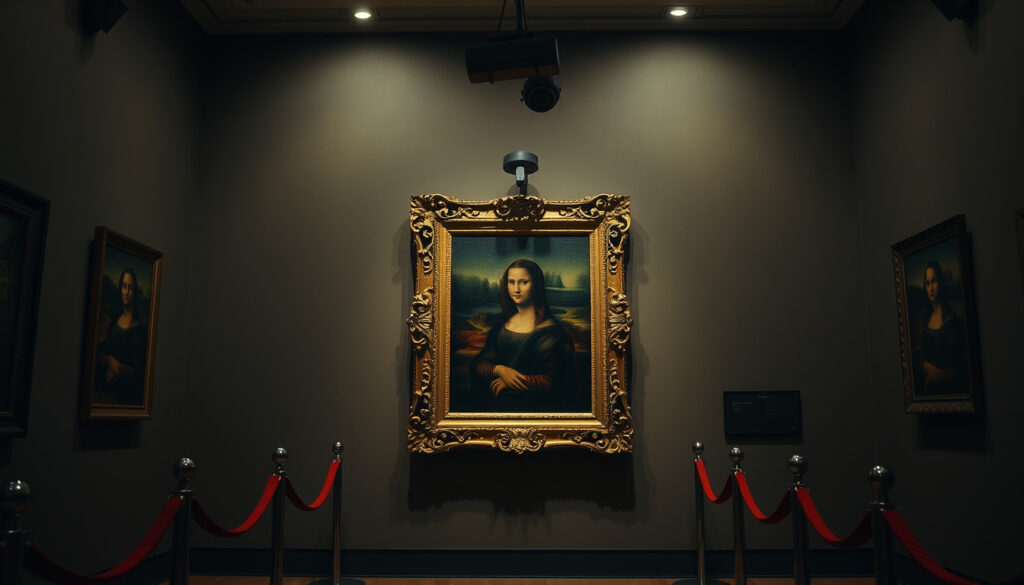
The Mona Lisa: History, Theft, and Essential Facts
Almost everyone can picture the Mona Lisa’s face, yet surprisingly few people can say how large the painting actually is. The portrait that Leonardo da Vinci left in his studio when he died in 1519 measures only about 77 by 53 centimeters — smaller than many posters of it (per the reference work Encyclopaedia Britannica and the painting’s Wikipedia listing).
Dimensions: 77 cm × 53 cm (30 in × 21 in) ·
Year completed: c. 1503–1519 ·
Current location: Louvre Museum, Paris ·
Estimated value: US $870 million (adjusted for inflation) ·
Number of visitors per year: Over 10 million at the Louvre ·
Year of theft: 1911 (recovered 1913)
Quick snapshot
- An oil painting on a poplar wood panel by Leonardo da Vinci (reference work Encyclopaedia Britannica)
- Housed at the Louvre Museum in Paris; entered the Louvre collection in 1804 (per Musée du Louvre’s official account)
- Stolen on 21 August 1911 by Vincenzo Peruggia (Musée du Louvre’s official account)
- The exact year the painting was started or finished is not documented
- The traditional identification of the sitter as Lisa Gherardini has not been definitively proven
- Whether Lisa was pregnant when she posed is a hypothesis, not a confirmed fact
- Probably begun around 1503; still in Leonardo’s studio at his death in 1519 (per Encyclopaedia Britannica)
- Entered the Louvre collection in 1804 (per Encyclopaedia Britannica)
- Stolen in 1911; recovered in 1913; back on display in Paris in January 1914 (per Musée du Louvre’s official account)
- The painting remains on display at the Louvre behind protective glass
- The Louvre draws more than 10 million visitors a year
- Owned by the French Republic, it is not for sale at any price
Nine data points, one pattern: the painting’s physical footprint is tiny, but its historical footprint keeps growing.
| Fact | Detail |
|---|---|
| Artist | Leonardo da Vinci |
| Year of creation | c. 1503–1519 |
| Material | Oil on poplar panel |
| Subject | Lisa Gherardini (traditional identification) |
| Dimensions | 77 cm × 53 cm (30 × 21 in) (Wikipedia) |
| Current owner | French Republic — displayed at the Louvre Museum, Paris |
| Theft period | 1911–1913 |
| Estimated value | over US $870 million (adjusted for inflation) |
| Visitors per year | over 10 million at the Louvre |
What the table says: the measurable facts are small, the historical consequences are enormous, and the two never quite align.
How big is the Mona Lisa?
The first surprise for many first-time visitors is physical: the Mona Lisa is an intimate object, closer in scale to a poster than to the monumental canvases that fill the Louvre’s grand galleries.
What is the most famous painting in the world?
- The Mona Lisa is regularly described as the most famous painting in the world, and the crowds around its display case support the claim.
- Its size is often quoted as 77 cm by 53 cm — about 30 by 21 inches — according to the Wikipedia listing for the painting.
- That makes it smaller than a large desktop monitor, and far smaller than most people expect.
A 77-by-53-centimeter panel is roughly the size of a large laptop screen — small enough that the museum places it behind glass and keeps viewers at a distance. The gap between the monumental reputation and the miniature object is the first fact that makes the Mona Lisa feel like a puzzle.
Is Mona Lisa a real person?
- The woman in the portrait is traditionally identified as Lisa Gherardini, a real Florentine woman and the wife of the silk merchant Francesco del Giocondo — an identification that the Encyclopaedia Britannica states has not been definitively proven.
- The same identification gives the painting its Italian title, La Gioconda, a wordplay on her married name.
What is not settled is whether Leonardo left any written record naming her. The identification relies on a biographical tradition, which is why historians describe it as strongly likely rather than proven beyond dispute.
The Mona Lisa is one of the rare artworks that becomes more interesting the smaller it is. A monumental canvas can impress at a glance; a tiny panel forces you to lean in — and that act of leaning in is where the experience lives.
Who painted the Mona Lisa?
Leonardo da Vinci painted it — the occasional search query “who wrote the Mona Lisa” is simply a phrasing slip, because the Mona Lisa is a painting, not a manuscript.
Why did it take 16 years to paint Mona Lisa?
- Leonardo probably started the portrait around 1503 and continued reworking it for years, leaving it in his studio when he died in 1519.
- That span is where the “16 years” in the popular question comes from, but it was not continuous: Leonardo juggled other commissions, engineering projects, and his own perfectionism.
- The painting stayed with him rather than being delivered to the family that may have commissioned it — a decision that still puzzles historians.
The 16-year figure is a round summary, not a measured production time. Leonardo treated the Mona Lisa as a work in progress for most of his life.
What happened to Leonardo da Vinci when he was 14?
- At age 14, Leonardo was apprenticed to the artist Andrea del Verrocchio in Florence.
- Verrocchio’s workshop taught him painting, sculpture, and the mechanical arts that would later fill his notebooks.
In Verrocchio’s workshop, Leonardo learned the craft of painting that would eventually produce the Mona Lisa — layered glazes, soft shadow, and a portrait that seems to breathe.
What disease did da Vinci have?
- Biographers have debated a right-side weakness late in Leonardo’s life, sometimes attributed to stroke and sometimes to a repetitive-strain condition described as “writer’s cramp.”
- The surviving evidence does not allow a firm diagnosis.
Was da Vinci rich when he died?
- Leonardo lived comfortably but did not die a great landowner; his estate was modest.
- His cultural wealth was enormous; his material wealth, by Renaissance standards, was not.
Did da Vinci have a child?
- Leonardo had no known children and never married.
How many kids did Mona Lisa have?
The woman behind the smile had a documented family life: Lisa Gherardini married the Florentine merchant Francesco del Giocondo and had five children with him.
How old would Mona Lisa be if she was still alive today?
- Born in 1479, Lisa Gherardini would be about 545 years old in 2025.
- That number turns the painting into a time capsule: a real woman’s face from the 1470s, still watching a world she could not have imagined.
Was Mona Lisa pregnant when she was painted?
- Some art historians have suggested the subject was pregnant or had recently given birth, pointing to her folded hands and the slight fullness of her figure.
- The suggestion is a hypothesis: no document confirms a pregnancy at the time of the sitting.
How did Mona Lisa die?
- Lisa Gherardini died in 1542 at about age 63, and she was buried in Florence.
- She outlived Leonardo by more than two decades, which means the painting has memorialized a woman who survived its painter by 23 years.
The pregnancy theory shows how the Mona Lisa’s gaps get filled: an observation about the composition becomes a biographical claim about Lisa, with no documentary anchor to hold it.
Why this matters: Lisa is not a blank fictional face. She was a real woman with children, a marriage, and a grave in Florence — yet her life is fragmentary enough that the portrait can still absorb any theory, from pregnancy to hidden-image speculation.
Who owns the real Mona Lisa painting now?
The simple answer: the French Republic owns the Mona Lisa, and the painting is on permanent display at the Louvre Museum in Paris.
Why is the Mona Lisa so expensive?
- It has no market price because it is not for sale; insurance estimates have placed its value above US $870 million adjusted for inflation.
- The French Revolution folded the royal collection into the property of the French people, which is why the Mona Lisa legally belongs to the nation rather than to any private collector — a history the Library of Congress Law Library describes as more layered than a simple “stolen from Italy” story.
- Its fame, amplified by the 1911 theft, is what converts a 77-by-53-centimeter panel into a nine-figure insured asset.
Why is the Mona Lisa so famous for kids?
- The 1911 theft gives the painting a built-in adventure story: a museum worker walks out with the most famous artwork in the world.
- The smile invites endless guessing — is she happy, shy, amused? It is a puzzle that needs no art history degree.
- Decades of cartoons, games, and book covers have made the Mona Lisa the first painting many children can name.
The trade-off: state ownership has guaranteed the painting’s survival and public access, but it also means the Mona Lisa will never be bought or sold. Its price exists only in the imaginations of insurance desks and headline writers.
Why is the Mona Lisa so famous because of theft?
On 21 August 1911, the Mona Lisa was stolen from the Louvre. Because the museum was closed on Mondays, the empty wall was not noticed until the next day — a head start documented by BBC News.
- The thief was Vincenzo Peruggia, a former Louvre employee who kept the painting hidden for more than two years, a detail traced by a research guide from the Library of Congress.
- In Florence, Peruggia showed the work to the art dealer Alfredo Geri at the Hotel Tripoli-Italia, an episode CNN’s reconstruction recounts in detail.
- Historical sources date the recovery to 10 December 1913 (BBC News), though a Library of Congress timeline places it on 12 December — a small disagreement in the record.
- The painting was put on display in Italy before returning to the Louvre in January 1914 (CNN’s timeline).
The scandal was enormous. The Louvre was shut for about a week while police worked through the building, and the theft turned the painting into an international story. Peruggia later said he had stolen the work to bring it home to Italy; the Library of Congress Law Library notes that this patriotic story glossed over a more complicated legal path.
Peruggia wanted to send the Mona Lisa to Italy. Instead, his theft forced the Louvre to harden security, made the painting the most watched artwork on the planet, and sent it back to Paris within months.
The catch: without 1911, the Mona Lisa would still be a Renaissance masterpiece — but it might not be a household name. The theft supplied the plot that turned art history into front-page news, and the painting never left the headlines.
Mona Lisa facts and myths: what is confirmed, what is not
Confirmed facts
- Painted by Leonardo da Vinci in oil on poplar panel (Encyclopaedia Britannica)
- Housed in the Louvre Museum since 1804 (Musée du Louvre)
- Stolen on 21 August 1911; recovered in 1913 (Musée du Louvre)
- Dimensions of 77 × 53 cm (per Encyclopaedia Britannica)
- Sitter traditionally identified as Lisa Gherardini (per Encyclopaedia Britannica)
What’s unclear
- The exact start and completion dates remain uncertain
- Definitive proof of the sitter’s identity has not been found
- Whether Lisa was pregnant when she sat is speculation
- Why Leonardo never delivered the painting to the family is unexplained
- The exact recovery date is disputed between 10 and 12 December 1913
- The cause of Leonardo’s late-life hand condition is unresolved
The takeaway: the confirmed facts are clean and stable, while the unclear ones keep accumulating theories. That asymmetry is not the problem — it is the machine. Every open question gives the Mona Lisa another reason to be noticed, admired, and argued over.
What the key voices said
Leonardo’s own writing, Peruggia’s defense, and the Louvre’s security briefing capture the arc of the painting’s strange life.
The soul of the painter must be like a mirror, which transforms itself into the color of the thing it reflects.
— Leonardo da Vinci (attributed)
Peruggia explained his act in patriotic terms — an explanation that the Library of Congress Law Library says collapsed a complex legal history into a simple comeback story.
I stole the Mona Lisa because I wanted to return it to Italy, to its rightful place.
— Vincenzo Peruggia, speaking of the 1911 theft
On the challenge of protecting a small panel in a room with millions of visitors, the Musée du Louvre’s official account is direct about the current setup.
Current security measures for the painting include bullet-proof glass and constant humidity control.
— Musée du Louvre, on the Mona Lisa’s display conditions
Why these voices matter: Leonardo’s mirror metaphor, Peruggia’s defense, and the Louvre’s climate-controlled box map the painting’s journey — from an artist’s mind, through a thief’s hands, to a glass case that smiles back at millions.
What the Mona Lisa story actually adds up to
A 77-by-53-centimeter panel, begun around 1503 by a perfectionist who would not let it go, claimed by the French state after the Revolution, stolen by a former Louvre worker in 1911, recovered two years later, and displayed since then under glass in Paris: that sequence turned a Renaissance portrait into the most recognized image in art history. For the millions of people who pass through the Louvre each year, the choice is simple — treat the Mona Lisa as a quick photo stop, or slow down and see the small, strange object underneath the fame. The second option is the one that explains why they came.
Related reading
Cultural icons have a habit of growing past their origins; these two pieces follow the same pattern.
- Sally Mann: Photographer, Controversy, and Timeless Art — why a living photographer became art history’s favorite lightning rod
- Hannibal Lecter Guide: Origins, Movies & Cultural Impact — another icon whose cultural footprint dwarfed its original frame
The connection: these stories share the same pattern — a small fact set generating a massive cultural wake.
Frequently asked questions
What year was the Mona Lisa painted?
Leonardo probably began the portrait around 1503 and worked on it intermittently for years. It was still in his studio when he died in 1519, so the range c. 1503–1519 is the most commonly used answer.
What technique did Leonardo da Vinci use for the Mona Lisa?
He painted in oil on a poplar wood panel. The soft blending of light and shadow, a technique often called sfumato, gives the face its elusive, lifelike quality.
Where is the Mona Lisa located exactly in the Louvre?
The painting hangs in the Louvre Museum’s permanent collection in Paris, behind bullet-proof glass, with constant humidity control.
How many times has the Mona Lisa been stolen?
Once: on 21 August 1911, by Vincenzo Peruggia. That single theft made the painting world-famous.
What is the meaning of the Mona Lisa’s smile?
There is no documented meaning. The smile’s ambiguity is exactly why it keeps generating theories: an invitation to interpretation, not a code to be cracked.
Why is the Mona Lisa considered a masterpiece?
Because of Leonardo’s technical control — soft modeling, atmospheric depth, and a portrait that seems alive — combined with the theft and recovery that made it the most scrutinized painting in history.
The overarching lesson: the Mona Lisa’s power lies not in its answers but in its ability to keep generating questions — a small, silent face that has been talking for over 500 years.
More related posts
 Bryce Dallas Howard: Family, Salary, Career, and FAQ
 Matt Cardle: From X Factor Winner to Independent Artist
 Best Running Shoes for Men 2026: Lab-Tested Top Picks
 Rip Torn: Life, Career, and Legacy
 Resting Heart Rate by Age: Normal Range, Dangers & ER Thresholds
 Sammy Virji: Real Name, Age, Ethnicity, Tour Dates
 Vic Reeves: Brain Tumour, TV Exit, and Bob Mortimer
 Alan Carr: Husband Split, Net Worth, Sobriety, Career Facts
