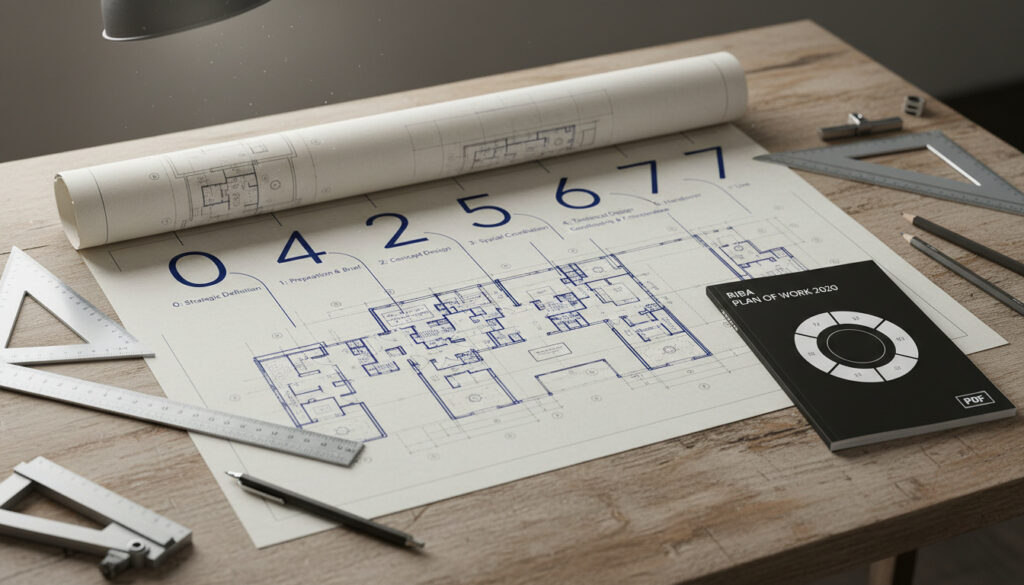
RIBA Plan of Work – 2020 Stages and PDF Guide
The RIBA Plan of Work 2020 represents the definitive framework governing building project delivery across the United Kingdom. Published by the Royal Institute of British Architects, this standard organizes architectural and engineering workflows into eight distinct stages, from initial strategic definition through to long-term building use.
Professionals utilise the framework to coordinate briefing, design development, construction, and handover processes. The 2020 edition remains the current active standard, superseding previous iterations while introducing critical phases for strategic planning and post-occupancy evaluation.
What is the RIBA Plan of Work 2020?
| Definitive 8-stage model covering complete project lifecycle | Organizes briefing, design, construction, and operational use |
| 2020 version established as current industry standard | Free PDF downloads available directly from RIBA |
- Eight stages numbered 0 through 7 define the complete project lifecycle
- Core tasks and information exchanges specified for each phase
- Structural reorganisation from the 2013 predecessor version
- No subsequent releases confirmed for 2023, 2024, or 2025
- Direct integration with NBS specification systems
- Embedded project strategies for cost, fire safety, and sustainability
- Sequential progression through Stage 4 with overlapping delivery phases
| Attribute | Detail |
|---|---|
| Current Version | 2020 |
| Total Stages | 8 (numbered 0-7) |
| Publisher | Royal Institute of British Architects |
| Core Delivery Span | Stages 1-6 |
| Primary Focus | Strategic definition through operational use |
| Official Formats | Template PDF, Overview PDF |
| Industry Integration | NBS, BREEAM, LCA |
| Historical Origin | 1963 |
What are the 8 stages of the RIBA Plan of Work?
Strategic Definition and Preparation (Stages 0-1)
Stage 0 establishes the project’s foundation through business case development, risk assessments, budget reviews, and site appraisals. This phase occurs without requiring a full design team appointment. Stage 1 transitions into preparation and briefing, where the project brief takes shape through feasibility studies, spatial need definitions, sustainability target setting, and the creation of the project execution plan.
Design Development (Stages 2-3)
Concept Design (Stage 2) produces the initial architectural concept aligned with engineering input and cost planning strategies. Design reviews confirm brief compliance. Spatial Coordination (Stage 3) advances these concepts through detailed design studies and engineering analysis to achieve a spatially coordinated design, typically culminating in planning applications.
Technical Resolution and Construction (Stages 4-5)
Technical Design (Stage 4) involves developing and coordinating architectural and engineering designs alongside specialist subcontractor information. This stage initiates change control protocols. Manufacturing and Construction (Stage 5) commences upon site possession, encompassing system manufacture, building construction, quality monitoring, and query resolution. These stages overlap to accommodate manufacturing lead times while design finalisation continues.
Project Completion and Use (Stages 6-7)
Handover (Stage 6) covers commissioning, building manual preparation, and handover procedures according to the Plan for Use Strategy, followed by the defects liability period. Use (Stage 7) manages ongoing operation, facilities and asset management, post-occupancy evaluation, and aftercare for the building’s operational lifespan.
Stages 0 through 4 follow strict sequential order. Stages 4 and 5 overlap to accommodate manufacturing lead times concurrent with design completion. Stages 6 and 7 function as a continuous bridge from construction completion to operational management.
Where to download RIBA Plan of Work PDFs?
Official RIBA Template PDF
The comprehensive working document provides detailed stage guidance, task breakdowns, and strategic frameworks for professional use. Download the RIBA Plan of Work 2020 Template PDF directly from the Royal Institute of British Architects.
RIBA Overview Document
A condensed reference guide containing stage descriptions, report templates, and strategy overviews serves as a quick-access resource for project teams. Access the Overview PDF for streamlined navigation of the framework.
Complementary Visual Resources
Third-party educational materials offer diagrammatic representations of stage interactions and workflows. The Supply Chain School handout provides additional visual mapping of the eight stages.
For additional context on implementation, refer to the RIBA Plan of Work – 2020 Stages Overview and PDF Guide.
What is the latest version of the RIBA Plan of Work?
Current Version Status
The 2020 edition remains the definitive and current standard. Sources confirm this version as the latest official release, with no subsequent updates implemented or announced through 2025.
Clarification on 2023, 2024, and 2025 Queries
Significant search volume exists for editions labeled 2023, 2024, or 2025. However, authoritative sources confirm no such releases exist. The 2020 framework continues to serve as the active standard for all building projects.
Sources confirm no post-2020 updates through 2025. Professionals should verify document dates when encountering materials labeled 2023, 2024, or 2025, as these may reference outdated projections or unofficial modifications.
The Royal Institute of British Architects maintains the 2020 templates and overview documents as the active standard for all building projects, aligned with current NBS procurement resources.
How has the RIBA Plan of Work evolved since its inception?
- : Original RIBA Plan of Work established to standardise architectural project stages
- : Previous major revision operated with seven distinct stages
- : Current eight-stage structure implemented, introducing Strategic Definition (Stage 0) and Use (Stage 7) while reorganising intermediate phases
- : Continued operation under 2020 edition with no successor released despite periodic queries
What is established versus uncertain about RIBA Plan of Work updates?
| Established Information | Information Remaining Unclear |
|---|---|
| 2020 is the latest official version | Timeline for 2026 or beyond revisions |
| Eight stages numbered 0-7 | Specific content of future updates |
| Free PDF availability from RIBA | Retirement date for 2020 edition |
| NBS integration currently active | Potential structural changes in next revision |
How does the RIBA Plan of Work integrate with industry standards?
The framework operates within a broader ecosystem of UK construction standards. NBS integration supports specification and procurement processes, with Stage 4 information specifically tailored for manufacturing and construction requirements.
The Structural Plan of Work 2020 mirrors RIBA stages for engineers, adding a sub-stage 4.5 for structural-specific technical coordination. Additionally, the framework aligns with BREEAM and Life Cycle Assessment (LCA) methodologies for sustainability benchmarking.
What do authoritative sources say about the framework?
The RIBA Plan of Work 2020 organises the process of briefing, designing, constructing and using a building into eight stages.
Royal Institute of British Architects, 2020 Overview PDF
Projects typically span Stages 1-6 for core delivery, with Stage 0 deciding project initiation and Stage 7 covering long-term use and maintenance.
RIBA Plan of Work 2020 Template
What are the key takeaways for construction professionals?
The RIBA Plan of Work 2020 provides the authoritative eight-stage structure governing UK building projects, with free PDF resources available directly from the Royal Institute of British Architects. Professionals should utilise the 2020 Template and Overview documents, remain aware that no 2023-2025 editions exist, and integrate these stages with NBS specifications for compliant project delivery. For ongoing updates, consult the RIBA Plan of Work – 2020 Stages, PDFs and Latest Updates.
Frequently asked questions
What changed in RIBA Plan of Work 2020 vs 2013?
The 2020 edition expanded from seven stages to eight, introducing Stage 0 (Strategic Definition) and Stage 7 (Use), while reorganising intermediate phases for clearer coordination between design and construction.
What were the RIBA Plan of Work 2013 stages?
The 2013 framework comprised seven stages: Preparation, Concept Design, Developed Design, Technical Design, Construction, Handover, and In Use.
What is a project execution plan in RIBA?
Developed during Stage 1, this document defines project outcomes, sustainability targets, quality benchmarks, spatial requirements, and strategic approach before design commences.
What is RIBA Plan for Use?
A strategy formulated during early stages governing how the building will operate after handover, including commissioning protocols, building manual preparation, and post-occupancy evaluation.
Is there a RIBA Plan of Work 2023 or 2024?
No. Despite search queries suggesting otherwise, the 2020 edition remains the current standard with no official releases for 2023, 2024, or 2025 confirmed by RIBA.
Where can I download the official RIBA Plan of Work PDF?
Direct downloads are available from the Royal Institute of British Architects website, including the comprehensive Template PDF and the Overview PDF for quick reference.
What does Stage 0 involve?
Strategic Definition involves developing the business case, reviewing risks and budgets, conducting site appraisals, and establishing client requirements without requiring a full design team.
How do Stages 4 and 5 interact?
These stages overlap to allow manufacturing and construction to commence while technical design completion continues, ensuring efficient project timelines.
More related posts
 Pete Tong: Meaning, Net Worth, Biography & Why the Phrase Exists
 Arsenal Transfer News on Twitter: Romano, Ornstein & More
 Why Has My Tax Code Changed? How to Fix It (Ireland 2026)
 Zooey Deschanel: ADHD, Kids, and Career Facts
 Madeleine McCann 2026: Latest News, Theories, What Happened
 Lee Mead: Relationship, Tour, Daughter, Hair Loss – 2025 Update
 Paul Anka 2025: Health, Net Worth, Daughters, Still Performing
 Howard Hughes: Mental Illness, Downfall, and Legacy
