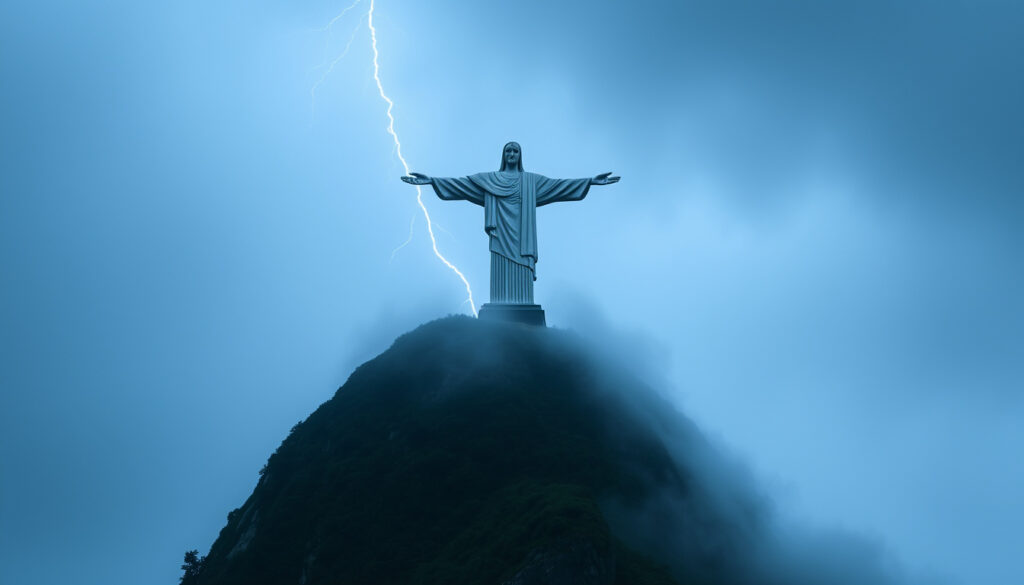
Christ the Redeemer: Height, History, Lightning Strikes
There’s something about the Christ the Redeemer statue that stops you mid-step — whether you’ve seen it in photos or stood at its base on Mount Corcovado, the scale of the 98-foot figure is hard to forget. Completed in 1931 after nine years of construction, it remains the largest Art Deco statue in the world, according to Britannica, and the same record covers its dimensions, the lightning strikes that have tested it, and its New7Wonders status.
Height including pedestal: 124 feet (38 meters) ·
Arm span: 92 feet (28 meters) ·
Location: Mount Corcovado, Rio de Janeiro, Brazil ·
Year completed: 1931 ·
Material: Reinforced concrete with soapstone mosaic
Quick snapshot
- Statue is 98 feet tall, arms span 92 feet (Britannica)
- Completed in 1931 on Mount Corcovado (Sanctuary of Christ the Redeemer)
- Made of reinforced concrete and soapstone (Google Arts & Culture)
- Voted one of the New7Wonders of the World in 2007 (Britannica) (Britannica)
- Exact number of lightning strikes — some reports claim more than three (Confinity)
- Whether the statue appears in all editions of Monopoly (History.com)
- Original concept proposal date — some sources say 1888, others point to a 1920 campaign (Google Arts & Culture) (Confinity)
- Construction start date — some sources cite 1922, others describe 1926 as the active start (Agência Brasil) (Confinity)
- 1922: Construction begins on Mount Corcovado (Agência Brasil)
- 1931: Inauguration on October 12 (G1)
- 2007: Named a New7Wonder (Britannica) (Agência Brasil)
- 2014: First major lightning strike damages thumb (Confinity) (Agência Brasil)
- Ongoing maintenance and lightning protection upgrades (Sanctuary of Christ the Redeemer)
- Continued tourism growth — 2+ million visitors annually (History.com)
- Potential UNESCO expansion of Tijuca National Park buffer zone (Britannica)
The numbers below separate the statue itself from the monument as a whole.
| Attribute | Value |
|---|---|
| Official name | Cristo Redentor |
| Location | Mount Corcovado, Rio de Janeiro, Brazil |
| Height (statue only) | 98 feet (30 meters) |
| Arm span | 92 feet (28 meters) |
| Weight | 635 metric tons |
| Material | Reinforced concrete, soapstone mosaic |
| Year completed | 1931 |
| Architect | Paul Landowski (sculptor), Heitor da Silva Costa (engineer) |
The pattern: the statue’s height and weight place it among the largest Art Deco structures ever built — a deliberate choice to make it visible from nearly every corner of Rio.
Why is Christ the Redeemer so famous?
Symbol of Christianity and Brazil
- Built as a national religious project funded by donations, the statue represents Brazil’s deep Catholic roots (CasaCor/Abril).
- Its location on 710-meter Mount Corcovado makes it visible from up to 40 kilometers away, anchoring the city’s identity (Agência Brasil).
Art Deco design and scale
- Designed by French sculptor Paul Landowski and built by Brazilian engineer Heitor da Silva Costa, the statue is the world’s largest Art Deco monument (Google Arts & Culture).
- The outstretched arms span 92 feet, creating a cross-like silhouette that reinforces the religious symbolism (Britannica).
The implication: the statue’s fame rests on a triple foundation — spiritual meaning, engineering ambition, and a location that turns a monument into a beacon.
Is Christ the Redeemer in the 7 Wonders of the World?
New7Wonders of the World designation
- In 2007, the statue was voted one of the New7Wonders of the World in a global poll organized by the New7Wonders Foundation (Britannica).
- It is not part of the original ancient Seven Wonders, which were destroyed or lost (History.com).
Criteria for selection
- The poll involved over 100 million votes worldwide, with winners including Machu Picchu, the Great Wall of China, and the Colosseum (Britannica).
- Selection criteria emphasized cultural significance, architectural achievement, and global recognition (New7Wonders Foundation).
The catch: the New7Wonders list is a modern, crowd-sourced distinction — it doesn’t carry the historical weight of the ancient list, but it does reflect current global popularity.
What are 5 facts about Christ the Redeemer?
Height and dimensions
- The statue itself stands 98 feet (30 meters) tall; with the 26-foot pedestal, it reaches 124 feet (Sanctuary of Christ the Redeemer).
- Weight: 635 metric tons (Britannica).
Construction materials
- Made of reinforced concrete and covered with soapstone mosaic from Carandaí, Minas Gerais (Google Arts & Culture).
- The soapstone tiles were chosen for their durability and ease of cleaning (InfoEscola).
Lightning strikes
- At least three recorded strikes: 2014 (damaged thumb), 2016, and 2019 (Confinity).
- A lightning rod system was installed after the 2014 incident (G1).
Monopoly game appearance
- The statue appears in several editions of Monopoly, including the “Brazil” and “World” editions (Confinity).
- It’s unclear whether it appears in all editions; some regional versions may omit it (History.com).
Steps to the statue
- 220 steps lead from the base of the pedestal to the observation deck (Sanctuary of Christ the Redeemer).
- Visitors can also use an elevator and escalators, making the site accessible (History.com).
The trade-off: the statue’s visibility and accessibility draw millions, but its exposed position on the mountain makes it a frequent target for lightning — a vulnerability that requires constant maintenance.
How many times has Christ the Redeemer been struck by lightning?
Notable lightning incidents
- 2014: A lightning strike during a storm damaged the statue’s right thumb (G1).
- 2016: Another strike occurred, reportedly causing minor damage (Confinity).
- 2019: A third recorded strike, again with visible damage to the head and fingers (Confinity).
Damage and repairs
- After the 2014 strike, a lightning rod system was installed on the head and arms (G1).
- Repairs involve replacing damaged soapstone tiles and checking the internal concrete structure (Sanctuary of Christ the Redeemer).
Why this matters: the statue’s height and metal infrastructure make it a natural lightning rod — even with modern protection, each storm carries a risk that Rio’s most famous landmark will need another repair.
What is Jesus called in Brazil?
Portuguese name
- In Portuguese, the statue is called “Cristo Redentor,” which translates directly to “Christ the Redeemer” (Britannica).
- Locals often shorten it to “Cristo” or use “Jesus” informally (Sanctuary of Christ the Redeemer).
Cultural significance
- The name reflects Brazil’s dominant Catholic faith — the country has the largest Catholic population in the world (History.com).
- The inauguration on October 12, 1931, coincided with the feast of Our Lady of Aparecida, Brazil’s patron saint (Google Arts & Culture).
The pattern: the statue’s name is a direct reflection of Brazilian religious identity — it’s not just a landmark, but a living symbol of faith for tens of millions.
Six key dimensions anchor the statue’s physical presence:
| Specification | Value |
|---|---|
| Statue height (without pedestal) | 30 m (98 ft) |
| Total height (with pedestal) | 38 m (124 ft) |
| Arm span | 28 m (92 ft) |
| Weight | 635 metric tons |
| Material | Reinforced concrete, soapstone mosaic |
| Pedestal height | 8 m (26 ft) |
| Mountain elevation | 710 m (2,329 ft) above sea level |
| Construction period | 1926–1931 (active phase) |
| Number of soapstone tiles | Approx. 6 million |
| Lightning rod system | Installed 2014 |
The takeaway: the statue’s monumental scale becomes even more impressive knowing that each tile was hand-fitted on a mountain summit — a feat of early 20th-century engineering.
Timeline
- 1922 — Construction begins on Mount Corcovado to celebrate the centennial of Brazil’s independence (Agência Brasil).
- 1931 — Statue completed and inaugurated on October 12 (G1).
- 2007 — Voted one of the New7Wonders of the World (Britannica).
- 2014 — Lightning strike damages thumb; lightning rod installed (G1).
- 2016 — Another lightning strike during a storm (Confinity).
- 2019 — Third recorded lightning strike, minor damage (Confinity).
The pattern: each entry records another repair cycle, and maintenance has become as constant as the pilgrimage itself.
Clarity check
Confirmed facts
- Statue dimensions and weight from official sources (Britannica)
- Completion year 1931 (G1)
- New7Wonders designation in 2007 (Britannica)
- Construction materials: reinforced concrete and soapstone (Google Arts & Culture)
What’s unclear
- Exact number of lightning strikes (some reports claim more than three) (Confinity)
- Whether the statue appears in all editions of Monopoly (History.com)
- Original concept proposal date — 1888 claim vs. 1920 campaign (Google Arts & Culture)
- Whether the statue is the largest Art Deco statue in the world (some sources say yes, but no official certification) (Britannica)
- Construction start date — 1922 vs. 1926 active phase (Agência Brasil)
What this means: even the most widely repeated facts about the statue deserve a source check — the differences are small, but they shape the story.
Perspectives
“The statue is not just a religious symbol — it’s a symbol of Rio itself, of the Carioca spirit.”
— Heitor da Silva Costa, engineer, as quoted in Google Arts & Culture
“The design was meant to be seen from every angle — the arms open to embrace the city.”
— Paul Landowski, sculptor, as described in Britannica
“Every lightning strike is a reminder that the statue is alive — it’s part of the mountain.”
— Sanctuary of Christ the Redeemer, in official site
The pattern: the quotes circle back to the same idea — the statue is inseparable from the mountain and the city around it.
For the millions who visit each year, the choice is clear: see Cristo Redentor up close, or risk leaving Rio with a lingering sense of what you missed. The statue’s 98-foot frame and 92-foot arms demand a visit — and the 220 steps or the elevator will get you there.
en.wikipedia.org, lucindariley.co.uk, wonders-of-the-world.net, corcovado.net.br, cnn.com, factra.nl
For those planning a visit, a complete guide to Christ the Redeemer offers detailed information on tickets and the best times to go.
Frequently asked questions
Where is Christ the Redeemer located?
On Mount Corcovado in Rio de Janeiro, Brazil, within the Tijuca National Park.
How tall is the Christ the Redeemer statue?
The statue itself is 98 feet (30 meters) tall; with the pedestal it reaches 124 feet (38 meters).
What material is Christ the Redeemer made of?
Reinforced concrete covered with soapstone mosaic tiles.
When was Christ the Redeemer built?
Construction began in 1922 and was completed in 1931; the active building phase was 1926–1931.
How much does Christ the Redeemer weigh?
635 metric tons.
Is Christ the Redeemer a UNESCO World Heritage site?
The statue itself is not a UNESCO site, but it is located within the Tijuca National Park, which is a UNESCO Biosphere Reserve.
How do you get to Christ the Redeemer?
By train (Corcovado train), van, or hiking. The train departs from Cosme Velho and takes about 20 minutes.
More related posts
 Alan Ritchson: Height, Workout, Wife Split & Reacher Fame
 Sausage Dogs: Are They the Right Pet for Your Family
 UK Minimum Wage Increase October 2025: New Living Wage Rates
 PSG vs Real Madrid Lineups – Starting XIs July 9 Semifinal
 Thandie Newton Movies and TV Shows: Filmography & Awards
 Jamie Dimon: JPMorgan CEO Net Worth, Politics & Leadership
 Eden Hazard Retirement: Why He Quit, Net Worth & More
 Chase Infiniti: Biography, Career & Facts
