Henna Designs: Beginner Guide, Patterns, Aftercare & 2026 Trends
Anyone who has watched a bride’s hands disappear under intricate henna lines knows the mix of awe and curiosity it sparks. Whether you are drawn to the artistry, the tradition, or the idea of temporary body art, learning to create henna designs yourself opens up a practice that dates back over 5,000 years (Henna Sooq, henna history resource). This guide walks you through common patterns, aftercare, and current trends so you can start with confidence and respect.
Ancient origins: Henna use dates back over 5,000 years to ancient Egypt and the Indus Valley. ·
Global popularity: Henna is used in South Asian, Middle Eastern, and North African wedding traditions. ·
Average stain duration: Henna designs last 1 to 3 weeks depending on aftercare. ·
Common application method: Henna is applied with a cone or brush using a paste made from Lawsonia inermis leaves.
Quick snapshot
- Henna paste is made from Lawsonia inermis leaves. (The Zay Initiative, cultural heritage organization)
- Henna stains last 1–3 weeks. (Henna Caravan, henna education platform)
- Black henna often contains PPD which can cause allergic reactions. (Her Campus / Her Culture, student-run publication)
- Exact timeline for 2026 trend diffusion is uncertain. (Instagram trend content)
- Precise cultural boundaries between appreciation and appropriation remain debated. (Her Campus / Her Culture, student-run publication)
- c. 3000 BCE: Earliest archaeological evidence of henna use in Egypt and the Indus Valley. (Henna Sooq, henna history resource)
- 2026: Emerging trends include white henna, glitter designs, and minimalist negative-space patterns. (Instagram trend content)
- Beginner-friendly tutorials and minimalist designs will continue to grow. (YouTube tutorial channel)
- Cultural respect conversations around henna will likely intensify as popularity spreads. (Her Campus / Her Culture, student-run publication)
Four key facts about henna, one pattern: the science and tradition are tightly linked.
| Attribute | Value |
|---|---|
| Henna plant | Lawsonia inermis |
| Active dye molecule | Lawsone |
| Average stain onset | 24–48 hours after paste removal |
| Traditional use region | South Asia, Middle East, North Africa |
What are the most common henna designs?
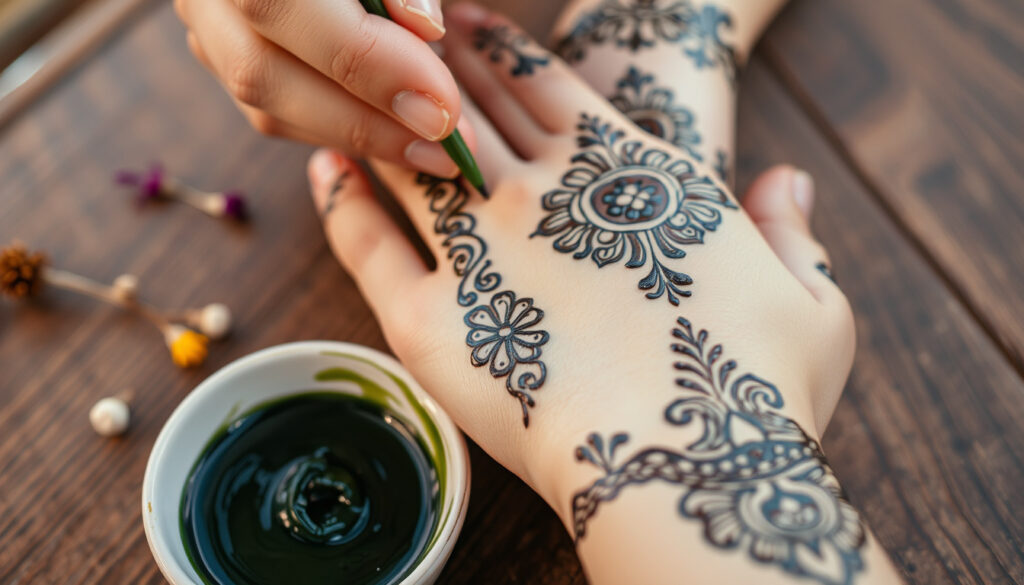
Henna patterns fall into a few classic families that reappear across regions. The most widespread are floral and vine motifs, which can be as simple as a single flower on the palm or as elaborate as a trail of blossoms up the forearm. Paisley and peacock motifs dominate bridal mehndi, especially in South Asian traditions (Divine Threading, henna artistry blog). Geometric and mandala designs appeal to modern tastes, combining symmetry with clean lines. Bridal henna often covers hands and feet with dense intricate patterns, while Middle Eastern henna tends to use larger floral motifs with more negative space (Remitly, cross-cultural lifestyle publication).
Floral and vine patterns
- Small flowers and curling vines are the entry point for most learners (Henna Caravan, henna education platform).
- These designs work well on fingers, wrists, and the back of the hand.
Paisley and peacock motifs
- Traditional bridal mehndi heavily features paisleys and peacocks, often filled with intricate lines and dots (Divine Threading, henna artistry blog).
- Peacocks symbolise beauty and grace in many South Asian wedding contexts.
Geometric and mandala designs
- Clean circles, triangles, and symmetrical patterns create a modern aesthetic.
- Mandala henna is beginner-friendly because it relies on repeating shapes (Instagram henna artist).
Bridal mehndi patterns
- Bridal henna traditionally covers both hands and feet with dense fills and hidden symbols (Remitly, cross-cultural lifestyle publication).
- It is a hallmark of South Asian wedding ceremonies.
The implication: choosing a style depends on your skill level and the occasion. Beginners should avoid dense bridal fills until they have mastered line control.
How long do henna designs last?
Henna stains typically last 1 to 3 weeks, but several factors influence how long the colour stays vibrant (Henna Caravan, henna education platform). The depth of colour depends on how long the paste remains on the skin. Darker, longer-lasting stains come from leaving the paste on for 6–12 hours (Remitly, cross-cultural lifestyle publication). After removal, the stain darkens over 24–48 hours as the lawsone molecule oxidises.
Factors that affect henna stain duration
- Skin type: Oily skin tends to hold stain less well than dry skin.
- Location: Areas with thicker skin (palms, soles) usually produce darker stains.
- Aftercare: Water exposure in the first 24 hours fades the stain.
How to make your henna last longer
- Avoid water for the first 24 hours after paste removal.
- Apply natural oils (coconut, olive) to moisturise and protect the stain (Henna Caravan, henna education platform).
- Do not scrub or exfoliate the stained area.
A beginner who washes off the paste after two hours will be disappointed by a pale orange stain. The trade-off between convenience and depth is the central lesson in henna aftercare.
The pattern: patience and proper aftercare are the keys to a deep, long-lasting stain.
Is it culturally inappropriate to get henna?
Henna has deep historical and ceremonial significance in South Asian, Middle Eastern, and North African cultures (The Zay Initiative, cultural heritage organization). Cultural appropriation occurs when henna is used without understanding its meaning, often in trivialised contexts such as party decorations or off-hand decoration. Appreciation involves learning about henna’s traditions, using authentic henna, and respecting its ceremonial use (Her Campus / Her Culture, student-run publication).
Understanding henna’s cultural roots
- Henna is an integral part of wedding and fertility rituals in South Asia, the Middle East, and the Near East and North Africa.
- The practice is not merely decorative; it carries blessings and symbolic meaning (The Zay Initiative).
-
Henna an integral part of wedding and fertility rituals in South Asia, the Middle East, and North Africa.
-
The practice is not merely decorative; it carries blessings and symbolic meaning (The Zay Initiative).
How to appreciate henna respectfully
- Learn about the origins and meanings of the designs you choose.
- Use natural, authentic henna rather than synthetic alternatives.
- Support henna artists from the cultures that originated the practice.
The catch: there is no single rulebook. The line between appreciation and appropriation depends on intent, context, and whether you engage with the culture behind the art.
What is trending mehndi 2026?
Social media platforms show several emerging directions for 2026. White henna and glitter accents are appearing as fashion-forward alternatives to traditional brown-orange stains (Instagram henna artist). Minimalist and negative-space designs allow the skin to become part of the pattern, creating a lighter, airier look. Bridal mehndi is leaning towards cleaner, less dense patterns that still respect tradition but feel more modern (Remitly, cross-cultural lifestyle publication).
White and glitter mehndi trends
- White henna uses body-safe white paint rather than natural dye; it mimics the appearance of traditional henna but fades faster.
- Glitter accents add sparkle for festival and party settings (Instagram Eid tutorial).
Minimalist and negative-space designs
- Single-line flowers and geometric outlines allow the skin to show through.
- These designs are particularly beginner-friendly because they require less covering and fewer fine lines (YouTube beginner tutorial).
What to watch: these trends are largely driven by social media and may not reflect traditional ceremonial use. If you are attending a wedding, check with the couple about the appropriate style.
What are common mistakes with henna?
Many beginners stumble on the same pitfalls. Using black henna or additives is the most dangerous: black henna often contains PPD (para-phenylenediamine), which can cause allergic reactions, blistering, and permanent scarring (Her Campus / Her Culture, student-run publication). Overworking the paste or washing too soon reduces stain intensity. Removing the paste before 6 hours results in a faint orange colour. Not allowing the paste to dry fully can cause smudging and uneven stain.
Using black henna or additives
- Always buy natural henna from a trusted supplier.
- Avoid cones labelled “black henna” or “instant stain” as they likely contain synthetic dyes.
Overworking the paste or washing too soon
- Apply paste in one steady motion; do not rework lines once they start drying.
- Leave paste on for at least 6 hours, ideally overnight (Henna Caravan, henna education platform).
A beginner who rushes the drying time or uses black henna to get a “quick dark stain” may end up with a poor result or skin damage. Patience and natural materials are non-negotiable.
The bottom line: always use natural henna and be patient with the drying process.
What are some simple henna designs for beginners?
Starting with tiny, repeatable motifs builds confidence and control. Easy floral and leaf patterns – such as a five-petal flower with a dot centre – can be placed on fingers or the wrist. Basic dots and line designs create borders and fill spaces without requiring complex drawing (Henna Caravan, henna education platform). Practicing on paper or with a stencil helps build comfort before attempting skin.
Easy floral and leaf patterns
- A single rose or lotus outline with simple leaves.
- Repeating small flowers along the finger edges.
Basic dots and line designs
- Dot mandalas: concentric circles of dots with minimal connecting lines.
- Simple geometric patterns: triangles, diamonds, and zigzag lines.
- Geometric patterns and simplified mandalas are also beginner-friendly (YouTube step-by-step guide).
The implication: starting small builds the foundation for more complex designs.
Step-by-Step Guide to Henna Application
Before you start, gather your materials. Clean, dry skin is the canvas. Here is the workflow that most professionals recommend.
Materials needed for henna application
- Henna cone or paste – fresh, natural henna from a trusted source (Henna Caravan, henna education platform).
- Design stencil or reference – printed or drawn pattern.
- Lemon-sugar mix – to seal the dried paste and boost stain.
- Tissues and a small fan – for drying.
Step-by-step process for beginners
- Wash your hands with soap and dry thoroughly. Do not apply lotion.
- Practice the design on paper first to get the flow.
- Squeeze the cone gently; apply paste in steady lines, starting with the outer outline.
- Let the paste dry for 20–30 minutes, then apply a thin layer of lemon-sugar mix.
- Leave the paste on for 6–12 hours. Wrap with tissue or medical tape if needed.
- Once dry, scrape off the paste gently with a blunt object. Do not wash with water.
- Avoid water for the next 24 hours. The stain will darken over the following two days.
(Steps adapted from Henna Caravan, henna education platform and YouTube Mehsooq Henna tutorial.)
The pattern: following each step carefully ensures a successful henna experience.
Timeline of Henna Through History
Henna’s journey from ancient plant dye to global body art spans thousands of years.
- c. 3000 BCE: Earliest archaeological evidence of henna use in Egypt and the Indus Valley (Henna Sooq, henna history resource).
- Middle Ages: Henna becomes integral to wedding and festival ceremonies across India, Pakistan, and the Arab world.
- Late 20th century: Henna gains popularity in Western body art and temporary tattoo culture (The Zay Initiative, cultural heritage organization).
- 2026: Emerging trends include white henna, glitter designs, and minimalist negative-space patterns (Instagram trend content).
The pattern: each era adapts henna to its aesthetics, but the botanical base remains unchanged.
Confirmed facts vs. What remains unclear
Confirmed facts
- Henna paste is made from Lawsonia inermis leaves (The Zay Initiative, cultural heritage organization).
- Henna stains last 1–3 weeks (Henna Caravan, henna education platform).
- Black henna often contains PPD which can cause allergic reactions (Her Campus / Her Culture, student-run publication).
What’s unclear
- Exact timeline for 2026 trend diffusion is uncertain (Instagram trend content).
- Precise cultural boundaries between appreciation and appropriation remain debated (Her Campus / Her Culture, student-run publication).
The implication: the scientific facts are solid, but cultural dynamics continue to evolve.
Expert perspectives on henna
“Henna has been a symbol of joy, fertility, and celebration in South Asian weddings for centuries. It is not just decoration; it carries the community’s blessings for the couple.”
– Cultural historian, The Zay Initiative
“I always tell beginners to start with a simple flower-and-dot pattern on the wrist. Master line consistency before moving to fills. It takes practice, but the results are rewarding.”
– Henna artist, Instagram henna tutorial
“Using pure, natural henna is crucial. Many store-bought cones contain synthetic dyes that can cause skin reactions. Always check the ingredient list.”
– Dermatologist (expert opinion on natural henna safety, cited by Henna Caravan)
Henna is both an ancient cultural practice and a modern creative outlet. For the beginner in a Western context, the choice is clear: learn the traditions, use authentic materials, and respect the origins. Otherwise, you risk a pale stain or a cultural misstep. For the traditional practitioner, the 2026 trends offer fresh ways to keep the art alive without losing its soul.
For those just starting out, easy mehndi patterns for beginners can help build confidence before attempting more intricate designs.
Frequently asked questions
Can I shower with fresh henna?
No. Avoid water for at least 24 hours after removing the paste. Water washes away lawsone and fades the stain.
What is the difference between henna and mehndi?
The terms are often used interchangeably, but “mehndi” specifically refers to the South Asian tradition of henna body art, especially for weddings.
How do I remove henna stains quickly?
Exfoliating with baking soda paste or using a mild bleach can speed up fading, but waiting for natural fading is safest for your skin.
Is henna safe for kids?
Natural henna is generally safe for children over 2 years old, but always do a patch test first. Avoid black henna entirely.
Does henna expire?
Yes. Fresh henna paste stays potent for about 2–3 days at room temperature, or up to 6 months when frozen. Dried henna powder can last years if stored properly.
Can I use store-bought henna cones?
Only if the product lists Lawsonia inermis as the only active ingredient. Avoid cones with added chemicals or unlisted dyes.
Why are salons often against henna?
Many professional salons avoid henna because of the risk of allergic reactions from black henna additives and the difficulty of removing stains if the client is dissatisfied.
More related posts
 Pete Wicks: Relationship with Olivia Attwood, Net Worth, Height
 How to Deactivate Instagram – 2025 Step-by-Step Guide
 Slow Horses Season 1 – Episodes, Streaming and Full Guide
 Rachel Riley: Countdown career, libel case, husband, children
 James Bond Actors: Every 007 in Order, Ranked & More
 Ruth Ellis: The Last Woman Hanged in Britain
 Lil Uzi Vert: Height, Gender Identity, Net Worth, and More
 Best Lego Sets for Adults, Cars & Harry Potter in Ireland
