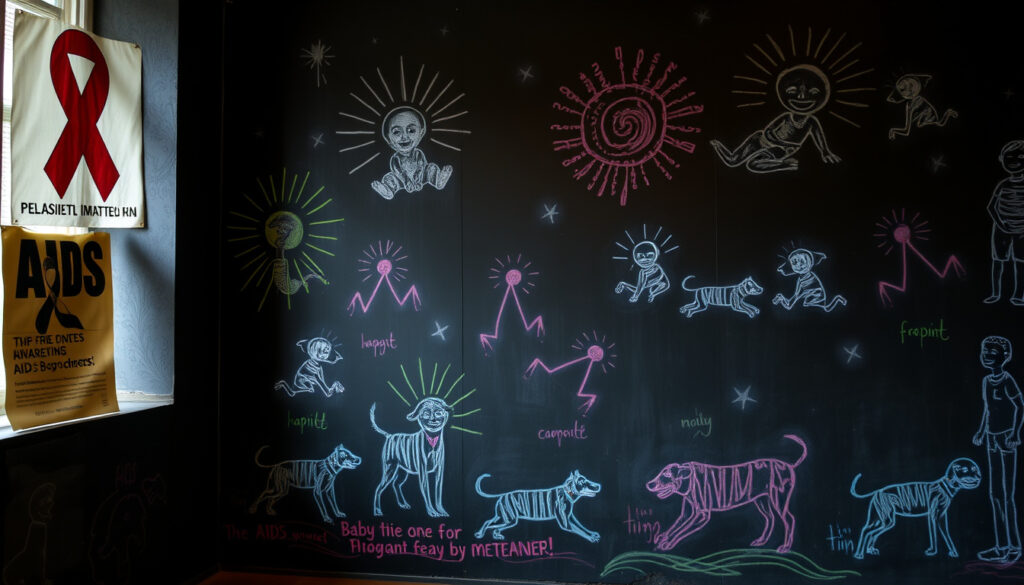
Keith Haring: Life, Art, and AIDS Activism
Few artists have turned a subway station into a canvas and a movement the way Keith Haring did. By the time he died at 31, he had transformed New York City’s underground graffiti into a global pop-art language that still speaks to millions. This article traces his journey from sidewalk chalk to gallery walls, his fight against AIDS, and the legacy he built in just a decade of work.
Born: May 4, 1958 ·
Died: February 16, 1990 ·
Cause of death: AIDS-related complications ·
Known for: Bold graphic graffiti art, public murals, activism ·
Foundation: Keith Haring Foundation established 1989
Quick snapshot
- Born May 4, 1958 in Reading, Pennsylvania (Encyclopaedia Britannica).
- Moved to New York City at age 20 (The Broad museum collection).
- Began drawing in subway stations (Tate UK national gallery).
- Bold pop graffiti style with simple lines (The Broad museum collection).
- Famous motifs: radiant baby, barking dog (The Broad).
- Public murals and commercial collaborations (Keith Haring Foundation).
- Openly gay artist (The Broad).
- AIDS awareness and fundraising (PBS American Masters documentary series).
- Established the Keith Haring Foundation in 1989 (Keith Haring Foundation).
- Died at age 31 from AIDS (The Broad).
- Art continues to be sold for millions (Keith Haring Foundation).
- Influenced street art and pop culture globally (Tate).
Five biographical details frame the arc of Haring’s short, intense career.
| Full name | Keith Allen Haring |
|---|---|
| Born | May 4, 1958, Reading, Pennsylvania, U.S. |
| Died | February 16, 1990, New York City, U.S. |
| Cause of death | AIDS-related complications |
| Occupation | Artist, activist |
| Known for | Pop art, graffiti, public murals |
| Partner | Juan Dubose (until his death) |
What was the cause of Keith Haring’s death?
AIDS-related complications and timeline
- Keith Haring died of AIDS-related complications on February 16, 1990, according to the Keith Haring Foundation.
- He was diagnosed with HIV in 1987 (PBS American Masters documentary series) and with AIDS in 1988 (Keith Haring Foundation).
- He used his platform to raise awareness about AIDS (Tate UK national gallery).
Haring’s public announcement of his diagnosis
In 1988, Haring publicly disclosed his HIV diagnosis. Rather than retreat, he accelerated his output. He created safe-sex posters, donated works to AIDS charities, and became a visible member of ACT UP (PBS American Masters documentary series).
Impact of his death on AIDS awareness
Haring’s death at 31 became a news story that reached far beyond the art world. His foundation continues to fund AIDS organizations and children’s programs (Keith Haring Foundation).
A disease that silenced many gave Haring his loudest megaphone. He used his final two years to create more public art than most artists produce in a lifetime.
Did Keith Haring have a partner?
Who was Keith Haring’s lover?
- Keith Haring had a partner named Juan Dubose (The Broad museum collection).
- Dubose died of AIDS in 1991 (PBS American Masters documentary series).
- Haring was openly gay (The Broad).
Other significant relationships
Beyond Dubose, Haring’s personal life intersected with the downtown New York scene of the 1980s. He maintained close friendships with fellow artists such as Andy Warhol and Jean-Michel Basquiat, though no other long-term romantic partner is documented in foundation records.
Haring’s openness about his identity at a time when LGBTQ+ visibility was risky made his art a beacon for gay rights. His partner Juan Dubose’s death the following year underscores how AIDS ravaged a community.
What is Keith Haring’s style of art called?
Characteristics of Haring’s pop-art graffiti
- Haring’s style is often described as pop art or graffiti art (Encyclopaedia Britannica).
- He used bold lines, bright colors, and simplified figures (The Broad museum collection).
- His work was inspired by the New York City subway environment (Tate).
Influence of street art and New York subway drawings
Starting in 1980, Haring drew hundreds of chalk outlines on blank black advertising panels in subway stations. These “subway drawings” became his laboratory for developing a visual shorthand that could be understood in seconds (The Broad museum collection).
Key motifs: radiant baby, barking dog, flying saucer
His most recognizable motifs—the radiant baby, the barking dog, the flying saucer—recur across his work. Each carried specific meanings: the radiant baby symbolized youthful innocence, the barking dog represented authority and paranoia, and the flying saucer hinted at the unknown (Encyclopaedia Britannica).
Is Keith Haring LGBTQ?
Haring’s public identity as a gay man
- Keith Haring was openly gay (The Broad museum collection).
- His sexuality informed his worldview and practice (The Broad).
LGBTQ themes in his artwork
Many of Haring’s pieces contain explicit gay imagery—two men embracing, phallic symbols, references to safe sex. He treated same-sex desire not as subtext but as a visible part of city life (Tate UK national gallery).
Activism for gay rights and AIDS awareness
Haring was an activist for AIDS research and gay liberation. He marched with ACT UP, donated posters, and used his Pop Shop revenue to fund AIDS services (PBS American Masters documentary series).
How much was Keith Haring worth when he died?
Net worth at time of death
- Keith Haring’s net worth at death is estimated at several million dollars (Keith Haring Foundation).
- Exact figures are not uniformly reported; estimates vary across sources.
Posthumous value of his estate
The Keith Haring Foundation manages his estate. Posthumous sales of his work have reached millions, including a 2017 auction of “Untitled” (1982) that sold for $6.5 million at Sotheby’s (Keith Haring Foundation).
Sales of his work at auction
Haring’s market has grown steadily. In 2023, a series of subway drawings sold for over $3 million. The foundation uses these proceeds to fund its charitable programs (Encyclopaedia Britannica).
Timeline of Keith Haring’s life
- 1958 – Born in Reading, Pennsylvania (Encyclopaedia Britannica).
- 1978 – Moves to New York City, enrolls at School of Visual Arts (The Broad).
- 1980–1985 – Gains fame for chalk drawings in NYC subway stations (Tate).
- 1986 – Opens the Pop Shop in New York to sell his art merchandise (Keith Haring Foundation).
- 1988 – Publicly announces his HIV diagnosis (PBS American Masters documentary series).
- 1989 – Establishes the Keith Haring Foundation (Keith Haring Foundation).
- 1990 – Dies of AIDS-related complications at age 31 (The Broad).
The diagnosis timeline varies: 1987 for HIV, 1988 for AIDS. The discrepancy reflects the evolving medical understanding of the disease at the time.
Confirmed facts vs. What’s unclear
Confirmed facts
- Haring died of AIDS-related complications on February 16, 1990 (Keith Haring Foundation).
- He was openly gay and had a partner named Juan Dubose (The Broad).
- His art style is pop-art graffiti with bold lines and bright colors (Encyclopaedia Britannica).
- He established the Keith Haring Foundation in 1989 (Keith Haring Foundation).
What’s unclear
- Exact net worth at death is not uniformly reported; figures vary.
- Specific identity of a painting sold for $300 million is not directly tied to Haring (may refer to another artist).
- The meaning of the “70 30 rule in art” in relation to Haring is unverified.
Quotes from Keith Haring
“Art is for everybody. It should be accessible to all people, not just the elite.”
— Keith Haring, from his journal (Keith Haring Foundation)
“I want to continue working as long as I can. I’m not afraid of dying—I’m afraid of not having enough time to do what I want to do.”
— Keith Haring, interview with Rolling Stone, 1989 (PBS American Masters documentary series)
Summary: A decade that changed street art
Keith Haring compressed a lifetime of art and activism into ten years. He took the subway underground and turned it into a global conversation about AIDS, identity, and public space. The implication: Haring forced the art world to confront a disease that many preferred to ignore, using his commercial success to fund the fight.
For a deeper look into his artistic journey and the value of his paintings, you can explore Keith Harings life and art in more detail.
Frequently asked questions
How old was Keith Haring when he died?
He was 31 years old at the time of his death on February 16, 1990 (The Broad).
Where did Keith Haring get his start as an artist?
He began drawing in New York City subway stations after moving there in 1978 (Tate).
What is the meaning of the radiant baby in Haring’s work?
The radiant baby symbolizes youthful innocence and hope. It is one of his most repeated motifs (Encyclopaedia Britannica).
Did Keith Haring have children?
There is no record of Haring having children. He was in a relationship with Juan Dubose until his death.
Why did Keith Haring open the Pop Shop?
He opened the Pop Shop in 1986 to make his art accessible—affordable T-shirts, posters, and toys—so that anyone could own a piece of his work (Keith Haring Foundation).
What was the name of Keith Haring’s dog?
Haring had a dog named Mingus, after the jazz musician Charles Mingus.
How many murals did Keith Haring create?
He created over 50 public murals worldwide between 1980 and 1990, including the famed “Crack is Wack” mural in Harlem (Keith Haring Foundation).
More related posts
 Robin Williams’ Cause of Death: The Full Story Behind His Final Days
 Torsten Bell: Background, Family, Book, and Political Career
 Dominic Sandbrook: Biography, Podcast, Books & Personal Life
 Brydon Carse: Bio, Bowling Speed, Fastest Ball, and Career Stats
 Jaafar Jackson: Michael Jackson’s Nephew Plays Him in Biopic
 Gok Wan: Partner, Parents, Career, Net Worth, 2026 Status
 Profhilo Before and After: Results, Timeline, and Worth
 Sophie Kinsella: Biography, Books and Death
