Aragón Data Center Construction: The €33.4B Groundwork
There’s a certain irony in watching a region known for its fierce defense of local identity quietly become the epicenter of a global digital gold rush. If you’ve been following the news, you know the headlines are dominated by staggering numbers and futuristic promises, but the real story unfolding in Aragón is far more grounded—it’s about concrete, land, and the hard graft of construction. This piece cuts through the hype to give you a clear-eyed view of what’s actually on the ground, what the announced €33.4 billion really means for workers and businesses, and why the construction phase, not the finished data centers, is the true engine of this economic shift. We’ll look at who is set to benefit, where the opportunities are concentrated, and what the next eight years of building might actually look like for the region.
Snapshot: Key Facts at a Glance
- Total Figure: The data-center projects represent a massive €33.4 billion investment for Aragón.
- Construction Phase: The largest economic impact is expected from construction, not just operation. The Chamber of Zaragoza highlights this as the primary generator of immediate wealth.
- Jobs Created: AWS’s decade-long project is projected to create around 15,000 jobs in the region.
- Key Locations: Expansion spans multiple hubs: Huesca, San Mateo de Gállego, and the area between La Puebla de Híjar and Azaila.
Projected Investment: €33.4B · Direct/Indirect Jobs: ~15,000 · Project Timeline: Decade-long · Key Driver: Construction & Civil Works
The Construction Ledger: Why Building Trumps Operating
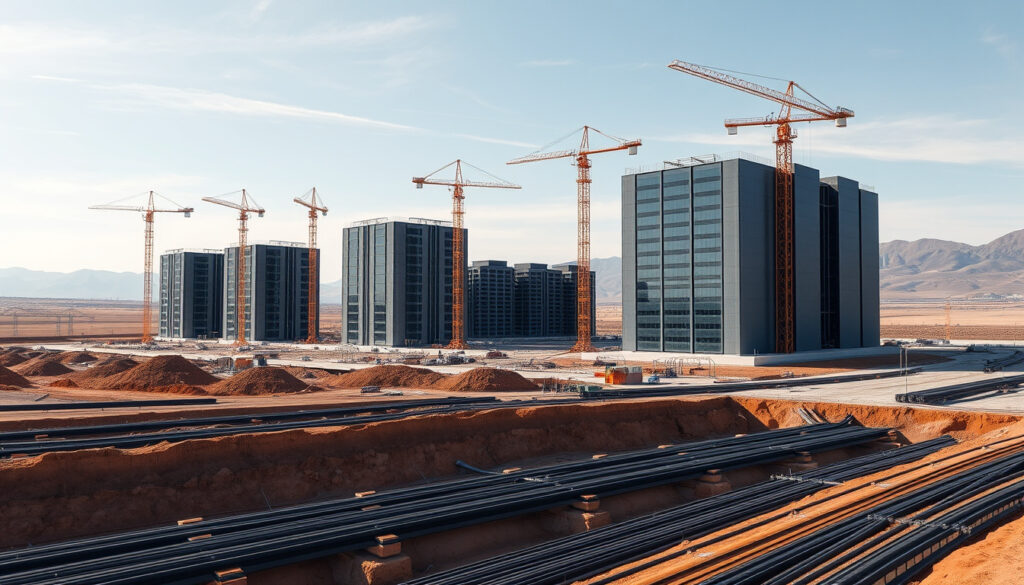
The initial economic energy in Aragón is not coming from the hum of servers but from the roar of machinery. According to analysis from the El Periódico de Aragón, the Chamber of Zaragoza has pointed out that construction constitutes the main driver of this investment wave. This distinction matters because it shifts the focus from the tech-sector endgame to the immediate, tangible impact on the local construction and engineering sectors. It’s a labor-intensive phase that employs a different kind of workforce—crane operators, electricians, plumbers, and civil engineers—who are seeing the benefits long before a single processor is installed.
This phase is also a logistical challenge and opportunity. The sheer scale of moving earth and laying foundations for campuses that span thousands of square meters requires coordination across multiple municipalities. For local suppliers of aggregates, concrete, and steel, this is more than a contract; it’s a multi-year revenue stream. The Chamber’s perspective suggests this is a “now” moment for local businesses to position themselves as suppliers, not just to the tech giants, but to the general contractors who will be tasked with delivering these massive sites on time.
The construction phase is reportedly worth around €13 billion, capturing a significant 40% of the total announced investment pie.
The upshot is that while the media often focuses on the “cloud,” the real economic engine here is “clay.” The services sector and the auxiliary industry that support a construction site—from accommodation for workers to equipment rental—are the unsung heroes of this initial boom. For a local entrepreneur, the question is no longer if they’ll be busy, but how can they upskill and scale to meet the rigorous demand of a global tech build-out.
The €33.4B Breakdown and Geographic Spread
When we talk about Amazon Web Services (AWS) in Aragón, we are talking about a planned long-term industrial strategy, not a single building. The total volume of investment puts Aragón on par with major European tech hubs.
El Periódico de Aragón reports that this includes new campuses in three distinct areas. The first is in the capital, Huesca; the second in San Mateo de Gállego; and a third, larger site that could be the flagship, located between La Puebla de Híjar and Azaila. This geographic diversification is key; it spreads the economic impact beyond Zaragoza city, creating what the Heraldo de Aragón describes as a potential for local companies to capture a significant 40% of the total investment in the coming years.
The official timeline, as reported by Europa Press, is a consolidation plan that has been declared of general interest by the Government of Aragón, which streamlines administrative processes. This political backing is crucial, as it signals the region’s commitment to being not just a location, but a partner in this venture. The commitment to build out over a decade smooths the investment curve, but it also means that the “construction boom” is a sustained, long-term feature of the regional economy, not a spike that will cool off next year.
| Location | Scale / Role | Reported Phase |
|---|---|---|
| Huesca | New campus / Node | Consolidation & New Build |
| San Mateo de Gállego | New campus / Node | Consolidation & New Build |
| La Puebla de Híjar / Azaila | Large-scale campus / Flagship | Active Development |
The economic calculation also involves a significant intangible: energy. The amount of power these data centers require is massive. While this article focuses on the upfront monetary investment and jobs, it’s the extensive grid connections and renewable energy contracts that are the unsung groundwork, requiring as much engineering muscle as the buildings themselves. This creates a dependency that benefits the energy sector, another Spanish stronghold, as much as it does the construction sector.
What to watch here is the evolution of local wages. A massive influx of construction work usually inflates labor costs in the short term. The question for Aragón is whether this raises the local standard of living or creates a bottleneck for other public works, such as the planned regional infrastructure projects. The balance will depend heavily on the influx of foreign versus local labor.
Confirmed Facts: The Plan on Paper
The official position from the regional government and AWS consolidates a few concrete numbers. The initial declarations from the Europa Press note that the Government of Aragón has declared the “Plan de Consolidación” as a Proyecto de Interés General. This minimizes administrative friction.
- Jobs: The creation of around 15,000 jobs (direct and indirect) by the end of the decade.
- Legal Status: The project has the official “general interest” declaration, facilitating permits.
- Investment Stability: AWS frames this as a commitment to the region, not a speculative venture, with a “long-term” pledge that extends past 2033.
The €33.4 billion figure is official and cited by El Periódico de Aragón as part of the Chamber of Zaragoza’s analysis. The scale of the project is clearly defined.
The source for these figures, About Amazon España, frames the employment and investment data as a long-term ecosystem play, indicating that the tech sector, which includes services beyond just the data centers themselves, will eventually rival the construction industry in value. This is the “catch” — the construction boom is temporary, while the operational tech jobs are the long-term prize.
Beyond the primary figures, an often-overlooked detail is the reference to the “multi-sector” and “rest” areas included in the fair’s layout, which in this case translates to the support services needed on these vast campuses. These ancillary services—from security to catering to logistics—are expected to generate a steady stream of lower-wage but stable jobs. This layered employment is what makes the impact of the announced projects expansive, touching nearly every sector of the local economy.
Pros and Cons of the Data Center Boom
While the influx of capital is a clear win, it’s essential to look at both sides of the ledger. The El Periódico de Aragón piece is bullish on the immediate effects of construction, but it’s worth recalling the long-term operational view.
| Dimension | Pros (The Boost) | Cons (The Friction) |
|---|---|---|
| Employment | Massive construction boom; 15k jobs in the short term; entry point for unskilled labor into high-tech orbit. | Jobs can be temporary; requires housing and services for inflow of workers, straining infrastructure. |
| Local Business | Aragonese firms have a shot at capturing 40% of the project value (€13bn). | Bidding wars for contracts could favor giant conglomerates if not regulated. |
| Infrastructure | Forced upgrade of the regional power grid and road access benefits all citizens. | Grid connection costs might be socialized, raising energy prices for locals if not managed properly. |
The trade-off here is generational, not just financial. The region is betting that the physical infrastructure built for AWS (roads, water, power) will become the backbone for a future wave of industrial and tech growth, diversifying the economy away from its agricultural roots.
The 2033 Outlook: From Building to Operating
Looking forward, the challenge will be transitioning successfully from a construction-led economy to a knowledge-and-services economy. The current phase is noisy, dusty, and extremely lucrative. The second phase is quiet, climate-controlled, and skill-intensive.
The official announcements paint a picture of a decade of transformation. If we strip away the tech jargon, the announcers are essentially proposing to rebuild a regional industrial park into a high-tech business campus. The question of “landlord vs. partner” is crucial: can Aragón build a domestic tech sector on the back of these installations?
The critical vulnerability lies in the IT infrastructure itself—the cooling systems. As the climate changes, the water and energy needed to keep these servers cool could become a political and environmental flashpoint. The editorials suggest that this is where the EU subsidies might wane if the sustainability targets are not shown to be met with real, measurable carbon savings, turning a massive investment into a stranded asset. The building phase we are celebrating today will be judged in the future by how sustainably it operates.
elespanol.com, aragondigital.es, heraldo.es, boa.aragon.es, elespanol.com, idealista.com, eldiario.es, heraldo.es
Frequently Asked Questions
When will the construction be completed?
Based on current projections, the investment is planned over a 10-to-15-year horizon, with the full consolidated plan extending beyond 2033. Some sites are prioritized ahead of others.
Will the creation of 15,000 jobs be enough for the local economy?
It is a significant injection, but it represents a mix of temporary construction roles and permanent operational staff. The indirect impact on local services is where the effect will be most strongly felt.
What are the environmental impacts of these data centers?
The primary concerns are electricity consumption and water usage for cooling. The answer remains a work in progress; AWS has stated a commitment to sustainability, but the actual consumption will be monitored once operational.
How can local firms get involved in the construction process?
Given that the construction value chain is estimated at €13 billion, local SMEs should position themselves as suppliers in the auxiliary construction sector—earthworks, concrete, and logistics—and register interest with major contractors.
Which locations are getting the new data centers?
There are three main focal points: Huesca, San Mateo de Gállego, and the area between La Puebla de Híjar and Azaila.
More related posts
 Josef Fritzl Case: From Discovery to 2024 Prison Transfer — Full Timeline
 IKEA Desk with Drawers: Best Picks for Ireland
 Lainey Wilson: Yellowstone Role, Health, Marriage & Kids Rumors
 Vlad Dracula: History, Facts, and the Man Behind the Myth
 Daddy Long Legs: Spider, Crane Fly, Harvestman? Myths & Facts
 Sebastian Stan: Net Worth, Family, Languages, and Career Facts
 WALL-E: Complete Guide to Pixar’s Iconic Robot
 Andrew Neil’s GB News Exit: Career, Net Worth, Wife
